I just read Into Thin Air. What should
I read next?
So-and-so just
died. How can you justify participating in such a dangerous sport?
/ How can you climb if you have children?
What does "sport" mean? What does "trad"
mean?
What does [climbing term] mean?
How do I get started climbing?
Can I learn to climb if I'm afraid of heights?
What do the numbers mean? / How are climbs rated?
How can I climb better? (for beginners)
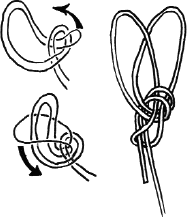
How do I tie a [whatever] knot?
How do I coil my rope? Should I use a mountaineer's coil or a butterfly coil?
Should I let a faster party pass?
See also: What you didn't ask but we wish you would.
I just read
Into Thin Air. What should I read next? [back
to top] [FAQ contents]
Everest '96 related books
(not necessarily recommended):
The
Climb by Anatoli Boukreev
Recommended books:
Annapurna
by Maurice Herzog
So-and-so just
died. How can you justify participating in such a dangerous sport?
/ How can you climb if you have children? [back
to top] [FAQ contents]
From: Pat Vernon
I am part of a family, i
can justify what they do. If my dad died of ink poisiong, sure he
died doing something for himself, but as a family member I accepted it
and knew he died doing something he loved. If I did not accpet the
fact he was a writer and had a problem with it, and he knew it, then his
death would appear unjustified in my eyes. You should have at least
some understanding among your family members wwhen you do something to
enrich your life. My family also realizes i climb for reasons they
cannot fully understand, but they know that I understand them, and they
trust that I am climbing for the right ones. Climbing is to have
fun and challange myself, those are the right reasons in their eyes, the
wrong ones are to put myself blatanly in the face of danger as soling does,
and somehow get enjoyment out of it.
From: Grant
I find it so pathetically
predictable that every time some big name (Alison Hargraves (sp?), Hall/Fisher,
Dan Osman, Alex Lowe, etc) dies while pursuing the sport, a bunch of people
will chime in and lament how senseless the loss is. People die, everyday,
doing everything imaginable (and otherwise...). Better in my mind
to focus on what the person brought to the sport and what new frontiers
were opened. People like Alex Lowe and Dan Osman couldn't give up or tone
down their pursuits any easier than any of us mortals could do without
a lung. It's what makes up the core of their existence and passion for
life. I'd rather be one left behind by someone who made a real impact with
their life rather than one who had potential but never used it, living
a life of dull mediocrity. "What's your dad/mom do?" "Uh, I don't
know- something that makes them come home in a bad mood all the time..."
Gee, that's certainly better than dying pushing the limits.
I feel a debt of gratitude
to those who continue to define the cutting edge of the sport, taking the
risks to live the moments some can only dream.
From: Chris Ferro
I'd take Alex Lowe's 40
years over just about anybody else's 70 or 80 years anytime (except maybe
Sinatra's). You're born, you live, and then you die. Unfortunately,
too many people miss that middle part.
From: Med Dyer
Many people who have kids
scale back on their pre-parental activities. Mostly this is due to having
less available "free time", but for some of us it also has to do with risk-taking
and our responsibility to be there for our kids. I'm sure many climber/parents
would love to climb more than they do, but the fact that they don't does
not mean they are "doing without a lung". It just means that they realize
there might be something that outweighs the necessity of "pushing the limits".
Everyone has to decide for themselves
what risks are worth taking and how those that are left behind will be
impacted. Alex Lowe made it clear before his death that he had done just
that. While it is fine to respect him for his choices and accomplishments,
I think reducing his death to "we're all gonna die" trivializes the total
cost of his death.
PS --And for the guy who
said, " You're born, you live, you die...too many people miss the middle
part", well, for many parents, kids -are- the middle part.
From: Kris
That's fine for some parents,
but others are autonomous beings and don't believe that once they have
children, their own lives are over. Where do you draw the line? Not only
that, but, as has been repeatedly stated, parents are killed all the time
and the kids still manage to turn out okay.
I've just seen too damn
many cases where parents gave up all of their personal activities for the
sake of their children, and then smothered and spoiled their kids into
little bastards while trying to live vicariously through them.
From: Tom Rogers
I would like to generally
think that if you take less risks then one is less likely to be killed
or hurt.
I don't fool myself about the risks.
I've been climbing long enough to know the risks to me and my families
health. I do try to not get myself into too many serious spots based
upon my broader experience. I would like to think that most of my
partners think I am a very careful climber. Will this keep me totally
safe? No. Well it keep me safer? Yes.
From: Andy Clifton
Someone's dead, doing what
he loved. He knew the risks, he made the choices. That's what Mountaineering
is about; balancing up one sets of choices and risks, doing it for yourself,
not letting someone else make the rules.
It's also called life...
From: MadBolter
Will forgets that Dan was
a friend to some on here, not just a curious sidenote to make you shake
your head and say "what a waste."
From: Steve Gray
I was in error for responding
the way I did, but I'm of the
opinion you were in the wrong for
immediately chastising me in
such a negative manner.
You didn't have to sit through the months
of analysis when Dan died. It was bad enough for those of us who didn't
know the bloke - how his friends kept their tempers, I'll never know.
From: Jeff
Driving is dangerous, walking is dangerous, everything in live has a an
element of danger, but I'm not going to live my life in an oxygen tent
hidden away in my house, I'm going to _LIVE_ my life. Just because I
know people that died in a plane crash doesn't mean I go to flying posts
and "warn" people that you can die from it... expecially when the accident
screams of it being the victims fault and stupidity that caused the
accident.
How can you say that climbing is "against the natural rules of god and
man"? We have hands, we have feet, we have the ability to climb rocks.
There are many _many_ first ascents of cliffs and mountains by monks and
other healers back in the 18th century and even before, searching for
food and medicine. If you want to start pulling a religion card out,
then we can play religion. If God didn't mean for people to climb, he
wouldn't have put stuff places that require climbing to obtain it. If
you want to preach the will of god, then go right ahead, but the will of
god isn't going to be 'don't climb', it's going to be 'don't climb with
any protection. Anything that can be done using only ones natural body
natural surroundings can't, by definition, be against the natural rules.
All in all, it all comes down to one thing in my book. Sure there is risk,
but with greater risk comes greater reward. I would rather die doing
something and have done something than live long and die haven't not done
anything with my life.
What does
"sport" mean? What does "trad" mean? [back
to top] [FAQ contents]
From: Dylan Sutton
To oversimplify, sport routes
are bolted whereas trad routes use 'natural' (ie. place it yourself as
you go) gear. Natural gear can be nuts, cams, slings around trees, pitons,
whatever works. Beyond that it get's fuzzy - you can have bolted
routes that aren't sport routes, and unbolted routes that are "sporty"
(but still trad). Many "trad" routes will also have some bolts or old fixed
pitons on them.
From: John Byrnes
Sport climbs are bolted
in a manner to allow the climber to focus on doing the moves rather than
the consequences of a fall.
From: Jonas Wiklund
Trad: All routes are done
ground up, no inspection, no cleaing and prepping, no problem. The first
acsensionist goes to great distances to avoid placing drilled protection,
but happyly mangles any crack whith pitons whenever he/she gets really
scared. A tradclimber (see below for definition) uses hemprope, hobnailed
boots and a swami-belt.
Tradclimber: A old person
with beard or a young failed sportclimber.
Sport: All routes are prepped
and bolted on rapple. Every move is as least V5 or harder. You are never
scared because the shiny new bolts are so close apart.
Sportclimber: A young person
without technique and hexes, or a old failed tradclimber.
What does
[climbing term] mean? [back
to top] [FAQ contents]
A good introduction:
Rock Climbing Equipment and Techniques
Glossaries:
The Climbing Guide
How do I get
started climbing? [back
to top] [FAQ contents]
Recommended books:
How to Rock Climb Series
How to Rock Climb! by John Long
Mountaineering:
The Freedom of the Hills by the Mountaineers Society
From: Undercling
You and your family are at the classic point where getting
involved in climbing might seem difficult. You know enough to realize
you want to do more of it, but not enough to do it successfully without
guides or mentors, and where do you find those or pay for the guides for
the next year! Going to the gym is a good way to not only find mentors
but to actually get the skills you want and need. And the better
gyms of course have a variety of classes that can get you started safely,
such as technique and also leading classes. Most gyms are fairly
social too, and in that milieu you probably will make lots of new friends,
some of whom will actually be these mentors you need. And of course
you have to start reading the books we have on the sport, specially
the books by
John Long. The gym or climbing store should have them.
From: Jay Cloidt
Also, one of the best ways to meet people who lead is at a gym. Most gyms I've been to around the country are very friendly, and most climbers will gladly help you out if you can't figure out a problem. This is a good way to meet and get to know more experienced climbers. This is how I met the person who became my climbing mentor. He took me up my first multi-pitch climb, taught me how to set top-rope anchors, and following him taught me a lot about gear placement. The lead class I took was more of a final exam for me. It let me know that I had absorbed enough knowledge to start leading safely.
Learning how to set top-rope anchors is an important step. Learn how to do it correctly from competent teachers. Everyone who climbs on your anchor is putting there lives in your hands. It's important to remember that.
From: Vaughn Ripley
Buy John Long's book: How to Rock Climb. And, buy a one day
class that covers the essentials of top roping for beginners. This way,
you can make sure that your friends are placing safe anchors, etc.
When starting out finger strength is not nearly as important as skill
and technique.
The only way to work on your skill set is to go out and climb a lot.
Check out my site for a beginners workout and some more info: www.virtualinks.com
From: dgallardo
Perhaps there is a mountaineering/outing club nearby that you
could join? They may have classes, workshops etc. It's also
a good place to meet more experienced climbers willing to take you underwing.
Another idea is to hire a guide at a major climbing area for a day or
more of one-on-one climbing. Maybe a bit pricey but it's probably
the most intensive way to learn.
From: Sandra Reeves
Before you commit to spending lots of money bare in mind that many
University have climbing clubs that will help non-climbers get started.
Beware though I have seen alot of dougey pratices from university clubs, the
im-portant thing is not to run before you can walk. Outdoor climbing has a
few more potential pitfall than wall climbing but the rewards are tremendous
From: blyslv
If possible it is a excellent idea to find someone to mentor
you. This is difficult though, as the person who has the patience,
inclination and desire to train a newbie can be pretty rare. Failing
that I would sign up with a reputable school. Ask them what you'd
be qualified to do after one of thier courses. If it is top-roping,
when you graduate you should have a basic understanding of the various
knots, gear and considerations required for setting up safe top-ropes.
If it is a multi-pitch class you should know how to follow a leader, clean
gear and elements of self-rescue. Classes also are a change to meet
interested people at the same level of competance. Climbing with
fellow newbies, you might not "advance" as fast, but there are other rewards.
See also:
How do I find/keep a mentor? on Tradgirl
Can I learn to climb if I'm afraid of heights? [back
to top] [FAQ contents]
From: Lori Ennis
I realized I was hooked the first time I tried out the climbing gym when
it opened in town...I went twice that first day, dragging my brother
with me in the morning and my best friend in the evening. Couldn't keep me
away. I was (and still am sometimes) afraid of heights and wasn't
willing to go past about 10 feet the first few climbs, but each time I
came down I wanted to go up again. Couldn't help it. The happy feeling I
got from climbing seemed to win out against the frightfullness of
the height, and it still does. Later that year I went climbing outside for
the first time and I knew it was something I would always want to do.
From: Joffrey
I had (have) the same problem. I started on low (10m) walls & that was
fine. I gradually tried high (60-90m) climbs in the crags. I almost
froze with fear sometimes & found that chimneys were the best place to
start. It slowly gets better.
From: Sabays
You're not the only one! I'm scared to death of heights, too, but I love climbing and I'm very new at it.
I started out in a climbing gym to get the basic knowledge, and to learn how to trust your equipment.
From there, I've played around at the local outdoor climbing walls, with a friend who's an
experienced climber. It helps to go with someone who's PATIENT, and let's you go at your own
pace. I went with someone who wasn't, and ended up going up about 10 feet and very frustrated.
My climbing friend lets me go up 20 feet, then come down, then go up 50 feet, then come down, until
I feel comfortable. Just concentrate on the wall in front of you, and you won't even think about how
high you are.
From: TradMan
I once thought that I was afraid of heights, but I realized
that
it was actually a (more sensible) fear of falling, which I still have.
Being afraid of falling is simply the desire not to get hurt or die from
a fall. We all probably feel that. But fear of heights is less rational
and I think it comes from not thinking through the whole situation.
If you are in a tall building looking out the window, or on a
high spot looking over a rail and feel frightened, you must weigh the
actual possibility of getting hurt. Very small.
If you are scrambling around on a dirty ledge unroped while
setting up an anchor, the chance of falling is much more real, and the
"fear of falling" may occur and falling is actually very possible.
Once I gave some thought to the subject, it became easy to say
to myself, "OK, I'm tied in, the rope ain't gonna break, my harness is
good, my pro is good, and my belayer is paying attention, so I'm not
gonna deck." Becoming familiar with the incredible strength built
into the gear and the rarity of gear failure helps calm those fears too.
Instead of allowing your mind to freely feel undefined fear,
you've gotta accurately define it and then correctly assess the
situation
and decide if those feelings are really justified or not. When you do,
you'll probably be more afraid driving home on the freeway than on the
rock.
From: Steven Branam
I have
always been afraid of heights, but as most climbers seem to
find, it is really a fear of falling. Learning to trust the
security of the rope has allowed me to get up high without
freaking out. But still, the knowledge of hundreds of feet
of air below you stays in the back of your mind, and gravity
is unforgiving.
From: Sherry
As a recovering acrophobic, I can testify that the more I climb, the less
fearful I am of heights in general, not just on cliffs. Not that I don't
still have my moments of panic, but they don't come as often. I got
interested in climbing because it draws on the same skills I used when I
used to study Aikido - balance, mind-body coordination, flexibility,
focus, and centering. And because I thought it might help me get over my
fear of heights.
For me the secret was to start slowly, respect my fears, and learn when to
push myself and when to give in. It helps to have more experienced
climbing partners who are calm, are compulsive about climbing safely, have
seemingly infinite patience, never berate me when I decide to give in,
encourage me when I decide to push myself, and let me make the decision.
To give you an idea of what _not_ to do - my worst climbing experience so
far was during a climbing course, when I rapelled to what seemed to me to
be a pretty narrow ledge about 200 feet above the ocean. I was so
frightened I forgot what to do, and couldn't get myself tied in to the
anchor. What I needed was for the instructor to speak calmly to me, tell
me what to do (but make me do it) and reassure me that I was safe. Instead
he got up in my face, yelled at me (which increased my fear to panic),
jerked the rope out of my hand and tied me in, and started to lead the
climb while muttering obscenities at me under his breath. BTW, once we
were safely back at the van, I got up in his face and told him, calmly but
firmly, what he had done wrong and what he should have done. To his
credit, he heard me and was much easier on me and the other folks on the
course after that.
From: Malcolm Daly
In the past 25 years I've taught 400-500 people how to climb, both casually
with friends and professionally through outdoor programs and guide services.
I've even taken my mother-in-law climbing.
During these first lessons I always ask my students why they want to climb,
and 40% - 50% of the students responded that they were scared of heights.
Despite this response, not once, in all my lessons, did I have a student
"freak out" or be unable to handle their fear. There's just too much going on
to have time to be scared.
So go for it. Get a couple of friends together and take a day with a
professional guide. You'll love it.
Milan Kundera, in The Incredible Lightness Of Being said that "Vertigo is not
the fear of falling‹it is the fear that you will be unable to overcome the
urge to hurl yourself into the void."
From: George Bell
When I started climbing I had a moderate fear of heights. Basically,
you have to learn to trust the equipment and yourself. The way to
do this is practice, practice, practice, indoors and out. You can
boulder to develop climbing ability without feeling acrophobia, and
then this confidence will help fight the fear up high. Eventually
when leading you will become so focused you won't feel the height, although
this may take years. By now it's only when belaying or rapping in exposed
places that I have enough time to think about it and get scared.
From: Francis Devonshire
One of the reasons I started climbing was to explore just how real my fear of heights
actually was. I still can't answer that one but despite having climbed for a while now
I still think I'm afraid of heights. (nb, the term "afraid of heights" fails to convey
the degree of absolute terror involved). Anyway I just went off with some mates and,
after protracted whimpering and squealing, top roped my first ever pitch. Today, on
the whole I'm too involved with the climb to worry about heights; if I'm trying to
make a move I'm only concerned with things within the span of my arms which I may or
may not be able to cling on to; the distance to the deck becomes an irrelavance.
However, I have yet to complete a climb during which I don't, at some point, curse
loudly that the whole thing is a bloody stupid enterprise and I'm giving my gear away
the moment I reach the top.
From: Larry Owens
Actually if you would just get on the rock and start doing it, you would
overcome your fear. Remeber, you are tied in (hopefully) and assuming you
have a good belayer that knows how to set things up, you will be fine
What do the numbers mean? / How are climbs rated? [back
to top] [FAQ contents]
Grade:
From: Dave Andersen
Note that the times here are for the "average" climber, whatever that
is. People have done up to grade VI's in a day, and people have taken
multiple days on grade III's. :-)
I - easy excursion. From a single pitch up to a few hours. Not
particularly committing.
II - Bit more serious, but less than a half day climb. You could get
a few II's in in a day if you worked at it.
III - Half day climb. (or thereabouts)
IV - A full day
V - A day or two. Moonlight Buttress in Zion.
VI - A few days. The Nose is a grade VI climb.
VII - Bring a gallon of tequilla, you'll need it.
Class
From: Ed Huckle
The roman numeral is grade whereas the number is the class. Grade I-VII denotes the amount
of time and commitment the route will take (this is described well in
the other response, from Dave Anderson) whereas the class denotes which
type of climbing.
Class 1: Walking on a trail
Class 2: Scrambling with use of hands
Class 3: Steeper climbing with handholds, some exposure, usually no
need for a rope.
Class 4: Steep, exposed, but easy climbing with rope for safety.
Class 5: Technical rock climbing - specific climbing moves necessary,
with a rope and intermediate protection necessary on each pitch.
Originally this was split up from 5.0 - 5.9 but, as time went on
people did harder climbs, hence the present state of the art, 5.14.
Class 6: This is how aid climbing was originally denoted. This has
since been shed for the current aid rating systems, which are denoted
by A0 - A5, based on difficulty of the aid placements, and the danger
of a prospective fall.
Rating Systems:
Technical Rock Climbing Rating Systems (UK, Czech, French, US, Australian, UIAA, German) from Climb UK
And some for fun . . . Bushwhack (BW), Bush Aid (BA) and Water Crossing (WA) Rating Systems
How the routes are rated
From: John Baker
I was wondering how subjective the rating system is here in the USA.
completely, just like everywhere else.
From: D B FRAZ
Routes are typically graded by the difficulty of the hardest move. Keeping in
mind that if a route is sustained then those moves will be more difficult, thus
the grade will increase. For instance, a 5.11 with one 5.13 move on it would
be 5.13. But a 5.9 with a 30 foot section of 5.12+ might also be 5.13. Of
course if you do the first 5.13 people will say it's a one move wonder and run
you down the road. So basically difficulty, endurance and sustained qaulity
are all factors but in place of the latter two being nonexistent then
difficulty is the least common denom. Gym ratings are always suspect, btw, and
if your gym has a bunch of one move wonders then they are definitely suspect.
From: eric
In general the rating system is very rough anyway. Not only is there the
issue a given route being easiler for short people or tall people, there
is also the issue if you have plenty of strength but zero ballance you
could have no problem on a 5.11 overhang and not be able to get off the
ground on a 5.9 slab, and vise versa.
Also rating are generally determined by some group of senior climbers at
you crag, so the scale at one crag doesn't always match the scale at
another.
So either just climb it and don't worry about the rating (at the very
worst you'll burn yourself out and bail) or go with someone who know your
crag better than you and knows you ability at have that person tell you
which routes you will be able to complete.
See also:
The 9th grade, the legitimacy by Björn Pohl
How can
I climb better? [back
to top] [FAQ contents]
From: Steven Cherry
Pick a foothold, get your
foot on the best part of it, then don't move it, juggle it, or adjust it
in any way -- don't take your eye off the foothold until your foot is correctly
on it
Get your weight on the foothold,
then stand up on it keeping your weight on it (and standing up as opposed
to pulling up)
On less than vertical, butt
out, on greater than vertical, butt in to the rock (this is quite general,
lots of exceptions)
Stand up fully whenever
possible, you can reach new holds and also your legs more fully take your
weight
Take small steps whenever possible,
you'll be amazed at what new holds you can reach when you move up even
a few inches, or how less pumpy it is to reach and use them
If you have a good foothold you don't
need your other foot to be on a good one to stand up, but get that other
foot on a good hold as soon as possible (and then repeat the process).
I'm one of those girly climbers who
can follow some hard routes without being able to do even one pullup. Footwork
is everything.
From: David Kastrup
Most
holds in the gym are there for a purpose and you can figure out that
purpose. That's different outside. In particular, you often
encounter invigorating dead ends. Avoid straying from the route only
because the holds are better when veering off.
Another thing to get used to is the situation "there are no holds or
footholds". You often have to make do with `features' instead of
holds for one or two hands or feet, like tiny edges, bends in a smooth
surface, depressions, rifts...
Getting a bit cynical helps. If there is no useful hold around, just
move your feet up. As long as the situation is desperate, you need
not idle. Doing something will not render it worse. And when you are
hanging at a precarious position with nary a hold and doubt whether
you can hold yourself much longer, just go on. You don't increase
your chances of success by clinging at a bad spot. On the other hand,
at a good resting position, try planning ahead the next few moves. As
opposed to the gym, the difficulty on a natural route is not uniform.
Getting over the hard pieces fast will help more than it does in the
gym.
From: Micah Lauer
When doing moves where you're facing straight on, remember to push your
hips into the wall while you're extending to reach the next hold(s).
This gives you additional reach and changes your center of
balance/gravity.
Don't ignore your feet. Feet are very essential and some newer
climbers ignore this, thinking that upper body strength will take them
through everything. Get good feet placements and learn to trust them.
Whether you're smearing a blank sport or using holds, don't ignore your
feet. Climbing is more about leg/footwork than many people initially
think.
Remember that lots of moves are not done facing straight on. In many
cases, liebacking or shifting body positions so that either your left
hip or right hip is facing into the wall is what will give you the
balance or reach to gain a hold. In many cases flagging a leg against
the wall helps maintain balance, even though you may not actually have
a foot hold for that leg. This type of technique can sometimes help
eliminate the "barn door" effect. There are a lot of techniques like
being able to shift or roll your weight over a particular leg or foot
that will come with practice.
Stretch and warm up before throwing yourself at hard stuff. Likewise,
cool down and stretch after you're done climbing. The only climbing
injuries I've ever suffered have been the result of not warming
up/stretching out. Don't overdo it on the tendons, and give yourself
some rest days if you're pushing it hard. I always perform much better
after I've pushed myself once I've had a day or two to rest. The more
you climb and progress, the better you'll get and learning how much
rest your body needs between sessions.
Work on the fundamentals. Keep advancing, but don't overdo it. It's
fun to try routes that are a bit out of reach, but at the same time,
you should also work your way through the lower levels and build a good
foundation based upon solid technique. I'm not as strong as I was 6
months ago, but I'm climbing at a higher level because what upper body
strength I may have lost has been replaced with better technique.
From: Bill Folk
1. Climb a lot, particularly bouldering. Concentrate on your form and on having fun, not on the grade.
2. Rest a lot. Don't overtrain.
3. Don't waste time and energy lifting weights.
4. Don't worry about specialized training until you stop improving from just climbing.
5. Regular, easy aerobic exercise will allow you to train harder and recover faster. Just don't overdo it and give your body even more to recover from.
6. Ease up on yourself a little. For someone who's been climbing for only 2 years, you're doing fine.
From: Chris Joor
Unless you look like a wine bottle you don't need the upper body strength
you
get from 'working out' or similar.
Just keep on climbing regularly and use your legs (in other words: work on
your technique).
Relying on your arms too much is very common for people who just start to
climb (and even more common for beginners of the MALE variety).
You have to learn to trust your feet, even in overhangs they take a lot of
your weight. If you're not comfortable with your feet more upper body
strength will not really help you (you just get tired a bit later).
After your warming-up, try these games/exercises (and try them in easy
routes
and don't just climb up but down also):
Use the tips of your feet/toes; place them perpendicular to the wall; don't
lift your heels. Agree with yourself that once you've carefully placed a
foot
you're not allowed to move it unless you're taking the next step with that
foot. This will hurt sometimes.
Try to take VERY small steps (use as much footholds as possible. Exaggerate.
If the next foothold is rather high, SMEAR in between).
Try not to lift your hands over your head. Dare to take a handhold beneath
the waistline when climbing down.
Try climbing a whole route without the use of your right hand. Do the same
for your left hand (to avoid overloading, better not try this while climbing
down). Try to start a route not using your hands at all (just the first
steps).
Try climbing a route while placing both hands at the same holds at the same
time.
Try to grab a hold in a different way every now and then.
Before you start a route, try to envisage how you're going to climb it; move
your hands in the air as if you were (you will look stupid) and STICK TO
THOSE MOVES once you're up there.
From: Tom Payne, 6/19/2002 on uk.rec.climbing
While moving from French 5 ('98) to French 6c/7a ('01) I would say that
I've developed the following, in rough order of importance:
1) Footwork. I've learnt to have both feet attached to the rock
_before_ moving upwards. Careful footwork allows me to get my body
closer to the next hold (so I can reach it statically) and be in balance
when I get there (so I can adapt if it's not the same shape as I
expected). Also, by keeping the weight on my feet I reduce the demands
on my arms and hands and so can climb on smaller holds and for longer
periods of time.
If you find yourself leaping for holds (dynos or dead-points), or if you
find routes with big holds easy but small holds hard then your footwork
needs improving. Games to play include:
a) ensuring that both feet are on footholds before moving your hands.
b) make a move, reverse it, then make it again before continuing. You'll
quickly get knackered if your weight isn't on your feet.
c) climb slabs, or (when at the wall) use bolt-ons for hands and only
features for feet.
d) conversely, the poorer the handhold the more you have to use your
feet. So, pick routes with small handholds and lots of features for
feet.
e) carefully place your feet: look at the foothold, work out the exactly
optimal way to use it (inside/outside edge, toe jam, heel hook, etc.)
then place your foot in exactly the right position. Try not to swivel on
your toes or switch edges: these work on big footholds but not when you
move onto smaller ones.
f) make sure both feet are attached while placing gear/clipping bolts.
2) Sequences. It's planning ahead. It's making sure that once you reach
the next hold you're in a good position to reach the one after that. A
good sequence just 'flows', a poor one leaves you foot- and
hand-swapping at each hold, and quickly tires you out.
Games here are:
a) plan your route _before_ you do it. Work out where your hands and
feet need to be to make each move from the ground. Then do the climb.
Don't worry if you end up doing something different to what you
expected, but do learn by comparing what you thought would work versus
what actually did.
b) mentally kick yourself every time you footswap or match -- try to
work out sequences that don't need these extraenous movements. Learn
cross-overs, flagging, and step-throughs.
c) plan your gear placements: spot the holds that you'll use when
clipping each bolt. Locking-off at shoulder height is much harder work
than hanging off a jug one move ahead.
3) Variety of techniques. Know about drop-knees, laybacks, rockovers,
undercuts, dynos, deadpoints, back-stepping, smearing, figure-4s, etc.
These movements can make seemingly-impossible movements easy: see Adam's
post for their application to steep walls. (Drop-knees are Egyptians, by
the way).
4) Balance, flexibility, finger-strength, body tension, and all the
other physical attributes. We're all blessed or cursed with more or less
of each of these. The top climbers have it all. But as mere mortals we
have to learn to make the best use of what we have (see points 1, 2, 3
above), rather than demanding 'more strength', 'better crimping power',
'more flexibility', 'longer reach', and all the other excuses. I
guarantee that you'll be able to find someone shorter/weaker/less
flexible than you who can do the route that you're failing on.
Finally, the books Performance Rock Climbing and How To Climb 5.12
say a lot more than I've mentioned here: it's worth picking up a copy
(especially Performance Rock Climbing).
See also:
The Archive of Rock Climbing: Moves and Tips
How do I tie a [whatever] knot? [back
to top] [FAQ contents]
Recommended Books
On Rope : North American Vertical Rope Techniques
by Bruce Smith, Allen Padgett, National Speleological Society Vertical
General Resources
ODP's Knot Directory
Specific Knots
Beer Knot
From: Brian Nystrom
A beer knot is a water knot with the ends of the
webbing stuffed inside each other.
How to tie The Beer Knot from Nathan Sweet
Bowline
From: Hardman Knott
Last night one of the East Bay hardmen showed me a variation
of the double-bowline. This is esentially the same knot,
except instead of the double loop, a clove-hitch is formed,
and the rope fed "through the hole, around the tree", ect.
It is backed up with a double half hitch, as is the regular
bowline.
One big advantage is that for clandestine use in the gym,
it looks much more like a figure-8 than a regular bowline
from a distance! (much hate untying that figger 8)
Like the bowline, it is relatively easy to untie after a fall,
yet supposedly offers better security against inadvertent
self-untying. (Afore-mentioned hardman related horror stories
of double-bowline untying incidents, as well as his belief
that this version is more secure)
From: David Kreindler
a re-threaded bowline, which is an excellent knot for
anchoring to trees with static cord. It is relatively gentle on the
tree, and if one half of the knot comes loose, you still have a single
bowline.
Tie a normal bowline, leaving a long tail. With the tail, follow the
bight around and then retrace the knot. The tail should emerge parallel
to the free end. You will end up with two bights around the anchor. It
is easy to equalize the bights by pulling on the only section of the
knot that is not doubled (easy to see, hard to describe). Of course, you
can tie a normal safety with the tail.
From: David Kastrup
the German
climber's association actually only recommends the use of two knots
for tie-in: one is the retraced figure eight, one is the retraced
bowline. You do this retraced bowline by first doing a usual bowline,
then retracing the entire thing, starting at the tie-in point, so that
you have *two* loops going through your harness. The bowline is
completely doubled, except for the hole the rabbit went through.
This retraced bowline functionally has a complete bowline as backup,
and it does not suffer from the "open under ring load" symptom that
has caused the German climbers association to stop recommending the
single bowline. While the single bowline is reasonably safe for
tie-in, it isn't for rescue (if rescuers clip a biner to your bowline
loop, the bowline might untie under load) or for joining chest and
seat harness, or a few other purposes.
Bowline (animated GIF) from the University of New England Mountaineering Club
See also: Should I tie in with a bowline or a retraced Figure 8? / Is it safe to tie in with a bowline? on Tradgirl
Butterfly Knot
Double Butterfly Knot from Ron Kilber
Clove Hitch
Tying a clove hitch one-handed from Climerware
Figure 8
Figure 8 with an extra pass from Climerware
Fisherman's Knot
Dogvine from Climerware
Girth Hitch (aka Larks Foot or Cow Hitch)
Climer Hitch from Climerware
Mariner's
Mariner's with a Daughtry finish from Climerware
Mule Knot
Mule Knot from the Washington Alpine Club
From: David Henderson
I'll attempt to describe a mule with words. You have your brake strand
pulling down from the plate/ATC. You take a short bight from it,
immediately below the ATC, and poke it through the CENTRE of the
carabiner to form a small loop. Then grab a long bight from below that
and lift it around the OUTSIDE of the carabiner and poke it through the
"eye" formed by the first bight. Take what's left over of the long bight
and as a backup tie the half-hitches above the ATC, as you described,
around the loaded strand.
From: Steve Prouty
My descriptive instruction for tying it would be as follows: While
belaying from below through an ATC or similar device, with the right hand
as a break hand, reach over with your left hand and grab the unloaded
rope below the break hand and pull a large bight up to your chest. Feed
the bight through the carabiner and away from you. Release the bight and
re-grasp it with the left hand on the other side of the carabiner.
Slowly release the right hand grip transferring the brake force to the
left hand. Now with the right hand form two loops on the unloaded
portion of the bight, just as though you were beginning to tie a clove
hitch. Position them so that one loop is to the left of the rope leading
to the climber and the other loop is to the right. Next take the left
loop and bring it towards you, around the rope leading to the climber and
then through the right loop (this is awkward at first with one hand). Be
sure to pull enough rope through to be able to tie an overhand back up
after. Finally work the knot carefully into position before transferring
the load to it and NEVER release the brake hand until the knot is backed
up and fully secure.
This differs a bit from David Henderson's post and I'm not sure
its anymore clear, but then again I didn't think it could hurt.
Munter Hitch
Munter Hitch from Virtual Links
Prusik
Prusik Knot from Geoff Kuenning
See also:
What knot should I use to tie webbing? / What are the safety concerns when using water knots? on Tradgirl
Beginners and Non-Climbers: Page 1 2
Most of the information in this FAQ was originally posted on rec.climbing. If you would prefer to have something attributed to you removed from this FAQ, please contact us.
High
Exposure by David Breashears
The Other Side of Everest by Matt Dickinson
Left
for Dead by Beck Weathers
Everest: Free to Decide by O'Dowd & Woodall
Sheer Will by Michael Groom
Climbing High by Lene Gammelgaard
Doctor on Everest : Emergency Medicine at the Top of the World - A Personal Account Including the 1996 Disaster by Kenneth Kamler
Touching My Father's Soul : A Sherpa's Journey to the Top of Everest by Jamling Tenzing Norgay
Dark Shadows Falling by Joe Simpson
Touching
the Void by Joe Simpson
The
Boardman Tasker Omnibus by Joe Tasker and Peter Boardman
Starlight
and Storm by Gaston Rebuffat
Thin
Air by Greg Child
Eiger
Dreams by John Krakauer
The
White Spider by Heinrich Harrer
The
Endless Knot by Kurt Diemberger
Deep
Play Paul Pritchard
The Climbing Dictionary
Climbing Anchors by John Long
More Climbing Anchors by John Long and Bob Gaines
Gym Climb by John Long
Toproping by S. Peter Lewis
How to Rappel! by Craig Luebben
Sport Climbing by John Long
Clip and Go by Duane Raleigh, John Long
Knots for Climbers by Craig Luebben
Self-Rescue by David J. Fasulo
Better Bouldering by John Sherman
Building Your Own Indoor Climbing Wall by Ramsay Thomas
How to Ice Climb! by Craig Luebben
Big Walls by John Long and John Middendorf
Is there a climbing gym in my area? on Tradgirl
Is ice climbing for me? / How do I get started? on Tradgirl
How do I get started aid climbing? on Tradgirl
How do I get started mountaineering? / Is mountaineering for me? on Tradgirl
European Alpine Ratings from Ari's Base Camp
Aid Ratings (Class 6) from the Big Wall Home Page
Ice/Mixed Ratings from Tuan's Ice Climbing FAQ
Bouldering Ratings (V ratings, YDS, Fontainbleau, Peak) from Bouldering.com
Other Bouldering Ratings (V ratings, YDS, B ratings, J-Tree ratings, Phoenix, Font, Peak) from Fish Products
Phoenix Bouldering Contest Point System - PBC Points to V grades, 4/23/2002
Epic (E) Ratings
Butt Ugly (BU) Rating System for rating summit weather
Mitch Allen T-rating system for using trees on-route
P Ratings for rating the puke factor
Route Buzz Ratings for how much you enjoyed a route
Humor Ratings for rating the quality of a joke
Technique: use your feet by Charles Arthur on UKClimbing.com
Effective Footwork in Rock Climbing by Reginald Braithwaite-Lee on Tradgirl
How can I climb harder (experienced climbers)? on Tradgirl
Knots for Climbers
by Craig Luebben
Mountaineering:
The Freedom of the Hills by the Mountaineers Society
Self Rescue by David Fasulo
Ashley's Book of Knots by Clifford W. Ashley
The Morrow Guide to Knots by Guido Regazzoni, Mario Bigon, Kennie Lyman
Caving Knots from Sherry Mayo
Knot Dictionary from Irish Climbing
Ropers Knot Page
Getting Hitched from WVclimbing.com
Slinging Chicken Heads
Typing a bowline one-handed from Climerware
Yosemite Bowline from The Cave Page
Irish Bowline by Joe McNicholas
Redoubled Bowline from SIS
The Apline Butterfly (animanted GIF) from the University of New England Mountaineering Club
The Butterfly or Lineman's Loop on Roper's Knot Pages
Clove Hitch (animated GIF) from the University of New England Mountaineering Club
Fisherman's (animated GIF) from the University of New England Mountaineering Club
Double Fisherman's (animated GIF) from the University of New England Mountaineering Club
Girth Hitch from VirtualLinks.com
Is it safe to use a girth hitch (aka lark's foot) and what are my other options? on Tradgirl
Munter Hitch Mishap on Google Groups
Prusik Knot from The Ruckus Society
Knot Kowledge - Prusik
Should I use a sliding x knot to equalize two pieces? on Tradgirl
Is it safe to use a girth hitch (aka lark's foot) and what are my other options? on Tradgirl
What should I use to backup my rappel? on Tradgirl

Proceeds from Tradgirl.com benefit The American Safe Climbing Association