| Climbing Areas | ||
| California | ||
| Colorado | ||
| Nevada | ||
| New Hampshire | ||
| New York | ||
| Tennessee | ||
| Utah | ||
| West Virginia | ||
| Outside the US | ||
| Aconcagua | ||
| Canada | ||
| Caymans | ||
| Mexico | ||
Climbing FAQ | ||
Articles | ||
Best of Rec.Climbing | ||
About Tradgirl | ||
by Dawn Alguard, 7/1/2001 - 7/5/2001
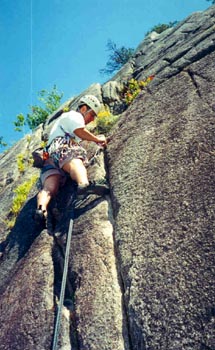 Todd leading Popsikle (5.7), listed as Koko Krack (5.10a) |
Death by granite. You could climb yourself to exhaustion here. If only it would rain . . .
The Gunk's weather forecast has read the same for weeks now: Saturday rain, Sunday rain, Monday through Friday beautiful, repeat. Between returning from Red Rocks and leaving for Squamish we've managed to get about three days in on real rock, thanks to an ill-timed rest weekend during what was apparently the last nice weather scheduled until September. And now we're heading to the rainiest climbing destination in North America.
The trip doesn't start well. A lost bag takes our lead rope, Todd's harness, and our tent with it. So on our first day of climbing we head timidly to Krack Rock at Smoke Bluffs with only our trail rope, half of a set of 8.8 doubles, to climb on.
Todd leads a 5.6 for starters. It feels a little stiff for 5.6 so when I lead up the 5.7 next to it I'm nervous and hesitant but my 5.7 turns out to be more straightforward than Todd's 5.6. From there, Todd decides to hop right on a 5.10 called Koko Crack.
"I must be on the wrong route," Todd mutters half-way up. "This is like 5.7." I check with the folks next to us.
"Is this 5.10?"
"No way," they laugh.
 Me leading an unnamed 5.8ish route at Krack Rock |
Next we move farther right to an area sketchily labeled "5.7 to 5.10c" in the book. There's a line there that looks leadable - a pair of parallel cracks diagonalling slightly to the left. The gear is good so I start up it, hoping it leans more towards 5.7 than 10c.
We started the day by leading on a single strand of rope, figuring that since we're only climbing single pitches we can't take a fall worse than factor one, so a single double rope is perfectly safe. But now that we're climbing harder stuff we've switched to using the rope doubled and clipping both strands, like twins. This theoretically increases the impact force on the top piece, so it might actually be less safe, but it feels safer and besides the gear is bomber and what about the rope cutting over an edge, not that there are any, and oh, hell. It's too complicated to figure out. Hopefully our lead rope will arrive tonight.
Lacing the route up with all the gear it will take, which is plenty, I arrive at a pumpy sequence I can't pull through. This route is steeper than it looks. I place two pieces and still can't bring myself to try the move above.
"Take," I say finally. I hang from my top piece more pleased with overcoming the psychological hurdle of hanging on my gear than annoyed with my failure to pull through.
"Climbing," I say after a few minutes rest and move up. A few more moves leads to a great stance and easier climbing above. If anyone wants to give me credit for the first ascent, I'll call it More 7 than 10c (5.8+).
All in all we manage to soak seven routes out of this chunk of rock before happily calling it a day. Back at the car I shuffle through Fern's detailed email to see if she mentions the 5.7/5.10 route mixup in her "Some errors in and changes to McLane's Squamish book" section.
"The Krack Rock section is completely messed up, crappy climbing too, avoid." Hoo boy. If this is the crappy climbing, we can't wait for the good stuff.
We drop by the local gear shop to return the harness we rented (yes, rented!).
"Was it really crowded?" the clerk asks sympathetically. Today is July 1st, Canada Day. It's also Sunday, the week of July Fourth, and totally gorgeous.
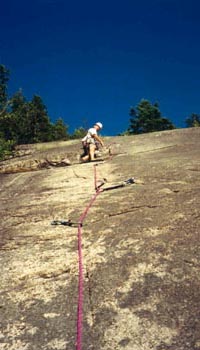 Todd leading Lost Horizon (5.10b) at Seal Cove |
The next day, with our lead rope restored and another cloudless blue sky above us, we decide to get to the good stuff, targeting the Smoke Bluff's Connection (5.10a), a four pitch "route" that actually consists of four separate routes on successively higher tiers, starting with Mosquito (5.8). The guidebook calls the Mosquito area highly popular and warns that Mosquito itself "suffers death by top-rope most days."
Forewarned, we almost walk right past it.
"I think this is it," Todd says.
"It can't be," I answer. "There's no one here." We see a guy belaying off the ground above the line we're eyeing.
"Which route are you on?" we call up.
"Mosquito," he answers. We're beginning to suspect that Canadians haven't the vaguest idea what crowded means. We're from the Gunks. If you don't have to wait for your route and you can't touch the climber on the route next to you, it ain't crowded.
I'm steaming along. Well, plodding really, but making progress and throwing in gear with dedication, when all of sudden a foot slips. Right here the crack pinches down too small to jam and my left foot has skated off the smeary-jam-toe-hook thing I'd been attempting. I catch myself. I still have two hands and the other foot on, after all, but now I'm panicked.
I start to step back down but don't have anywhere to place my foot, which was the whole problem to begin with. Then I start to climb up, only one or two moves to a stance, but it's too scary. Why, I'd be yards away from my gear. I stop in the middle.
"I can't," I say.
"Yes you can," says Todd.
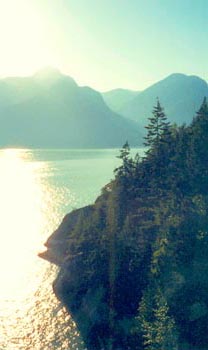 Sunset from the top of Seal Cove |
Every pitch on the Connection is a work of art. Now we understand why Krack Rock isn't a more popular area - the climbing really does get better than that. The final two routes, Jabberwocky (10a) and Wonderland (5.9), are particularly good. Another party catches up to us as I'm belaying Todd on Wonderland but we've just climbed a four pitch, three star route five minutes from the car in near solitude.
We walk off from the top and return to our packs. Plunking myself into the dirt at the base of Mosquito I notice an odd, airy feeling. A bit of prodding confirms my suspicion - I've ripped the back seam on my pants. Thank goodness for the cordelette, chalk bag, prusiks, and other sundry items that are hanging off the back of my harness.
I tie a jacket around my waist and we walk back to the car. After a quick bite to eat, we decide to try one of the other Squamish climbing areas - Seal Cove.
"I'm a little worried it might be crowded," Todd says. "I think it's kind of a destination spot" but there are no signs of life at Seal Cove - no climbers and, sadly, no seals. The 5.9 traverse that takes you to the start of most of the routes looks too scary and runout for me to either lead or follow. I'm almost certain to end up in the water and I've already been through one pair of pants today.
"Now that we know we can handle 5.10 friction, we should be fine on the Apron," Todd says. We're getting used to the rock here. This is not Yosemite granite, slick and polished. This rock has texture, as the backs of my hands and the seat of my pants can attest to.
But we're not ready for the Apron yet. We've targeted Wednesday for that, somehow calculating that it'll be the least crowded day. So on Tuesday we check out Starr Wall and Stooges Slab in the Upper Malmute area.
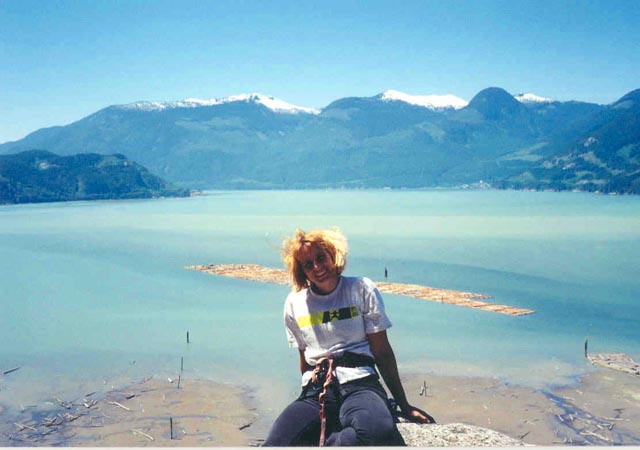 At the top of the Starr Wall |
I lead a 5.8 at Stooge's Slab. This is the friction area supposedly designed to encourage beginning leaders. I'm thinking to myself that beginning leaders might like their bolts a little closer together but the moves aren't hard.
"I guess that might be fun," I mutter as I bring Todd up, "if you've never led anything else before in your whole life." It's like a handicapped ramp. No holds - just walk up it. We move on without trying the other routes.
Next up is Shannon Falls. We want to climb to the right of the falls which means we have to cross the river. We walk up the tourist trail to the designated waterfall viewing area and crawl through the fence. I feel guilty about doing it, setting a bad example for the children, but these are the approach instructions given in the guidebook. Now we're supposed to cross on the big log. Crossing the first half of the river on the log is no big deal. It's a really big log. But the second half of the river is higher than the log in the middle and the current racing over the log is swift. This is not the way to go.
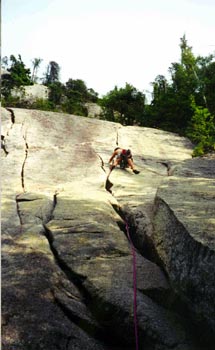 Todd leading Cardhu Crack (5.8) at Shannon Falls |
There's a pair of climbers working on the classic Local Boys Do Good (5.11a). Very funny. The leader is at the first belay and it's apparent that he's never climbed a multi-pitch route before in his life. He can't figure out how his partner is supposed to join him at the belay.
The low angle is working against me. With every move the rack swings forward and into the crack. First, I step on a blue alien still attached to the rack and can move neither up, nor down, nor reset my foot to free the alien. Finally I plug a piece in overhead and hop-step the alien clear. Next, pieces of the rack start placing themselves. At one point when I can't move I look down and see two nuts stacked in the crack. Cool. I've never placed stacked nuts before. I wonder if any of this self-placed gear will actually catch me if I fall off while trying to disentangle myself from it.
Finally, I'm just exhausted.
"I don't know how much more I can do," I complain. It's my feet that are the worst. Luckily, a small horizontal seam appears and I grab a rest on it before finishing. By the time we're done with Klahanie Crack, the folks next to us have given up on their attempt at multi-pitch climbing and are rapping back down. We negotiate to swap ropes with them. Todd had planned to lead the first pitch of Local Boys Do Good (10b) and then maybe take a stab at the second but "I'm not proud," he says and we take the top rope. As it turns out, getting to the first bolt is sketchy enough that, without a stick clip, we're glad for the TR.
The route is hard and fun. Todd shows me a picture of it in the guidebook later. "It wasn't that low-angle when I was climbing it," he says. It certainly wasn't. In the book it looks no steeper than the 5.8 at Stooge's Slab but in reality it was a helluva a lot trickier. For some reason, Squamish suffers unusually heavily from the foreshortening effect.
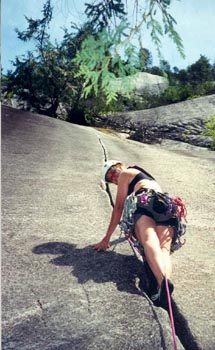 Me leading Klahanie Crack (5.7) at Shannon Falls |
Finally, the big day dawns - our Apron day. The long route day. The Chief itself. It's another beautiful day, though windier, and our plan is to start with The Bottom Line (5.9) and climb our way up to the ledge where Diedre, Banana Peel, and all the rest start. Finding The Bottom Line takes some work since there are no people nor signs of people, just dirty slabs with the occasional clean streak to indicate a route. Todd leads the first pitch, which the book recommends gear for. Then I lead the second pitch, which the book (amazingly) doesn't recommend gear for. I carry the rack anyway because I'm leading and someone has to carry it and I'm awfully glad to have it since clipping the first bolt is one of the hardest moves on the pitch and the first bolt is some 30 feet above the belay.
I backclip the bolt and spend a frantic few minutes trying to fix it without killing myself. Even with the gear I've placed, I'm a long way up with a treed ledge to hit on the way down. Finally I clip a second draw to the bolt to protect me while I rearrange the first draw and get it right. A few hard moves lead off from the bolt and then it's easier, but very runout, climbing to the belay. The last 30 feet are pure unprotected friction. I move with the utmost caution, remembering my long fall on the White Way at Wall Street. Of course, this is bullet-hard granite, not crumbling sandstone. As I belay Todd up I'm annoyed to see him walk up those last 30 feet without touching his hands to the rock.
Once at the top of this three pitch route we traverse across the small forested ledge to the start of the other routes. What we find is unexpected. I can't emphasize this enough. We absolutely didn't expect to find . . . people. Yes, here indeed are the crowds we've been repeatedly warned about but haven't encountered. There are people everywhere, including two waiting parties totaling five people at the shared start.
We're offered Snake, a "scary 5.9" with a separate start but decide we've just done "scary 5.9" and pass. After sorting through the people a bit we realize that everyone waiting, including the party currently climbing the shared start, is heading for Sparrow. We plonk down to wait, figuring that once they're out of the way we'll have a long stretch of Diedre clear ahead of us. It's our turn quickly and I lead the short, unprotected first pitch and Todd follows. Unfortunately, during all this time, the lowest party on Diedre hasn't moved. At all.
There's no escape from the Apron, no rap lines, no way out but up. We climb maybe 10 minutes for every hour we sit. The pitches seem short, although some of them are almost a full rope length, because they're so easy as to be uninteresting and so runout that no time is wasted on gear placements. We TR random bolt lines not documented in the guidebook that we run across at belays. We share our first on-belay pee. Somehow we end up doing the 7 pitch route in 9 pitches. By the end I'm desperately offering to simul-climb, something I've never been willing to do before, if only it'll get us past them.
Finally, I pull onto the last ledge at the tree line. The guy belaying next to me is from the party who was in front of us at the starting line. I guess their route to the top hasn't been any faster than ours. I can only hope it was more interesting.
"Banana Peel?" he asks. I nod. "How was it?"
"Mind-numbingly boring," I say.
If the climb up nearly put me to sleep, the walk down is certainly an eye-opener. You just walk down the slab. Face out. Unprotected, totally exposed, for a long, long way. It's steeper than the route. I swear it is.
We've climbed 13 pitches today, including the sidebars, but it feels like we haven't climbed at all. I wonder if we should have held out for Diedre. At least it looks like the climbing would have been more interesting.
"Oh, well," I say. "It was a good rest day anyway. I haven't stuck a single body part in a crack all day." Then, the kicker. Back at the car I take off my harness and feel that familiar breeze. Yes, I've ripped the butt out of another pair of pants. Butt-scooching on this rock is death for pants.
 Todd leading Koko Karck (5.10a), listed as Popsikle (5.7) |
"Doesn't it ever rain here?" Todd asks our waitress at breakfast. She looks stunned. Stumbling over her words she tries to explain that it rains all the time. Earlier in the week a passing soloist claimed that it had been an unusually rainy season so far. But we're not buying it anymore. We suspect the bad weather mystique is a hoax perpetuated to keep potential visitors away. As proof of the this theory, the weather forecast for Squamish, as viewed from Connecticut, was 65 F and mostly cloudy for the whole week. The actual weather, as viewed from Squamish, was 75 F and cloudless. It's all an elaborate conspiracy.
What to do with our last day? Something more interesting on the Chief like Calculus Corner or Rock On, both highly recommend? The Lower Malmute, beautiful lines but mostly hard? Try to find our way to Star Chek, the route Fern recommended that climbs out from the Cheakamus River in three bolted pitches? I vote for a return to Smoke Bluffs, which I've enjoyed best of all the areas we've sampled so far.
So we do a Smoke Bluffs whirlwind tour, visiting Burgers and Fries, the crag you can watch from McDonald's, where I lead its namesake route (5.7); Alexis, where we TR my favorite route of the whole trip, White Streak (10c); High Cliff, where we completely fail to get up Red Nails, the 11c "test piece" finger crack; Island in the Sky, where I pop off the first moves of Fissureman's Friend (5.8), scaring myself when I unexpectedly land on my butt but not hurting either myself or my pants; and finally The Zip, where Todd leads The Zip (10a) as an excellent finale to our trip.
"You could have led that," Todd says. And in a way it's true. It's easy to see how a person who calls Squamish home could become a confident leader. The bomber rock, placement opportunities so boundless you have to limit your greed, soft landings on dirt made spongy by (supposed) regular rain, the fact that you can almost always scramble to the top and rap clean your gear if you decide to bail. Add to that short approaches, gorgeous settings, and a two minute drive from fast food alley to cliffside. What happens when Squamish climbers try to climb somewhere else? It must be a rude awakening.
Not that you should climb at Squamish, because you shouldn't. It's mine, all mine! I mean, it's crowded and the weather sucks. Yeah, that's it. Big crowds. Rains all the time. Bad. Squamish bad. Very bad. Trust me on this one.