| Climbing Areas | ||
| California | ||
| Colorado | ||
| Nevada | ||
| New Hampshire | ||
| New York | ||
| Tennessee | ||
| Utah | ||
| West Virginia | ||
| Outside the US | ||
| Aconcagua | ||
| Canada | ||
| Caymans | ||
| Mexico | ||
Climbing FAQ | ||
Articles | ||
Best of Rec.Climbing | ||
About Tradgirl | ||
by Adrian MacNair, 9/2002
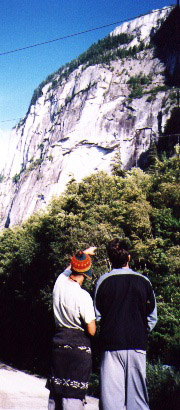 Adrian and Wolfgang dreaming about the Split Pillar (5.10b) |
Focusing completely upon the entity, I am suddenly aware of its overwhelming size, as each step on the gravelled side of the highway brings it into greater view. The entity appears as a gigantic white phantasm, it's sloping granite flanks bathed suddenly by the pale moonlight; the sheer walls of the upper sections of the monolith appearing like that of a giants' teeth, gleaming in the darkness.
I stop in my tracks and stare in captivity at that which is both terrifying and beautiful; both alluring and repelling; I stare upon the massive granite walls of the Stawamus Chief. I am in Squamish, British Columbia, with the impudent idea that I am to climb upon this great monster's back. I stare at the smooth, featureless wall of the Grand, trying to pick out that one line of weakness, the Split Pillar. The "easiest" line up this gigantic rockface, the grade is an intimidating 5.10b. Would I be fortunate enough to stand triumphant upon the top?
My partner, Wolfang, his girlfriend Alejandra, and I arrived in the Stawamus Chief climbers campground at about 3 o'clock in the afternoon on September 3. Although it had been raining in Squamish all day, we later found out that this had been the first rainfall in three weeks! Tired from the airport waiting, the taxi ride in Vancouver, and the bus ride to the Chief, the logical thing would have been to hit our sleeping bags and rest for the next day. But we were so excited about our arrival, that despite the drizzling rain and darkness in the forest, we simply had to explore what we had come so far to see.
 The Stawamus Chief |
With the rain spitting a smooth layer of slime on the black granite of the Campground Wall, we looked in the guidebook for a good route. None seemed very interesting, with the exception of two routes: A Pitch in Time (5.10b), an overhanging fistcrack; and Rainy Day Dream Away (5.10c), a splitter fingercrack which started wide and steep, but seemed to get narrow and slabby at the top. We decided upon the approproiate "Rainy Day" route, rationalizing that jamming would offset the difficulties of the slippery rock. Wolfang racked up as I flaked the rope on the dirty wet ground.
Once ready, he started jamming up the easy fistcrack which led to fingers, and came to a dirty ledge with a dead tree. Bypassing it on the left, he entered the crux stage of the route, a vertical fingercrack which split the slab above. He entered it timidly, and began protecting heavily. It wasn't long before he was on tension, panting in the humid forest. After resting, he would jam up a few metres, slot a cam or a nut into the crack, and rest again. Before long he was virtually aid climbing the route, placing gear while sitting, trying to sew the heinously thin crack up. With extreme difficulty he topped out.
 Adrian leading A Pitch in Time (5.10b) on the Campground Wall |
The next day found us exploring above the Campground Wall, into the Bulletheads area of the Chief. The access is quite unique, as we needed to ascend many fixed lines up third and fourth class terrain to arrive at the base of a beautiful black granite slab. We decided to climb a 2-pitch route called Slot Machine (5.6,5.8). As the name suggests, the route features much finger and fist jamming, and was a spectacular start to our trip. Shaken from last nights experience, I decided to lead the first pitch at 5.6, to properly familiarize myself with Squamish rock.
Seeing that the route was split into two different cracks, I decided to use double ropes to make life easy for myself. After a very difficult and bouldery start, I walked the route easily, but enjoyably, to the anchors. Wolfang followed, and we swapped leads. He finished up the 5.8 section rather easily, and after I had cleaned for him I felt that the route was rated incorrectly. A quick check in the guidebook proved us right. The corrections page in the back showed that the first and second pitch of Slot Machine were backwards; so I had actually led the 5.8 pitch. The route itself was spectacular, with excellent protection, sustained jamming, and gorgeous black granite which sizzled in the hot sun.
Looking for another climb, we decided to try a Peter Croft route called A Cream of White Mice (5.9). The route was split into three pitches of 5.9, 5.6, 5.9. The original start called for climbing up a dark, wet gully, something I did not like the idea of. The alternative start in the guidebook sounded much better. A bolted arete led back into a corner, up an easy face, and a long traverse to finish up a dark corner.
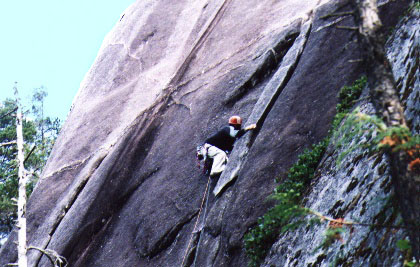 Adrian leading the first pitch of Slot Machine (5.8) |
Swapping leads, I scrambled up the easy 5.6 pitch, and decided to finish the route in one long pitch. Now, the beta called for a "long traverse" to finish up a dark corner. But looking to my right I couldn't see any traverse ledge which might help me. I decided that the guidebook was wrong again, as I saw bolts further up where the slab met the headwall. The 5.6 moves quickly turned more challenging, and the protection disappeared. Looking up, I could see an anchor 10 metres away, but my last protection was already at least 5 metres below me. After some balancy moves, I decided it was not worth it, and I downclimbed to my protection. Extending the slings, I made a very frightening traverse on micro-crimps and friction holds until I gained a left-facing crack. I began happily jamming up the crack, assuming this was the "dark corner" that the guide referred to. The crack was taking small TCUs at the start, but soon the protection was getting too thin for my talent, and I was once again feeling strung out above my pro. Admitting defeat for a second time, I downclimbed and downcleaned (a rather tricky task at the time), until I reached the bottom of the crack again. I felt lost.
With my new protection above me in the crack, I began moving right again, away from my pro, making yet another strenuous and awkward traverse towards what appeared to be an arete. Reaching the corner, I looked back and felt sorry for my second who would be making an equally scary traverse. Without time to dwell on this, I looked for some sign of a route. Seeing a fist crack which led upwards, I began jamming up it, and surmounted a ledge with a tree. Slinging the tree, I was protected once more. Feeling a little better, I looked up and realized with irritation that I had followed yet another false line as the arete above looked sparse and unprotected. Peering around the arete and above, I finally saw the "dark corner", a 5.9 fingercrack leading to the anchors. Downclimbing the fistcrack, I tried to enter the fingercrack, but the rope drag from the tree was interfering with my progress. Once again I jammed up the fistcrack, unclipped my protection, and then climbed back down and around the arete.
Now fully runout and without much appreciation for Crofts route (at the time), I entered the fingercrack and began laybacking up the corner. The crack looked like it would have taken a few nuts, but I ran the 10 metres quickly, and without pro, finally reaching the anchor. Wolfang followed, and admitted that the traverse had been frightening. He described my runouts as "bold", and suggested that the "directissima" would have been much easier. We may never know.
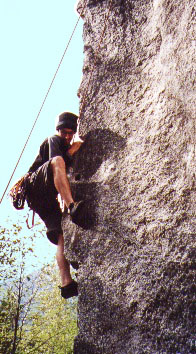 Toproping the dynamite holes in the Bluffs |
Wolfang started the day by leading a very enjoyable climb called High Mountain Woody (5.9). The 48 metre route took about 16 pieces of gear, and was varied and exciting. When we reached the top of the cliff, a couple had appeared and began setting up a rappel. The man was lean and athletic looking, with dark hair and a strangely familiar face. He was soft-spoken and polite, and rapped down to climb High Mountain Woody. Meanwhile, Wolfang rapped down to set up a haul line for our gear, since you have to climb out of the Upper Malamute; you cannot walk off. The wind was blowing in strongly off the waters of Howe's Sound and it was very intimidating to stand at the edge of the cliff, peering down at my partner.
I began hauling the gear up the cliff when I found that the pack seemed to be stuck on something. Lowering it back down to what I thought was the ledge, I rapped down the line, and found it had stuck in the rather large rest hole on High Mountain Woody. I lowered the pack to the ledge, and finished my rappel. The man then offered to set up a haul line for our pack and we gratefully accepted. Racking up quickly, yet casually, he then led High Mountain Woody on 3 pieces of gear. When he topped out, he hauled our pack for us, and put his partner on belay. In amazement, I asked his partner who the man was.
"Oh" she replied, "he's very good. He climbs 13's."
"What's his name?"
"Sig Issac. He used to climb in Ontario actually, with these famous brothers."
"You mean Dave and Reg Smart?"
She nodded her head. Checking the guidebook was most illuminating. Apart from Sig Issac's first ascents, there are some impressive blurbs on him in the guidebook. On August 8, 1996, he climbed Freeway (11 pitches, .11c/d), The Grand Wall (12 pitches, .11a/A0), and Northern Lights (12 pitches, .12a) in 14 hours and 40 minutes car to car. He led every pitch and ran down the backside of the chief every time. In the same year, he and Guy Edwards climbed the Grand Wall via the Roman Chimneys in 1 hour and 44 minutes, eclipsing Peter Crofts previous record by a full hour. It was quite a thrill to run into him like that. I later remember where he looked familiar: The cover of Gripped Magazine, Feb 2001.
I then led up a nice 5.9 called Gonch Pull, which had a spectacular finishing pitch called Stephanie's Tears (5.9). Stephanie's was a beautiful corner crack which took superb finger jams, excellent laybacking, and delightful friction smearing. We finished the day on Paul's Crack (5.10a), a fingercrack with a tricky start, leading into a wonderful 5.8/9 finish. Wolfang led the route and we topped out with plenty of sun left to return to the campground for a meal well deserved.
 Howe's Sound from the Bulletheads |
But standing in front of the Grand Wall, looking up at the Split Pillar around 200 metres above, I was not sure we had the skill to pull it off. I decided that climbing Apron Strings would give us a better indication.
Wolfang was open about his doubts that I could lead this climb. In Ontario I had spent many hours on tension on some 5.9, frightened to proceed upwards, but too ashamed to come back down. Such incidents had not proven myself as an adept and talented trad climber in his eyes. I knew then, however, and know now what my problem was: committment. I was unwilling to take the calculated risks necessary to succeed in traditional climbing. My hesitation on climbs stemmed more from a lack of self-confidence in my climbing, my protection, and ultimately in myself. I had vowed to make this trip to Squamish a testpiece for my courage. This does not mean that I was willing to take unnecessary chances on climbs beyond my ability, but rather a journey into exploring what truly were the limits of ability, and just how much was being hampered by self-doubt and fear. With these thoughts in mind, I racked up for the 5.10b.
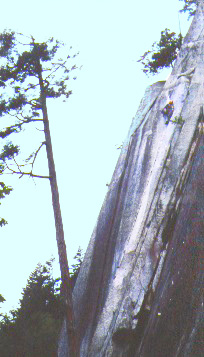 Adrian on the first pitch of Apron Strings (5.10b) |
After I had placed some preliminary protection, I decided to run it out towards what appeared to be a sling protruding from the flake. When I reached it, I clipped a carabiner on it and looked behind the flake. A weathered and beaten Wild Country Forged Friend was decidedly stuck in the crack, and I happily clipped in and climbed on. 5 metres beyond the fixed pro I spotted yet another sling. Believing my luck too good to be true, I quickly ran it out to the next sling and once again examined the specimen underneath. An equally overexpanded Friend was buried below the flake, although this one had a flexible stem. Clipping the second fixed piece, I looked up with strong energy and confidence towards the thinning crack above.
The tiny footholds that I had been gloriously laybacking off seemed to be growing more infrequent, and my hands were now searching for solid jams in the layback. I was quickly getting tired, and only moving quickly could keep the fatigue away. The problem was that although it was easy to make quick progress up the flake, the further I went, the more I realized the need to stop and get some protection in. Searching for a good handhold to rest on, I smeared my feet almost to eye level where I spotted a good-sized jib (foothold in gym-speak). Keeping my left arm straight and struggling to control my breathing, I fumbled with the green 3/4 inch DMM TCU on my rack. Prying it free, I slotted it in the crack and quickly switched my hands to shake my left arm out.
Moving up a few more metres, I could see where the crack ended, but it seemed to be on terribly thin moves. Pausing again, I took out my 1/2 inch purple DMM TCU and gingerly eased it into the now tiny crack which I was clinging to. My legs were wobbling slightly with the fatigue of the climb, and I was shaking my arms out in an attempt to control the massive attack of exhaustion which had descended upon me. Familiar doubts had by now crept back into my mind, and I suddenly felt the urge to sit down. Easing very gently onto semi-tension, I was reluctant to remove my fingers from the locks they had in the crack.
As my partial weight came down on the TCU, I watched in horror as it rotated outwards, one camming unit completely exposed. The TCU was on a very inefficient one and a half points of contact with the rock, and I pulled into the layback again. Grabbing the TCU, I rammed it into the crack in the hope that brute force would put the cam in place. Certain that it was now placed perfectly, I began to move upwards again. At the moment that the rope made a pulling contact with the TCU's sling, the hapless cam fell out of the crack as though it were deliberately not cooperating with me. Frustration seemed to overtake my feelings of fear and fatigue, and in very deliberate and controlled movements, I reached down to snag the loose TCU, and calmly placed it above me. Yanking down on the sling hard, the cam was finally placed securely. With renewed confidence I climbed onwards.
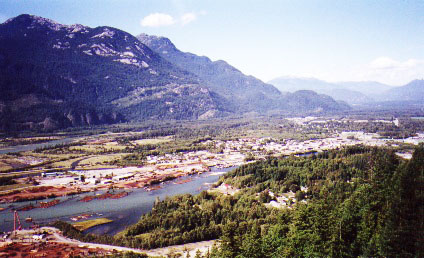 View of the town of Squamish from Flake Ledge on the Grand Wall |
Slotting large nuts blindly into the crack at my side proved fruitless and further tiring to my situation, while none of my cams seemed to be working either. Running out of options, I grabbed my gold Friend and jammed it into the hold which I had been using for my right hand. Yanking down on the sling, the cam did not budge, but I was not fully confident of it since I was unable to inspect where it sat in the crack from my viewpoint. Making things even worse, I had now sewn up the only hold for my right hand.
With my legs shaking and my body slowly failing, it suddenly became clear to me. I had two simple choices: stand here until I fall off, or make a move for the anchors, which would either result in success or failure. The one option provided only failure, while the second at least gave me a chance. To one now reflecting on the situation, the choice seems to be easily made, but the effects of a tiring climb seemed to have the same results which altitude has on mountaineers. My senses had been dulled by fatigue and fear. Only a sense of urgency to finish the route now propelled me on from somewhere deep within me.
My left hand locked into the crack, clinging desperately, my right hand began inching across me, making an awkward and balancy crossover move towards what looked like a hold above. My left leg flagged out instinctively to keep me from barndooring off the cliff, while my right hand continued to move above and beyond my left. With my reach at its limit I made a sudden dynamic push for the hold, my left hand slipping from its locked position, and my feet cutting loose. My right hand hit the hold and somehow slotteddeep into some hidden, yet perfect handjam. With my body fully supported by this perfect handjam, I swung my left hand up to a better hold and quickly made the "thank-god" mantle onto the slab above.
Scrambling towards a large and easily protected crack, I slotted a 3.5 friend in and exhaled for what seemed like the first time on the climb. My body went limp on the rock, clutching the warm granite with my hands, allowing my face to lie against the rock, panting as though I had run a marathon. When my breath had finally returned to normal I shouted a victory "whoop!" and stemmed to the anchors easily. Putting my partner on belay, I allowed the sun to caress my sweat-drenched body, the smile on my lips now planted inextricably for the remainder of the day . . .
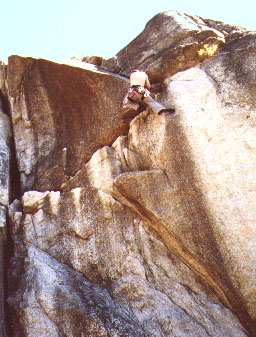 Adrian on Neat and Cool (5.10a) |
Wolfang and I walked the few kilometres from the campground to town, and entered the Bluffs via Loggers Lane, a road which leads to many of the lower Smoke Bluffs crags. After wandering around for quite some time, we could not find any crag which provided the combination of sun and beautiful climbing we were looking for. Continuing to search progressively uphill, we came upon the crag Burgers and Fries, an area which is like Rattle Snake Point to Squamish; many beginners and topropers, with guides and instructors providing help from below. Based upon the guidebook description I expected we would be able to find at least one appealing line. But its low-angle, discontinous cracks, and generally unappealing asthetic quality left me thinking that the Smoke Bluffs were going to majorly disappoint.
Not ready to give up yet, Wolfang and I (and Alejandra), came upon the crag Neat and Cool. I spotted one attractive line immediately, and looked it up in the guidebook. The name was Flying Circus (5.10a), and I decided to lead it. Unfortunately somebody was toproping it at the moment, so Wolfang racked up for an overhanging climb Neat and Cool (5.10a), the namesake of the crag itself. The route starts below a left-angling crack which leads to a roof where it diverts right again, a semi-mantle into a left-angling crack again which leads to the anchors.
The distinctive "Z" movement of the climb was an irrestible part of the attraction. Wolfang lead the route in style, placing good protection, acting with minimal hesitation, and finishing on an impressive runout. The fact is that Wolfang was in his element: overhanging, thin holds, power moves. I had some trouble at the crux section of the route where a semi-mantle is required before diverting left into the final layback of the "Z". In fact I almost fell off before grunting my way past the roof.
When we got down, a Squamish local told us that he was glad Wolfang placed 2 pieces at the crux move. Apparently there have been people who have had ground fall trying to make the move on one piece. One didn't walk away from the fall.
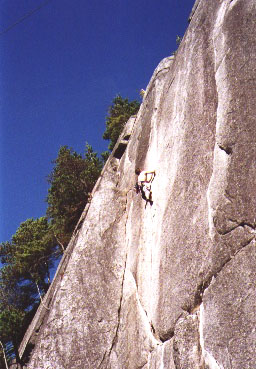 Adrian leading Flying Circus (5.10a) |
I finished the crack on adequate gear, without rests or even many pauses. It was a purely enjoyable experience. Wolfang had commented upon my climbing in Squamish with some interest. In Ontario I had climbed with quick and desperate movements; scared and runout on suspect rock, hesitant to move up, searching for escape from a self-inflicted torture. But here in Squamish I had started climbing differently; quick and confident movements across solid rock, with good protection placements, and reassuring finger jams.
We were about to leave the Neat and Cool crag when we spotted an interesting zig-zag route to the right of the Neat and Cool route. It was named Geritol (5.10c), a crack climb which finished on some slippery looking holds at the top protected by bolts. Wolfang led the first section to the bolts well, but got stuck on the topout face moves. After many attempts, I suggested he simply use the bolt as a foothold and finish the climb. He stepped on the bolt and after some awkward moves he made a dynamic throw for a jug and stuck it. Topping out, he set up the belay and I cleaned. The first section was about 5.8, moving into some 5.10a/b moves before the bolts.
After I had pulled the QD from the second bolt, I found myself clinging to some extremely polished and crimpy rock. After many tries, I had not made any upward progress, and decided to use the bolt as a foothold as well. Even so, I still could not solve the Geritol puzzle. The moves called for thin gaston-crimps with polished and scary footholds, with a good metre between me and the finishing jug. I tried again and again, but could not finish the climb. Going on tension, I half-climbed, half-cheated my way to the jug hold. I'm not a great sport climber, but I have been able to redpoint .11a or .11b before, and so the grade seemed a little soft considering the difficult moves required. Wolfang felt it was more like an .11a. But we didn't spend too much time dwelling on it, as we packed up and headed for town to have a nice post-climb sundae.
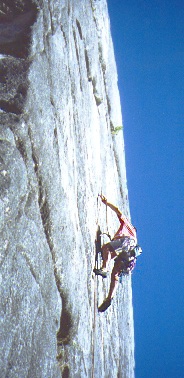 Wolfgang leading Geritol (5.10c) |
It was supposed to be a rest day, and we had woken up late, and done many rest day chores for most of the morning and early afternoon. But with the good weather and temperature, we were regretting the wasted day, and so our hasty decision to climb the Grand Wall did not occur until fully two o'clock.
My previous success on the .10b pitch which started the route had not necessarily meant that I was destined to lead it again. Wolfang was determined to give the climb a try, and I was not about to talk him out of it. After all, the climb had left me breathless and utterly exhausted, so I felt that Wolfang should have a go at it. We once again scrambled to the belay ledge, and he started up Apron Strings.
The beginning went well, and he did not protect more than was needed. In fact, it was not long before he had clipped the two peices of fixed gear and was working his way to the thin finish. But then he suddenly ran out of steam. Sitting on his gear he took a long rest, and while he did so he began to place gear above him.
After well over an hour, Wolfang still could not solve the remainder of the route, and was fumbling around with small gear to place in the crux section while on tension. I did not say anything, however, since he once told me that he hates to feel that he is rushed by his belayer; something I can understand and agree with given all the times he had to stand on belay as I worked a route for hours, never once chastising me.
When he clipped the anchors at the top, I dismantled the belay and started cleaning the route. It went fairly well until I hit the crux section which was loaded with wires and small cams. One nut could not be dislodged so easily and I was forced onto tension while I cleaned it. I found myself at the top of the crack again, and decided to see if there was an easier alternate finish, now that I was under the safety of a toprope. But I could find no other way than the crossover I made on lead, and so I made it.
Reaching the anchors I was determined to make up time by leading the 5.9 second pitch quickly. I grabbed the rack and led the 5.9 layback on three cams, running the crux out confidently. I then finished the superb 20 metre 5.6 zig-zag fist jam crack on three large cams, reaching the Flake Ledge by about 4pm.
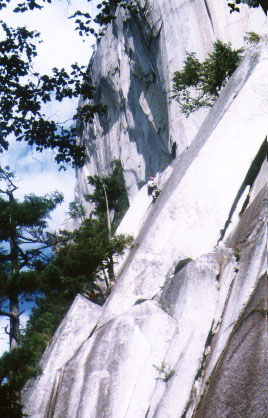 Adrian on pitch 2 (5.9) of Apron Strings (5.10b) |
But upon further reflection after the fact, I now see it as one of the alluring aspects of the route. A runout, while unnecessary and easily remedied by a $4 investment, added some character and committment to the climb. This 5.7, which under a Rumney-style bolting spree, would ordinarily be done carelessly and thoughtlessly, the leader knowing that any mistake would result in very little penalty. But without the bolts, the leader is forced to draw upon an inner strength and courage; to place one's feet precisely and confidently; to make each move with crisp awareness of the precariousness of the situation. Rarely has a 5.7 commanded so much respect.
After the length of the first pitch, and the indecision of my partner, it was then with great surprise that Wolfang threw himself on the third pitch. Where his caution had hindered him before, he now bravely took a few slings and some wires in case he could find some hidden protection, and started up the 5.7 dyke. I can honestly say that even today I am still unsure as to where he drew his courage from to climb up something which looked so unprotectable. In any case, he proceeded where I had not dared to tread.
His progress was careful and steady. Each step was precise and calculated, as he went farther and farther from the ledge. After quite some time he shrieked in delight as he came upon a bolt, a full 10 metres from the Flake Ledge. With the bolt below him, Wolfang now moved much quicker, and clipped a second hidden bolt. In no time he had clipped the anchors. I was soon on belay, and made a quicker, but equally tense trip up the dyke, all the while wondering what it had been like for him in that runout.
Looking above the anchors, I could see that the dyke started angling leftwards towards University Wall. The guidebook called for another runout, this time 5.9, before a traverse would bring us back right and below the large roof. We scanned the rock for a long, long time, but could not see a single bolt on this pitch either. Once again, courage failed within me, and I told Wolfang that the decision to proceed was his. The success of the first runout had left him so confident that he immediately accepted, and started off along the dyke.
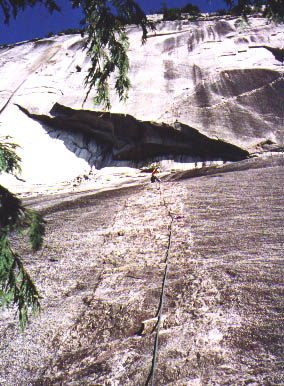 Wolfgang leading the runout 5.7 pitch of The Grand Wall |
Reaching a crux move Wolfang stopped and hesitated. He shifted his body several times, and finally made the move. He then started traversing back right again, where he was able to clip a second bolt. Soon after, he reached a flake and placed a Camalot. Surmounting the flake, there was a tricky traverse before he reached the anchors.
Once again on toprope, I quickly made the traverse to the bolt, and then continued along the dyke. I stopped at the crux move, and could see what the problem was. A nasty gaston hold and some small foot placements were the only things which kept me balanced on the rock. I had to shift my body weight up, pull off the gaston, and make a delicate move before I was once again on easy holds. The 5.9 rating therefore seemed a little sandbagged on what could easily be rated a .10a. I then moved right, coming to the flake and the camalot.
I could not understand why he had placed the camalot, since the climbing at this section was getting very easy, and to make matters worse I could not extricate it from behind the flake. The size of the flake and the angle of the slab made it easy to work at the cam with both hands, and I used the nut tool to try and retract the heads from their overexpanded position. After quite some effort, I could not dislodge it, and I continued climbing. Just before the anchors was a bolt protected traverse on some extremely delicate face moves and balancey positions, thus solidifying in my mind that Wolfang had just led a very hard pitch.
Wolfang and I switched belays, as he was determined to have a go at his Camalot, and he made the awkward traverse back to the flake. After a long effort, he finally pulled it from the crack triumphantly. I was also secretly relieved, since we had agreed upon a rule prior to the trip: Any gear which had to be left in the rock, which could not be removed, or needed to be left in an emergency, would be bought back after the trip under a 50-50 shared expense. It was a fair rule, and I had agreed to it. A new Black Diamond Camalot would have cost me quite a pretty penny, even at half the cost.
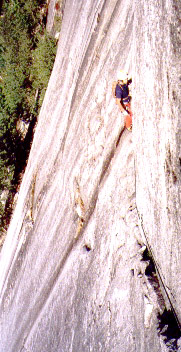 Wolfgang following the 5.10b traverse pitch on the Grand Wall |
Arriving at the campground in the blackness, we ate our dinner with a mix of emotions. We were happy to have come so far on the route, overcoming the runouts and the difficulties along the way. But we were disappointed that we had not reached the Pillar. Each day as we walked past the Grand Wall we had seen a small figure scaling the imperceptible crack, and inevitably we would hear the summit cheer as the victorious leader arrived on its' top. That victory shout haunted our thoughts and dreams constantly, as the Grand Wall became less of a desire, and more of an obsession . . .
Following the failure on the Grand Wall, Wolfang and I decided to explore the Apron Wall of the cliff, a gently sloping slab on the Chief, providing some great friction climbs. Our plan was to climb the 7-pitch 3-star route Diedre (5.8) which we had heard so much about. But first we decided to tick another gem off our list by climbing the route Exasperator (5.10c) on the Grand Wall. We arrived at the familiar base of the Grand by 11am, mostly owing to the chilly September weather which kept us in our sleeping bags far too long on this trip. Exasperator was a route recommended to us by Sig Issac when we met him on the Upper Malamute, and so we were eager to try it.
As it was my lead, I was happy to rack up for it. Unfortunately the rock was rather wet from rainfall during the night, and the rock was especially black in appearance. Memories of Rainy Day Dream Away worried me, as I knew I would be relying on jamming rather than smearing.
 Adrian leading first pitch of Exasperator (5.10c) on the Grand Wall |
Wolfang scurried up to my stance and we swapped leads. He began off on a very technical and awkward right-angling fingercrack, which he sewed up in typical fashion. It took him a long time to feel comfortable enough to free climb the route, but impressively he suddenly moved through a long hard section and reached the left-angling fistcrack. He finished up the route and I was quickly on toprope. The traverse was indeed difficult, with shallow fingerjams and reachy movements. The rain had dried up enough to provide decent friction, but the climb was certainly strenuous. Once the traverse turned more vertical again, I was able to move quickly and easily up to the left-angling fistcrack. This proved far more difficult than I could have imagined, and I decided to leave a stuck camalot in the crack momentarily while I finished the route. Call it silly, but I wanted the clean toprope ascent. I retrieved the camalot on rappel.
Wolfang started up the first pitch, which was a low-angle slab which zig-zagged significantly to the first anchor. When I followed, I decided it would have been easier to simply free solo the pitch, and avoid the rope drag. We swapped leads and I started traversing left towards the most prominent feature of the route, the 5.8 layback Dihedral. I moved quickly and effortlessly along the extremely frictioned rock, placing no protection, running the two pitches together to arrive at the Dihedral.
Wolfang soon joined me at the belay, and he began laybacking up the route. There was an English couple ahead of us who were moving rather slowly, but the weather was fine and we weren't in any hurry. My partner moved through the layback with some, but not much difficulty. He soon arrived at the next anchor.
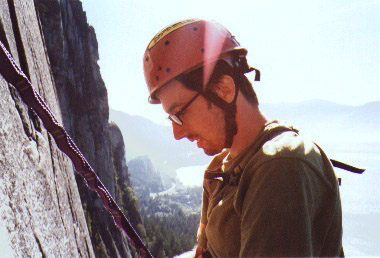 Adrian before the aid pitch on the Grand Wall, below the Pillar |
I started off on the next pitch, moving so quickly that Wolfang was unable to feed me the rope from his ATC fast enough. I apologized and moved more slowly, but I still raced through the next 5.8 layback, placing two nuts for mere formality. Before I came to Squamish, I read in the guidebook that local legend Hamish Fraser soloed the Squamish Buttress via Diedre in 34 minutes car-to-car. I simply could not understand how somebody could risk their life in free soloing, and have always felt that such an act is something which requires complete commitment body and soul to the act. I still do, but on that day something changed within me. I felt a confidence in myself and a complete trust in my abilities, that placing protection almost felt unnecessary and superfluous; that is to say, I found the enjoyment of climbing so pleasurable that stopping intermittently to place protection was breaking the flow of the climb, and interrupting the "dance" on the rock.
The couple ahead of us was finishing up the last pitch when I reached the next belay, and I stood there, my protection well below me, watching the leader climb with complete casualness. I did not feel a false sense of security; I felt so much in control of the situation that clipping into the anchors at the time was something I did not even consider. I know that many people may find it difficult to understand, just as I did when reading such accounts.
When Wolfang reached my perch, I ran out the last pitch placing no protection, except for the rusty piton which protruded from the rock on the crux move onto Broadway Ledge. Wolfang was very concerned that the hour was getting late, and we quickly considered on the best retreat from the cliff. The couple ahead of us had more foresight than we: they were going to walk off down a path to the right, and both had headlamps. As for us, we decided to rappel, and we had only one headlamp.
We began to rap quickly as the sun set on the horizon, although as many of you probably know, rapping on low-angle slabs is rather difficult. I began to ignore the backup prussik since the friction on rappel was such that even when one let go of the brake line, one would still arrest. I had to continually shove the rope through the rap device in a concerted effort to move down the rock.
 Adrian leading A Pitch in Time (5.10b) |
We finished rappelling in the dark, and found that Alejandra was not waiting for us anymore. She had left a note that she had returned to the campground because we had agreed to meet friends there at 6:30 and were probably late. It was a wise thing for her to do, especially before dark, and so we continued the perilous descent in the dark, with Wolfang leading the way. His headlamp helped him find the path, and by moving slowly and cautiously, we both arrived safely at the bottom. Wolfang then rushed ahead and quickly disappeared, as he was concerned for his girlfriends safety, and wanted to make sure she had arrived in camp. I made my way back to camp in the dark, walking slowly and fatigued. But I was not distressed. Quite the contrary, I was very happy, thinking about the climbing that day, and the wonderful pleasures of moving up the rock without pause... a flowing and moving "dance" up the warm granite, the sun shining on my neck, and the sky azure above.
I arrived in camp to learn our friends had left due to the late hour, but we dined on our usual camp food of rice and beans, and soon we were merry once more. The dark mood Wolfang had been in was gone, and he began to reflect jokingly about my leads that day, calling me "Mr.Runout". The unpleasantness on the rappel had been forgotten, and once more we fantasized and discussed our eventual triumph on the Grand Wall.
Wolfang and I arrived at the base of the Grand Wall at 11 in the morning, the sun shining everywhere but on the Stawamus Chief, leaving us feeling chilled and stiff. The last thing I felt prepared to do was lead a pitch as difficult as Apron Strings. I even reasoned with Wolfang that we should simply walk along the Flake Ledge, a thin ledge which would connect us with the beginning of the third pitch of the Grand Wall, bypassing the strenuous 10b. But Wolfang was opposed to the idea, preferring to start "from the ground up". Despite his difficulties on Apron Strings before, he wanted another chance on it, and I gladly agreed.
He started up the now memorized beginning of the right-facing crack with ease, making quick work of the menacing layback. I began to think that he would walk the route easily, as he clipped the familiar fixed protection. But soon he ran into the difficulties again, and was on tension. Remembering my own experience a week ago, I could sympathize with his fears completely. The crux section on the route was nothing to sneeze at, and it took a lot of confidence, commitment, and care to navigate onto the slab above. After a long time of indecision and reluctance, Wolfang aided past the crux, and made his way to the anchors. Fighting off the cold, I raced up the climb, trying to get my blood flowing, knowing that my lead would be next. I felt a small sense of personal satisfaction that I was able to clean the gear without falls, and soon joined my partner at the belay.
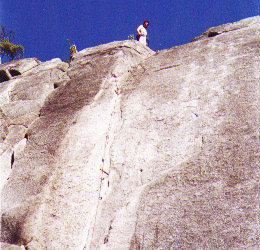 Adrian at the top of Flying Circus (5.10a) |
Whatever difficulties Wolfang may have had on Apron Strings were easily made up for by his proficiency on these two pitches. He led them as confidently as last time, although more quickly, since he now knew where the bolts were, and what moves to expect. For some reason, in the early afternoon sun we were able to see the bolts quite clearly on each pitch; they had been thoroughly "camouflaged" last time, despite scanning the rock with our eyes everywhere.
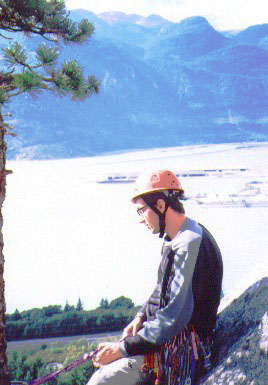 Belaying on Flake Ledge on the Grand Wall |
Wolfang made the traverse to meet me below the bolt ladder, and I began girth-hitching slings together to make "etriers". 6 slings would serve the two of us well, and I was quickly on aid, linking the bolts together as I angled rightwards towards the familiar tree at the base of the Split Pillar. We were now so close we could taste it. Arriving at the hanging belay at the base of the 40 metre crack, I arranged the rope perfectly so that my partner would be able to start climbing immediately. Despite our attempts to climb quickly, it seemed to be late in afternoon already, the sun traveling towards the mountains over Howes Sound.
 Wolfgang leading the Split Pillar (5.10b) |
I soon began up the crack, laybacking quickly and smoothly. I felt very strong, and the smears were good and plentiful. I cleaned the first few cams without difficulty, but soon the laybacking seemed to be getting more strenuous. Each time I had to stop to pull protection out, I found myself panting for breath, straining to hold on to the edge of the layback. It wasn't long before I, like my partner before me, collapsed on tension. Fighting off the onset of fatigue, I began climbing again, but this time it wasn't very long before I felt limp, and again fell onto tension. It was the beginning of a vicious cycle, and I was soon beyond fatigue, in a place where one knows the climb is beyond oneself. And yet I continued . . .
After an exhausting time, I finally got to the section where the layback on the crack could be turned into fist jamming, and I quickly made use of it. I jammed up the crack more quickly now and soon arrived at a bulge before the top. I now came to the first of four over-expanded Wild Country Friends. I worked on my Gold Friend for a long time before I finally extricated it from the rock. Moving up I came to my green one. A quick glance proved it was futile. The Friend was stuck for good. Taking the biner from it, I continued up to where a large hole before the top provided a rest. In the hole was my Blue Friend, and it was so overexpanded that I could not budge it from its place. At first I wondered many questions to myself:
"Does Wolfang know he needs to add a sling on these Cams? The slings are so short, they walk in easily." "Maybe he was so scared that he just jammed it in." "Maybe it's both."
Whatever the case, I did not care at this point. I was very tired, and thoroughly frightened from having to hang like a spider above the abyss so many times. After extricating the second of the four over-expanded Friends, I found myself at the last crux section. I tried and fell many times, but finally I made a wild leap for the ledge, smearing my feet wildly on the granite, and mantled out like a whale flopping onto a beach. I lay there in the dying sun like something sick, unable to comprehend how Wolfang had made his way up that monstrosity. I felt that, and perhaps still do, that I have never climbed something so difficult in all my life.
Wolfang was desperately worried about the fact that the shadows had almost caught me on my ascent to the top of the Split Pillar, and he threw the ropes over for rappel. I had not been on the top long before he was sliding down the rope towards the stuck cams. I had assured him that they were difficult to retrieve, and certainly impossible given our situation and time. Somebody would get them, but it wasn't going to be us. He agreed, and continued rapping down the line.
Suddenly he swore audibly, and I looked over the edge to see what was the matter. The ropes had somehow gotten stuck in the Split Pillar below us! I could not believe our bad luck! Wolfang cursed loudly, and he was quickly becoming as stressed as he had been on the Apron Wall. Tugging on the ropes, he could not get them unstuck from the crack. I sat back against the wall, and let the dying sun bath my face in alpenglow. I was not as worried as my friend. I accepted the possibility of our failure, as surely as I accepted the possibility of our success. There was no point in worrying about anything. Either he would succeed in freeing the ropes, or I would be sleeping on this ledge tonight.
 Wolfgang rapping down the Grand Wall |
I rapped down to the next station, and Wolfang began pulling the rope through the anchors above. Suddenly I shouted for him to stop. Looking 10 metres to our right, the rope was traveling to the anchors with a knot in it. Had we not noticed, it would have become stuck above, and we would have been in a terrible situation. Wolfang became very angry, and started blaming me for not checking the ropes before he pulled. Thinking quickly, I tied myself off to the anchors using the end of the other rope, and started traversing out towards the rope on the smooth slab. A fall would have resulted in a nasty pendulum, but I moved slowly and deliberately, until I had reached the rope. Untangling it carefully, I crept back to the belay, where Wolfang had almost finished setting up the next rappel.
We were about to start down when Alejandra told us that the ends did not reach the ground. His rope was 60m, and my rope was 50m, but together we needed a full 60 metres to get safely to the ground. Once again we were stuck in a dilemma, and Wolfang shouted at Alejandra to try and find an alternate rap station. She soon spotted one, but it was an awkward sideways rappel, 10 metres to our left. We quickly made the preparations, and rapped over to it.
When we arrived, we found that the anchor consisted of just two bolts, and no chains to feed a rope through. This meant that when we tried to pull our rope through the bolts later, there was an excellent possibility it would get stuck. At this point Wolfang was so desperate to get down, that he placed a nonlocking biner on one of the bolts, and was preparing to rap off it. I immediately declared there was no way I was going to rap off one bolt, and one nonlocking biner. Stressed and exhausted, it was difficult to reason Wolfang into using two carabiners to make our escape. But he soon came around, and we made two more sacrifices to the Chief to make our escape from the rock.
On the ground safely again, Wolfang and Alejandra packed up quickly and started walking away. I had been slowly removing my shoes, and trying to find some water for a drink. I was practically dehydrated. There was a brief argument as Wolfang demanded that I hurry up, and then he promptly left me there. I continued to put my hat, jacket, and approach shoes on, and slowly remove my climbing gear, packing it in my bag. I did not mind navigating the forest in the dark. I was not at all upset at either Wolfang or the darkness. The climb today had left me utterly spent.
When I was finally ready to depart from the base of the cliff, I saw a light heading towards me. It was Wolfang. Without words, he began to guide me down the path, and through the forest. He looked back many times to check hat I was okay. By the time we arrived safely at the campground, the unpleasantness was once again forgotten. All that remained was the memory of a very spectacular day.
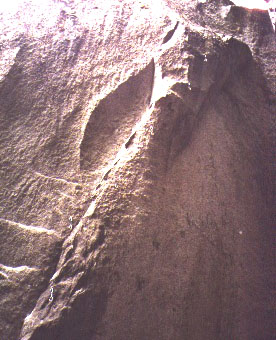 A view of Permanent Waves (5.13c) on the Kacodemon boulder |
We made the long trek up the backside trail, following the guidebook instructions as well as we could. After a full hour we had passed the White cliff, and found the "guidebook exit" from the gully, onto the slabs which would supposedly lead to the Solarium cliff. My partner Wolfang, and Alejandra were not enjoying the tiring trip we were having, especially considering the fact that we had no idea where this magical Solarium was anyway. So I dropped my pack and volunteered to scout ahead and find the crag on my own.
I ran off ahead, darting through underbrush and pine trees, looking for some sign of a trail. After a while I found one, which then diverted into many trails, some leading down, some straight, and some up. I followed the straight path, and soon found myself along some beautiful black granite slabs. Traversing along the trail, which got increasingly thin, I suddenly found myself strung out on a ledge the width of a banana, which dropped away for 20 metres below. So I backtracked and took the other trail which led down.
Again the paths diverged into countless little trails. Following one, I would end up at a dead end, or at the beginning of some unknown crack or climb. I kept looking for the Sunblessed start, but in the end I could not decipher which one it was. Slightly frustrated, I ran back towards my friends. When I finally arrived, an hour and a half had passed, and they were less than cordial upon hearing my news. We decided, unfortunately, to turn back.
 Adrian leading Climb and Punishement (5.10d) at Smoke Bluffs |
We walked along and came up to Cobra Crack (A2), a Peter Croft Aid route which is perhaps the finest looking finger-crack I have ever seen. The problem is that it is overhung so badly that it has never been freed. And many have tried. The crack was literally sewn up with somebody's rack. TCU's and small wires were in the crack from start to finish, biners not included, making a veritable connect-the-dots beta on the pro. As far as I know, Andrew Boyd and Jordan Wright have both tried to work the project, and it may finally go free at something around 5.14a! Just seeing that route was reason enough to visit the Cirque.
We left the Cirque, having desire to climb nothing there, and returned to Campground Wall, to try something new. I decided on A Pitch in Time (5.10b), the overhung fist-crack we had seen on day one. I started up it easily enough, but was soon sketching like a new climber on a 5.4. I didn't trust a single piece, I was frightened every time I moved up, and fist jams were feeling very inadequate. I groveled up the crack, over-protecting like crazy, until I finally collapsed on tension, unwilling to go further. When my mind cleared, I realized I had barely climbed 8 metres. I lowered to the ground, humbled in the most unmerciful way. And then Wolfang did what Wolfang does best. He grabbed the rack, and led the crack in style. Clipping the anchors, he had barely expended an effort. I politely declined the invite to toprope the route.
The next day we decided would be our last. Bad weather would be moving in, and so we headed to the Smoke Bluffs to have one last fun time in Squamish. I was, naturally, disappointed with my efforts on A Pitch in Time, and today I felt strong, with renewed confidence and excitement. My last day in Squamish I really wanted to push the limits of my climbing.
We trekked to Penny Lane Crag, and I went in search of something interesting. A few metres right of the namesake climb Penny Lane (5.9), I came across a nice looking flake route Climb and Punishment (5.10d). Without further ado, I racked up, and started off. The first moves require some bouldery moments to scramble up the slab which bars the way to the flake. Once at the base of the right-facing flake, I put in some pro, and started laybacking up. Before long, I came to the thin finish of the crack, and clipped a doubtful piton. After chalking up, I grabbed a crimp, made a few moves, and chucked for a jug. I mantled onto the first ledge, and placed some protection, happy with my success so far. The finish to the climb was a beautiful off-balance right-facing finger-crack. I decided to place my new #2 Rock Empire Cam in, and jammed happily up the crack to finish the route. Setting the anchor, I lowered off to allow Wolfang to top rope the route.
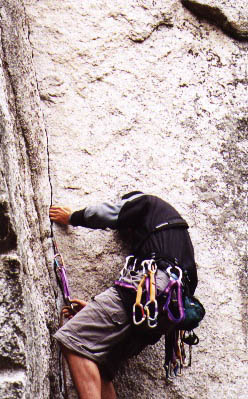 Adrian leading Kangaroo Corner (5.11a) |
We moved on, and soon came across Neat and Cool crag again, and I decided that it would be challenging to try the short 15 metre Peter Croft route Kangaroo Corner (5.11a). The crack itself is only about 8 metres, but it is very thin. It starts in an open book corner, with a left facing crack which allows one to stem on the other side of the rock. Slotting small wires above my head, I attempted to crimp my way up the thin crack. I fell once onto a good nut, before I made the bouldery moves to the ledge, and then the easy wider crack to the anchors. After that route, we toproped the arête next to Kangaroo Corner, a man-made side of rock, created by dynamite holes long ago. It was a fun diversion from the usual climbing, since it was all face climbing, and no cracks.
So I managed to finish the trip with my first ascent of an .11a, which I was very satisfied with. Squamish is one of the most beautiful places I have ever visited, and it is truly a rock climbers paradise. There were so many routes which were left unclimbed, which I will go back to try someday when time, and skill, allow: Rock On (Apron), Squamish Buttress, Angel's Crest, Sunblessed, Lower Malamute, etc etc. And one day, perhaps I will have the guts to try to climb the Split Pillar on lead.