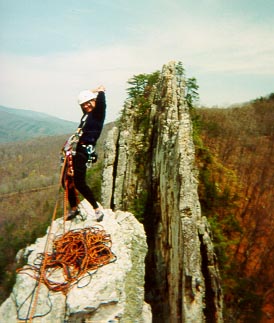
Lost City

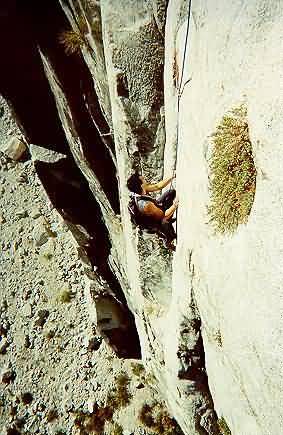
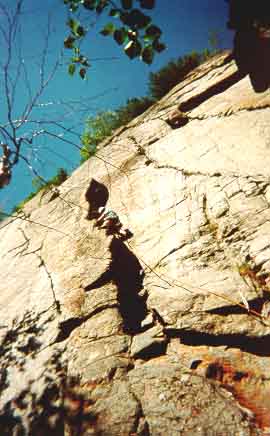
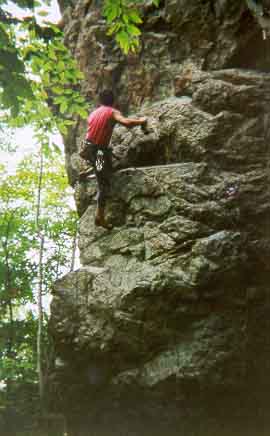
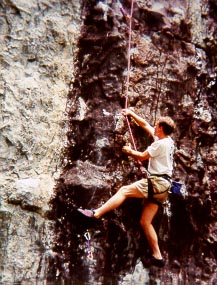
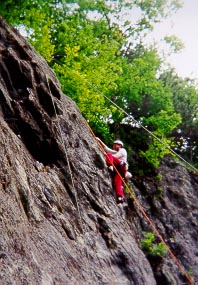
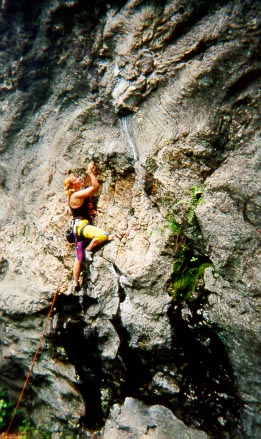
On Saturday Steven and I went to Lost City. I’d never been there before and Steven has only been twice so we spent a little time wandering around looking at everything. Finally we found Lost City Crack (5.10a) which Steven had led on a previous trip and decided to start with that. When we were done we dropped a TR on the face to the right of it which looked hard.

Steven leading Lost City Crack (5.10a)

Steven tried the opening moves a few times and then decided to use the cheater block. We’d already figured out that you could scramble up a nearby block and lean over onto the face at a jug from which point the climbing looked a little easier. He got a long way up the route with some falls and then decided to come down.

I was making some progress climbing the direct start so I was determined to get it. I must have made 20 attempts, each time getting a little higher but ending up back on the ground. Eventually I noticed that I was shredding the skin off the fingertips on my right hand and decided to quit. Later we ran into some guys on Survival of the Fittest (5.13) and asked them about the face. They told us it was 11c if you start from the block, 12a from the ground. Woo hoo! As I said to Steven, “I’m almost there. All I have left to do is the hard move.”

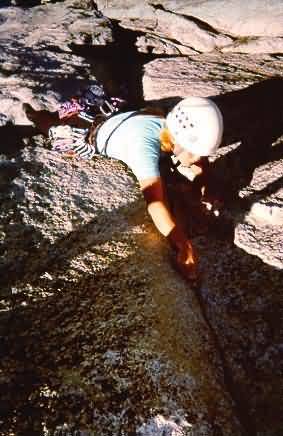
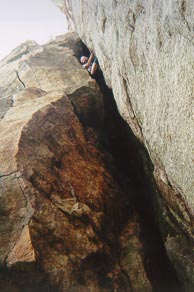
From there we found a pair of cracks that Steven thought were 5.8. There was another crack in a corner nearby that looked more enticing though and I decided to lead that one even though I didn’t know what it was rated. It ended up being easier than 5.8 and a really fun route with lots of great stems and a few good jams. I felt pretty good leading this route, no irrational moments of fear at all. Plus I hardly used any cams. The more scared I am, the more I use cams as an emotional crutch.

Climbers Are the Only Animals that Self-Deprecate, You Know

Day Five

I hang from the rope, kicking my toes against the rock. Half laughing, half furious I yell “I hate climbing!” At the rock, at Karl and Todd above me, at Yosemite in general. I am staring into the maw of yet another off-width crack. I had planned to have a special off-width day during our time with Karl but of course Yosemite is not arranged as conveniently as that. Instead I’ve been fed a steady diet of cracks, ranging in size from fine to hopeless, throughout the trip. Now on day five, our last day with Karl, I despair of ever “getting” it.

A beta shower falls. I can never hang from the rope for long. My competitive nature demands to know now what the outcome of the next battle will be. At Karl’s suggestion I put the other side of my body into the crack. I place my outside foot against the face as Todd recommends. I remember the beta from Sacherer Cracker and move my inside arm down so that I can palm against the rock.

Push, press, wedge, stand up. I am two inches higher. Push, press, wedge, stand up. Again. Push, press, wedge, stand up. Slip. Precious inches lost, paid for in blood. I knew my foot wouldn’t stick to that tiny crystal. Everything here is so damned slippery. Push, press, wedge, stand up, but carefully this time. Another twenty or thirty repetitions and I’ll be through this, I think, but it’s not as bad as all that. I gain the juggy knobs at the top of Bong’s Away Center (5.10a) and stop there.

“Are you going to do it again?” Todd asks me. I nod, resigned. Karl lowers me to the start of the wide section and I begin inching my way up it again. I slip on the same damned nubbin and am caught by a combination of friction and the rope.

“You did it,” Karl congratulates me as I reach the belay, but I just shake my head.

“I think the rope caught me when I slipped,” I tell him.

“Why do climbers do that?” Karl asks. He’s gone back to a question that’s been on his mind recently: Why are climbers so quick to talk themselves down?

“You don’t hear rock stars doing that,” Karl said earlier in the week. “They say ‘What a great gig’ not ‘I blew that one bar.’ But with climbers it’s always ‘It was just TR’ or ‘I had to hang’ or ‘It’s soft for 5.11.'”

For now I only smile at him, but I think I know why. It’s frustration. You want so much to simply say “I did this” but you never can. It’s always there–in your head, in the re-telling, in the log book, in the trip report–the dreaded footnote. “Tainted” they call those ascents. Tainted. What a horrible word.

Todd on Rixon's Pinnacle West Face (5.10c)
Todd on Rixon’s Pinnacle West Face (5.10c)


Today is my day. Todd is doing more watching than climbing. Yesterday I rested while he climbed. Armed with one of Karl’s two-way radios I wandered about Yosemite Village, luxuriating in the feel of sneakers on my feet and a waistline free of webbing.

I passed a young couple. “She’s a climber,” I heard the woman say to the man as they walked by. What gave me away, I wondered. Was it the biner the radio was hanging from? The clothes I was wearing, the tape residue on my hands? Or was it the suspicious way I was eyeing the brown tube they were carrying towards the restrooms?

Me on Rixon's Pinnacle West Face (5.10c)
Me on Rixon’s Pinnacle West Face (5.10c)


Later I had the opposite experience. Seeing Todd and Karl top out on Sons of Yesterday from the Awahne parking lot, I headed back up to the base of Serenity Crack.

“You made it up,” a belayer congratulated me as I finished the scramble to the ledge. I smiled weakly, too worried about making it back down with a pack on to treat the scramble lightly. I sat on the sun-baked rock next to him and made desultory conversation about the heat.

“Do you know anything about the sport of climbing?” he asked finally, no doubt confused about my continued presence there.

“I should have told him I was just waiting for them to finish with the route so I could solo it in my tennis shoes,” I told Todd and Karl later, but at the time I only explained that I was a climber waiting for friends.

It turns out that Karl knows the leader, Dan, who we run into again on Todd’s rest day. Karl and I have just rapped down from Lunatic Fringe (5.10c) when Dan and a different partner show up to do laps on it.

Me climbing and Karl belaying on Lunatic Fringe (5.10c)


“Make sure you tell that guy from yesterday that the woman he thought wasn’t a climber flashed Lunatic Fringe,” Karl says. It’s on the tip of my tongue to add “on TR.” I know what Karl would say if I did: “Why do climbers do that?”

But I think I know why. It’s fear. I’ve seen the flames on rec.climbing when someone gets “caught”. I decided awhile ago that I would never claim an onsight of anything. Even if I travel to a foreign country and am brought blindfolded to solo a route whose name and rating I don’t know, someone will argue that it’s not an onsight because I was led to the base of the route. “Full disclosure,” I think, worrying that Dan will be misled by Karl’s innocent words. “It’s the only way to go.”

Day Three

We’re at the base of El Cap where I’ve led Pine Line (5.7), climbed Moby Dick Center (5.10a) cleanly, and nearly made myself a fixture on Moby Dick, Ahab (5.10b), squealing, squirming, grunting and groaning, but not gaining an inch of height. Now our goal is to get me up a 5.11. I’ve never climbed a 5.11 cleanly. Last night Karl had a brainstorm.

Me leading Pine Line (5.7)


“Short but Thin (5.11b). It’ll be perfect for your small hands. Oh, but the crux is height dependant. Well, we’ll figure it out.”

He sets it up on TR and climbs it first, running through the beta. “You just have to power through this part.” “Here’s a jug.” “Rest here. The crux is next.” He worries through the crux, trying to find a short person’s version. Finally, he has it. “One more thin part here and then easy face climbing to the top.”

I’m nervous. The plan is for me to work the route for as long as it takes to get it clean, but I don’t want to waste the whole day on it. I figure I’ll see if I can do the moves at all, then think about trying to link them. I power through the first moves, end up shifting into a layback, pretty sure Karl didn’t layback here, feeling desperate just as he reminds me of the jug by my right hand. I grab it and I’m safe. Now the crux. With my smaller hands I can get just enough of a finger lock in the disappearing crack to wrestle through the combination layback/back step that Karl has choreographed. I’m through the crux and on to the last hard part. The tension is mounting. I tell myself to slow down, not to rush it, not to think about getting my first 5.11, to just think about the moves. The moves. The anchors. I’m done. My first 5.11.

“You flashed it,” Karl cheers.

“Super-beta flash on TR,” I qualify. “Besides, it must be a pretty soft 5.11.”

“Why do climber’s do that?” Karl says mournfully.

But I think I know why. It’s rationalization. If I can climb a 5.11 then there must be extenuating circumstances, someone must have helped me, it must not be 5.11. Because if I can climb this 5.11 then maybe I can climb other 5.11s, maybe pretty soon I’ll be expecting to climb 5.11, maybe I’ll be disappointed when I can’t. And maybe if I can climb 5.11, then I should be leading 5.9, and if I try to lead 5.9 then maybe I’ll die. So maybe I didn’t climb 5.11 after all.

Starting the first pitch (5.9) of Reed's Pinnacle Direct
Starting the first pitch (5.9) of Reed’s Pinnacle Direct


The wide part at the top of Sacherer Cracker (5.10a) stumps me. You see? I can’t even climb 5.10.

Day Seven

“Just do the move, Dawn,” Todd says impatiently. I move my foot up, not for the first time, and test the hold. It’ll never stick. The rock looks bumpy but feels like glass. I’m tired of this slick Yosemite granite.

“It’ll hurt,” I say.

“You’re on top-rope,” he says. It’s true. The first bolt of Movin’ to Montana (5.8) is over my head.

But even short falls hurt on slabs, I think. I don’t want to fall. I keep looking for the 5.8 move. I know it must be around here somewhere. There isn’t a 5.8 move I can’t do. Well, maybe off-width 5.8, but this is my kind of climbing: slabby face. Todd says I can step on holds that aren’t even there, but I can’t step on this.

“It’s not going to stick,” I tell him.

This is our last day at Yosemite. I don’t want to back off this route, walk away with that taste in my mouth.

“So try the move and take the fall,” he says.

I remember those words. I said them to myself before my long fall on Honky Tonk Woman at the Gunks. “Take the fall,” I told myself. “Then you can come down.” I’ve learned since then: sometimes you don’t want to take the fall. But this isn’t one of those times. Still.

“Dawn,” Todd says in his best Daddy-is-speaking-to-you-now voice, “do the move.”

So I play sullen child to his stern adult. I’m sobbing as I step up, per orders, onto the foot that won’t hold. Even as I’m moving I’m halfway through the words “I don’t know why you want me to get hurt,” the unfair accusation of a child who isn’t getting her way. My weight is on my right foot, my left is hovering an inch above the ledge, yet I’m not falling. I stand up, ever so slowly. Somewhere during the move I stop talking but I’m still crying, shaking, out of control. Blindly, through the tears, I fight to find a place for my left foot. I move the right foot up again.

“You’re over the bolt now,” Todd warns me.

“I know,” I say, my tone blaming him for putting me there. But I am calming now. If the first move is 5.8, the next move is 5.7 and the next is 5.6. With the second bolt clipped all difficulties are behind me and I sail out of sight to the anchor.

I belay Todd automatically, hot and thirsty and uncomfortable in the stance I’ve arranged. The low-angle rock at the top of the route is causing a mountain of rope drag. Todd climbs quickly, yelling “up rope” at one point. It’s hard to feel him through all this drag but he hates it when the rope is too tight.

Todd cruising up the Stoner's Highway (5.10c)
Todd cruising up the Stoner’s Highway (5.10c)


“The move,” I think when he stops. I feel a sharp tug on the rope and feed him slack, then more when he keeps tugging. Suddenly I realize that the pull is strong and steady and I lock him off. Did Todd fall? I hear him yell something that sounds like “slack.” The rope is no longer taut so I give him more. I wonder why he’d bother to downclimb from the hands-free stance below the first bolt. Oh well, he’s back up to the bolt now.

It’s a long time before he pulls through the move and joins me at the belay.

“Did you fall?” I ask him.

“Maybe,” he says, sticking his tongue out at me.

“The move was hard, wasn’t it?” I say.

“I never said it wasn’t,” he replies.

“Say you’re sorry you were mean to me,” I say.

“Say ‘I’m glad you made me do the move’,” he counters.

Ultimately we compromise. I say I’m glad I did the move and he says he’s sorry he was impatient with me.

“I don’t like this place,” Todd says. “Do you want to move somewhere else or do you want to call it a day?”

“Oh, I’m done,” I answer. I’m glad I led the route, glad I pulled through a move I didn’t think I could make, no matter how benign the situation was, glad I didn’t back off. All right. I’ll say it. I’m glad he made me do the move. It’s a perfect end for me. I need no more.

Looking out over the valley from the second belay on Reed's Direct
Looking out over the valley from the second belay on Reed’s Direct


We spend the afternoon splashing in a pool part way down a waterfall. It’s been a year since my first trip to Yosemite and the initial passion of my love affair with climbing has faded. I no longer make the hour round-trip to the gym to fit in fifteen minutes of bouldering between other obligations. Sometimes when it rains on the weekend I’m actually glad to waste the day on the couch watching football. And I can be content to spend an afternoon in Yosemite halfway down a waterfall, dangling my feet in the water and soaking up the sun like any other tourist.

My relationship with climbing has had its bad moments, but it’s a growing thing. I’m working on it, not running from it as I have in the past with other things when they got harder or less novel. I think of it that way sometimes, as a relationship. We have fights, climbing and I, but we always make up. Climbing is there for me, changing but solid. I’d like to grow old with it.

“I guess we’re officially wimps today,” Todd says.

Why do climbers do that? I think I know why. It’s honesty. A relationship needs honesty to survive, needs examination to grow. Improvement doesn’t happen without motivation and the motivation to improve comes from the belief that something even better can be had.

The untainted ascent. It’s reachable. I just have to keep climbing toward it.

Starting the Adventurous Tunnel Through (5.6) on the Reed's Regular Route
Starting the Adventurous Tunnel Through (5.6) on the Reed’s Regular Route
 

Sliding

Todd and I leave for Yosemite at the end of the week so my focus this weekend was on mileage and multi-pitch.

On Saturday, Steven suggested I lead Snooky’s Return (5.8). I’d been on it before but didn’t remember a thing about it. He told me I’d followed it cleanly but had said I wouldn’t like to have led it. I took one look at it and knew why.

“I really need things that are pretty G these days,” I said.

“Snooky’s is totally G,” Steven said. “You can put gear in every two feet.”

Good gear,” I qualified, eyeing the thin seam that occasionally opened into a narrow flaring crack.

“It’s bomber gear,” he insisted.

So I racked up. Well, I didn’t have to get very far off the ground (just to the crux) to realize my instincts had been right. The small nut I had in as my highest piece didn’t inspire me with confidence.

“It’s not even the smallest nut,” Steven argued. It was smaller than any non-brass nut Todd carries, so it was plenty small in my mind, but the size wasn’t really the problem. The problem was that I could see the entire nut, no part of it was hidden by a bump, constriction, or even a small crystal. The nut was held in place solely by friction and its own slight taper.

Having faith in neither the nut nor the move, I chose to come down. Steven suggested Thin Slabs Direct instead.

“This is the same route,” I said after a quick glance. “You can’t fool me.” Sure, it was 5.7 instead of 5.8 and when the crack opened up, it opened up farther, but the moves and the pro were similar – thin slab moves over small, sketchy nuts.

So Steven led it. Trying to make it look smooth, easy and well-protected, he rushed it and succeeded instead in making me giggle when he sketched through a move and then spent a few minutes fiddling with marginal gear. I was glad I’d stuck to my guns and when I sketched through the same moves following it I was even gladder. BTW, the third pitch of this route is a real attention getter at 5.7.

On Sunday I had a fear-hangover from Snooky’s and worried my way through the first pitch of Horseman’s (5.5) despite the availability of great gear everywhere. So when Todd suggested we get on City of Lights (5.7), I immediately panicked.

Now some people will tell you that City of Lights is a sandbag and I happen to be one of them. My history with the route goes like this: I led it early in my career and fell repeatedly at the crux, onto what I don’t remember because I had a sort of blind faith in gear back then, but eventually I pulled the move.

My second attempt at leading the route was more recent, during the height of my lead head crisis. On that day I made an epic out of it: climbing up, climbing down, hanging, taking practice falls, swapping gear in and out, bailing, starting up again, and, finally, pulling the move.

On Sunday I was relieved to discover that Todd meant to lead the route himself. We were after mileage, after all. Todd zipped through it, set a belay above the normal spot to avoid some congestion, and put me on. I stepped confidently up to the move . . . and couldn’t do it!

I was amazed. I had always assumed that I’d cruise the move on top rope, that my problems with it were caused by fear, or the weight of the rack, not by the move itself. Repeatedly I launched myself at the out-of-reach jug and repeatedly I slid back down the rock to my previous stance. I didn’t know whether to laugh or to cry (but I knew I wanted the sympathetic stranger underneath me to stop giving me beta and encouragement). Finally, I forsook all finesse and powered through it in one desperate blast.

Now I think I should try leading the route again. I won’t be afraid of it next time, I think, because now I know that I can’t do the damn move. So maybe I’ll surprise myself and do it.

Try Again

What happened to the weather? It was supposed to be beautiful this weekend but after the rain on Saturday we woke up to fog and drizzle on Sunday. It looked like another bad day until Todd decided he was going to lead Retribution (5.10b), wet rock and all. He spent some time hanging below the crux to dry off the crucial pocket but otherwise cruised it. We all did Retribution and Nosedive (also 5.10b but way harder) and I got them both clean despite the conditions. Then we wandered on down to the Mac wall where Todd decided to lead Try Again (5.10). The man was on a mission.

To everyone’s surprise he fell off the crux (blame the dampish rock). And I had explicitly asked him if he was going to fall off before he started! Luckily there was plenty of rope drag so he didn’t take me off my feet this time. When I followed it I stopped at the famous jump move. From a ledge you have to jump to this jug. Well, I’m probably the most static climber you’ll ever see. Dynoing just isn’t my thing.

“You don’t have to jump,” a climber to my left said. “You can go up left.”

I looked over and saw all the chalk to my left and instantly decided I was going that way. It’s more moves but Dawn doesn’t dyno. The next challenge was the crux, which I’d been on before one day when Todd led Co-existence and I couldn’t pull the roof, so I’d tried pulling the roof on Try Again instead with a similar lack of sucess. On Sunday I managed on the second try, even though the holds were a little bit greasy, so I felt pretty good about that.

Todd starting up to try Fly Again (5.11+)

Once we were all done with Try Again we TR’d Co-existence (5.10+). This was actually my third time on the route. The first time, as I mentioned, I hadn’t been able to pull the roof at all. The second time I got through it after a lot of beta (and a little pulling) from Todd. So on Sunday I had some hope of getting it clean, but that wasn’t to be. Next time though.

I wanted to lead something. My lead head is too fragile these days to go a whole weekend without, so we pulled out the book to find something in my grade in the area. Somehow we ended up with Groovy (5.8+), not in the area and a little steep for me these days but very G rated and I’d followed it cleanly in the past so it seemed like a good choice. I was doing OK at first but got a bit panicked when my legs started doing the Elvis thing and I couldn’t make them stop. Steven suggested that I bail right to a good stance. I’d already thought of that. It seemed a bit like cheating, but once I had an invitation . . .

With steadier legs I got back into the corner and climbed up to the crux – the traverse under the roof. I was in a horrible smooshed position with my entire left arm stuck into the crack under the roof, my helmet jammed into the corner and my legs up by my waist. I knew I couldn’t spend long in this position, but my lead head was screaming for gear. Luckily, Steven had told me on the ground exactly which piece I needed and where it went so I managed to fumble it in almost blindly. From there it’s one move till you can clip the anchor, which I did as soon as was humanly possible. I wasn’t stopping there though – I was moving up to the higher anchor (the Ursula anchor) so we could TR Space Invaders afterward.

I was a little stymied. I couldn’t figure out how to get past the anchor. Then I realized that I needed to use the chocked block the slings were around. Because anchors are normally “off limits” the block itself had become invisible to me. Once I got that figured out I moved pretty quickly to the top anchor and lowered off, feeling really good about the lead. I’d been scared more than a few times but I’d remembered to repeat “I am strong and confident” to myself instead of crying for my belayer to help me.

I think the times I’ve been coerced into hanging on gear since my lead head problem started really have helped. Now when I’m feeling desperate I concentrate on getting in a piece and I think to myself that I’ll hang from it once its in. This helps me to feel like safety is eminent and not all the way up at the anchor. Then once the piece goes in, I usually find that I relax enough to carry on without hanging from it.

As a final bonus, I flashed Space Invaders (5.10+) on TR, the hardest route I’ve climbed cleanly at the Gunks yet. It was a great day, only spoiled by the fact that my Cowboys lost. But I guess you can’t win them all.

Adopt-a-Crag Day

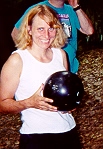
On Saturday I went to the Access Fund’s Adopt a Crag day at Pinnacle in Connecticut. I’d never climbed at Pinnacle before, so I was interested to see it (and to help, of course). We cleaned in the morning and I won the unofficial “strangest thing to find at a crag” award by unearthing a bowling ball. We were supposed to climb in the afternoon but it started pouring as soon as we finished eating lunch. Here’s something I didn’t know before but know now: bowling balls are slippery when wet.

My find at the Access Fund's Adopt a Crag day at Pinnacle in Connecticut

More Clutch Than Cruise

“I’m going to put in another piece and come down,” I say.

“Put in two more pieces,” Todd tells me.

“Why are you coming down?” Steven asks me. “The book says it’s only 5.6 from there.”

“Well, it doesn’t feel like 5.6, my feet are on fire, and I’m thirsty,” I answer, fidgeting in another piece.

“Put in something higher, more in the main crack,” Todd orders.

“Why?” I ask, feeling belligerent.

“Because I can’t tell how good that rock is from down here. It looks kind of blocky.”

All the rock here looks blocky, I think, but I put in a piece higher up. “That’s a great piece,” I say and before I know it, I’m climbing again. I don’t even warn Steven but he’s watching and with great gear in the moves are 5.6 and I’m making them.

Me leading Mister Roger's Neighborhood (5.8)
Me leading Mister Roger’s Neighborhood (5.8)

How did I get here? Six weeks ago I was leading hard 5.8 at the Gunks, ready to start on easy 5.9. Five weeks ago I was leading bolted 10s at Rumney, onsight and clean. Today I’m hanging my way up 5.8 at the Adirondacks, ready to bail off the 5.6 finishing moves, dehydrated and exhausted because I’ve been leading this damned one-pitch route for over an hour.

I guess it started with a fall–a fall that left me eye to eye with my belayer, my feet dangling mere inches from the ledge he was standing on. But it didn’t hit me then. That day I went back up, shaky but sure that I could pull over the roof if I made big, confident moves instead of small, controlled ones. And I did. I felt like I had gained something that day.

The reaction, when it started later that night, was at first purely intellectual.

“You don’t know what the hell you’re doing,” I chided myself. “What if you’d made one more move before coming off? You had no idea you were nearly in ground-fall range.” I took the rest of the weekend off from leading, telling myself I had some thinking to do. The next weekend was spent sport climbing and, although I had moments of fear making hard moves between the closely spaced bolts, I made the moves anyway.

The following weekend, not sure what I had resolved except that I was going to stay off R-rated routes for a while, I found myself at the bottom of Pink Laurel, one of the safest 5.9s at the Gunks and a route I had followed cleanly in the past. Now it was a different story. Perhaps it was the weight of the rack, or summer’s humidity greasing the holds. Perhaps it was fear. Whatever it was, I came off at the start of the crux, taking a short, harmless fall onto a good piece that held. I was angry. Mark that: angry. Not scared, not hurt. Angry. I’d wanted to lead the route cleanly.

Once I finished kicking the wall in frustration, I went back up, pulled through the tricky first move to a poor stance from which gear can be placed. I placed a nut, moved up once, clipped a fixed piece, moved up again, and that’s when it hit: pure panic. I needed gear and I needed it now. I hung from a hideous hold, trying to fumble an Alien into a horizontal I could reach but not see. When the third piece I tried stuck I clipped the rope through it and considered saying “take”, something I’d never done on lead before. I pulled on the sling to test the piece. It came straight out. Doubly panicked, I downclimbed to the fixed nut and hung.

I lowered off, shaking and hyperventilating. Todd calmed me down. I’d done everything right, he told me. I placed plenty of gear; I tested a piece I wasn’t sure of; I downclimbed when I was in trouble. I was almost through the crux; I just needed to put my hand in the horizontal where I’d been trying to place the Alien and stand up to a jug. I hung from such a bad hold for so long I could have easily pulled through the move. I downclimbed the hardest moves on the route.

Thus propped up, I went back to try again. Which is when I really fell apart. I couldn’t even convince my body to return to my high point, never mind climb past it to a hard move with gear at my feet. And that’s how, several weeks later, I found myself at the Adirondacks, in the middle of what had since become a familiar nightmare: just below the crux, gear in everywhere, paralyzed by the thought of falling on it.

We start the day, my first ever in the Adirondacks, with Steven leading On the Loose (5.9+) at Spider’s Web. As my lead-head stock has been falling, Steven’s has been rising and he leads this steep, pumpy hand crack with assurance. Following him, I reach his last piece overheated and exhausted. I jam myself into an awkward stance and eye the gear with frustration. I have to clean it, or at least unclip my rope and clip the rope I’m trailing for Todd.

Steven leading On the Loose (5.9+)

“I think this is the crux,” Steven tells me and I let go in resignation. Hanging from the rope, I look at my tattered tape gloves and wish once again that I’d just suck it up and buy Spider Mitts, whether it makes me a wuss or not. Back on, I take a much less strenuous stemming approach to the final moves. Why is it that I can never find the labor saving variations when I need them most? Being pumped seems to trigger a counter-productive “just pull through it” response. After reaching the belay, I drink half the water I’d theoretically brought up for Steven and have to rest for five minutes before I have the energy to pull up the rope to belay Todd.

From there we set up White Knight (5.11) on TR. I watch Todd curse and hang his way up it, knowing that bodes badly for me but still hopeful. Later I’m surprised (but shouldn’t be) when I can’t even make the first few moves off the ground. Todd is pumped from the route and I’m pumped from just trying to start it. Steven’s still feeling strong, but it’s my turn to lead something. We move our packs over to Mr. Roger’s Neighborhood, a 5.8 with a small roof for a crux and excellent protection.

I stand on top of the starter block and finger the first holds. I tell myself the usual story: You don’t have to do this. You can rack up, put in a piece, try a move, and see how it feels. If you don’t like it, you can come back down. Or put in more gear and hang. This is perfectly safe and you can quit any time.

Todd wanders over and throws in a cam to protect the step across from the block to the start of the route.

“I don’t have any trouble putting in gear,” I remind him. Since I’ve started getting hysterical when I lead he’s gotten more protective.

“I know,” he says.

I lean across the void and stand on tippy-toes to remove the cam, then extend even farther to put it back exactly where it was.

“There,” I say. “Now I’ve placed my own gear.”

I rack up before he can lead the whole route for me. Steven belays. I’ve barely climbed with Steven since my last big fall. He’s heard about my new lead head but he’s about to see it in action for the first time.

I manage the step across and climb up to the roof where I stuff in a #4 Camalot. It sucks but there’s something reassuring about a really big cam even in the worst of placements. It says “I can hold you without even trying.” Then I add a nut above it. The nut says “I’m a good nut.” Despite this I make only a few half-hearted attempts at the first move over the roof before climbing back down to the stance and announcing that I don’t want to lead the route after all.

“Hang first,” Todd says. His strategy is to have me hang to prove to myself that the piece will hold. It works. I pull the first move, reach a jug for my left hand, and quickly stuff in another cam. I put my right hand on the next hold, move my feet up, and stop. I can’t convince myself that my right hand will hold, that my feet will stay on, if I let go of the jug with my left hand. In a panic, I scurry back down and hang. Over and over I try the move. Again and again I refuse to let go with my left hand.

“You’re on toprope,” they tell me.

“I won’t be once I finish the move,” I protest.

“The piece will be at your waist.”

I’m unconvinced.

“Just take a short fall on it.”

I try but I can’t. I tell myself, “this time I’ll pull through and just take the fall,” but it doesn’t happen. The best I can manage is a controlled swing onto the gear as I’m downclimbing.

“So put in a piece higher up.”

It sounds stupid. I’ve got good gear at my waist. What can another piece do for me? But it works. I stand up, place a piece, clip it, and pull through the move almost in the same motion.

By the time I finish the 80 foot pitch I’ve placed 16 pieces and Steven and Todd are taking bets as to whether I’ll run out of runners before I hit the anchor. But I’ve placed every piece myself and done every move under my own power and I’m glad I led the route.

“You did it!” some people we met earlier in the day congratulate me. “How’d you like it?”

“I’m sure you heard the whining,” I say, embarrassed now that I’m safely on the ground.

“Oh, I was whining on my lead too,” Karen says (5.11, that is).

“She’s been having lead head problems since she took a few big falls,” Todd tells them, defending me from an accusation that hasn’t been made. But I know what he means. Every time I’m whimpering on lead now I wish that I could explain to the imaginary audience below: how I used to be a bold leader; how I used to fly up my leads; how gleefully I’d snicker when my partner recommended placing two pieces below the crux. How much it has cost me. But I know the condemnation is never really there, only empathy and understanding. Still, I think about wearing a sign on my back: “Objects on lead are tougher than they appear.”

“It was good for her,” I overhear Todd tell Steven as I drift off to sleep that night. “She did something hard, she hung on gear, and she didn’t die.” But I know that theory; I’ve heard it before. Each time, since my fears started, that I’ve made it to the top of something, whether cleanly or not, I’ve thought of it as a victory–the beginning of the end of this dark and shameful chapter in my climbing biography. And then the fear hits me again.

The next day we stand at the bottom of Pegasus (5.7+) on the lower Beer Wall and begin the same old story from page one. I finger the starter holds, convinced that I cannot even safely do the move that will get me off the ground. I place two pieces in six feet. I stop below the crux and I want to come down. And I hear, “hang from the piece”, “put in a piece higher up”. And I know that it will work, that with time and patience and suffering and whining, I can lead this route. And it’s just too much.

“I’m coming down,” I tell them. I clean the gear, downclimb the moves I wasn’t sure I could climb up. I walk away from Pegasus. Todd leads a 9 and we toprope a 10+. I have no trouble on these routes with their thin, delicate moves and without any fear to overcome. Steven leads Clutch and Cruise (5.8) and Todd follows. Steven suggests that we pull the rope so I can lead through his gear, but I’m not interested.

Todd leading Lichenbrau Dark (5.9)

“There’s nothing wrong with my gear,” I say for the umpteenth time. Mentally, I know my gear will hold even though emotionally I know it would be easier to fall on Steven’s gear. Then, whether it’s because the overhanging crack is too wide for my hands or because I’ve got the thought of leading it in my head, I can’t pull through the overhang and come off. Repeated attempts to get back on prove to be more draining than productive and eventually I sulkily ask to be lowered.

While a crowd gathers to watch Todd hang out at a rest stance between the second and third bolt of a 5.12, I disappear off on my own to have a good cry. There are moments like this when I consider quitting, when I wonder if the bad days outnumber the good, if climbing will ever be purely fun again or if it will always, from now on, be tinged with this wretched mixture of fear and self-reproach. I consider whether walking away from Pegasus might be just what I needed. Despite the “you can quit at any time” pep talk I’d been giving myself before each lead I’d yet to actually back off one. Maybe now, I think . . .

Todd leading Pats' Blue Ribbon (5.12)
Todd leading Pats’ Blue Ribbon (5.12)

But no. I used to believe I’d find the magic bullet, that one day my lead head would snap back in as suddenly as it snapped out that day on Pink Laurel. And when that happy day came I’d start leading 5.9, a smarter, safer leader but once again a bold and confident one. Now I begin to understand that it’s going to be a long process. I run through all the advice I’ve gotten: practice downclimbing, try aiding to learn to trust your gear, put in a lot of mileage at an easy grade, practice falling. And another one: give it time. It comes back, but it comes back slowly. Perhaps that’s the only answer.

I rejoin the gang, applaud Todd’s success in clipping the third bolt on Pats’ Blue Ribbon, take another stab at Clutch and Cruise, throw a little determination at it, and get it. It’s not a magic bullet, but it leaves me with a smile.

Me on Lichenbrau Dark (5.9)

Twelve’s a Crowd

It starts with me and Lisa and Brenda, a sort of girl’s only climbing trip. I’ve never been to Rumney before. But then neither have Todd and Steven so I invite them along. We run into Julie at the Gunks one day and it turns out she needs a partner for that weekend. She lives in Boston, so it’s closer for her anyway. Naturally Brenda wants to bring her boyfriend Jeff along, a welcome addition since he climbs harder than any of us. Then one of Todd’s regular partners, Edison, gets added and the guys Lisa and I climb with at the gym: Mike, Dan and Barry. Dave Anderson mentions wanting to meet me and Steven on rec.climbing and Rumney’s a lot closer for him than the Gunks.

Ultimately there are twelve of us. I create a “Rumney Trip” email list, count guidebooks, try to match up people to share tents and rides. Lisa reserves three campsites. I begin to worry that we’ll descend on Rumney like a hoard of locusts, that we’ll never manage to get twelve people moving in the morning, that the Gunks crowd won’t mix with the gym crowd, that people who don’t read either rec.climbing or gunks.com will feel left out of the conversation. I forget to worry that no one will show up.

This time it starts with Steven. He decides that he needs to spend some of the short time he has between Seneca and Yosemite closer to home. Even the prospect of meeting Dave Anderson can’t tempt him into joining us. Then Edison cancels, then Dan. Julie says she’ll show up Saturday night. Dave, Brenda and Jeff all have plans to stay elsewhere. Barry has just plain disappeared.

“The hell with it,” I tell Todd. “I’m done playing cruise director. You and I and Mike and Lisa will have a good time anyway.” But secretly I’m haunted by the vision of two tents stretched across a hundred dollars worth of campsites. It turns out not to be quite that bad. When Todd and I get to the campground we find that Barry is with Mike and Lisa and that they each have their own tent. Once Julie has joined us Saturday night there are five tents in our three site suite, a respectable number. But I’m getting ahead of myself.

Saturday morning we start at the 5.8 crag. In keeping with the spirit of the name, I lead a 5.8, Snake Skin Slab. I stand at the bottom of the route feeling the rock. It’s very positive, sharp even. It feels like just about anything could be a hold if you wanted it to be badly enough. Nevertheless, I start up shakily. New rock is always strange. The first clip is too high for my taste and I have to step up to reach it – I’m too short to clip it from the good stance. I move slowly, testing each hold as if my life depends on it, even though the route is responsibly bolted. I’m only just starting to feel comfortable when I reach the anchors and then I’m safely clipped in and lowering off before I know it.

Todd leads it next, then Barry. Barry and I started climbing at almost exactly the same time but he’s been outside very little. This is one of his first leads outside but he looks much less sketched on it than I did. I think to myself that this has something to do with taking a few bad falls. I can remember when I went sailing up routes on lead without a second thought too and wonder if I’m getting more cautious or just more timid.

Lisa asks Todd to put a rope up on Arm and Hammer (5.11a) so we wander around the corner to check it out. One bolt looks very much like another so we ask a pair of guys on the corner to point out the route. They’re eager to do so and ask Todd if he wants beta. He says no but then spends quite a bit of time fingering the first holds and looking at the first bolt. It’s a man thing. I know he’ll never ask the guys if he can borrow their stick clip so I walk back down the hill and do it for him.

“That’s why I haven’t put it away yet,” one of them says as he hands me the stick. They follow me back up the hill, feed Todd some beta after all, and watch him pull through the first moves. He doesn’t like the next hold so he reverses the moves till he’s back on the ground.

“You just downclimbed the crux,” I tell him, shaking my head. I thought he was just doing the route to put the rope up for Lisa but now I know that flashing it matters to him. He gets some more beta from the guys and starts back up, making it to the rest at the second bolt this time. There are spots above that where he whines a little but he gets his flash and lowers off.

“It’s really hard,” he tells me seriously and I know that means he’s not sure I can do it.

“It’s OK,” I tell him. “I won’t mind if I can’t do it.”

I put my hands on the first holds. It seems like they ought to be good enough – until I try to pick my feet up, that is. There’s a small ledge where I need to put one of my feet in order to make the long move to the next hold but I can’t quite get a foot up there from the ground; I have to make an intermediate move. Todd just did a sort of smeary/hoppy thing but I don’t have the strength to hold the outward pull that generates.

In the meantime, Jeff and Brenda have shown up and Jeff has put a rope up on a 10d on the corner. Our group is taking turns on it as I repeatedly step up on and fall off of the same move. Barry asks me if the route is hard. He can’t wait to try his first outdoor 5.11.

“Yes, it’s hard,” I tell him.

With any other partner I’d have politely given up already but Todd appreciates stubbornness and I have plenty of it.

“How’s it going over there?” Barry asks umpteen tries later.

“Still in the same place, Barry,” I tell him testily. There are many facets to climbing outside. There’s how hard you can climb, certainly, but there’s also how hard you lead, how good your gear is, how efficiently you set an anchor, how well you keep it together high above your last piece, how much endurance you have, your route finding abilities. Mix in the variations of sport, trad, ice and alpine and who’s a better climber than whom is not so easy to determine. In the gym there’s only how hard you climb and I know the relative place that each of us from my gym crowd holds in this hierarchy. Barry and I are dead even. It aggravates me to think that he might come over and walk up this route when I can’t even get off the ground.

Finally Todd finds me a foot that works and I pull the first move. The route is hard all the way up. There are a couple of moves that Todd did dynamically but I have absolutely no dynamic technique so I have to find a way to make them statically. I fall a few more times but in the end I’ve done all the moves and I’m reasonably pleased. Lisa climbs the route next. She’s four inches shorter than I am and watching her climb reminds me that I should shut up about reach problems. She hits every hold statically and is a pleasure to watch. Then Barry climbs the route. Not to gloat, but he doesn’t do any better on it than I did.

By now there’s someone waiting for Arm and Hammer and our rope has been pulled on the 10d for the same reason. The crag, which was already hideously crowded when we got there, is growing more crowded by the minute. We’re just packing up to move to Waimea when I hear Todd say “Dave Anderson.” Sure enough, there’s Dave with three friends. Introductions are made and Dave and his friends decide to head to Waimea with us.

Dave on Waimea (5.10d/5.11c)


Jeff starts up Waimea (5.10d/5.11a) immediately. The rest of us sit around and eat and gawk at China Beach (5.14) and other routes that look even less plausible. Jeff reaches the first set of anchors and continues up to the second set, over a roof dripping with water. He asks if anyone wants to do the higher portion of the route and I insist that Todd does at least, so he leaves it set up. Everyone wants to try the route but no one wants to go first. Finally Dave volunteers. He falls once at the crux and then cruises steadily to the first anchor. He’s ready to come down but we all urge him to try the upper portion and he does it without much trouble.

There are twelve of us now. It’ll be a while before we all get a turn so Dave and his friends and I go over to Triple Corners. There’s a large group there too and they have a rope or draws up on everything under 5.11. Although it’s somewhat annoying to find all the routes occupied, the group leader is reasonably cooperative, agreeing to our top-roping on their ropes or leading through their draws.

I tie into Technical Second (5.10b) with Dave belaying me. I enjoy the route and find the crux to be at the roof where you make a blind move around the corner. But that’s not where I fall. I fall on the last move before the anchors, surprising myself and making my customary “eek” noise.

“Are you OK?” Dave asks me.

“Of course,” I tell him. It was just a top-rope fall, after all. I study the move and have no trouble with it the second time. It’s just a matter of putting my foot in the right place. One of Dave’s friends goes up next and falls on the same move. He too has no problem with it on a second try.

As Dave ties in, I go back to Waimea to belay Todd. He climbs the route cleanly all the way to the second anchor and I tell him he should have led it. Next it’s my turn. I know where the crux is from watching people fall off it. And I know that it’s a balance problem from hearing them talk about it. Below the crux the route is pumpy. Although it doesn’t appear to be very steep at first glance, it overhangs just enough to keep your weight on your arms the whole way on holds that are only barely good enough. I’m tired when I get to the crux and the switch from arm-intensive power moves to delicate, footwork-intensive moves is almost a relief. I make it to the first anchor cleanly but don’t manage to pull the roof below the second anchor. A little beta and a second try gets me over it.

There are still more of us to climb Waimea. I head back over to Triple Corners and lead Trigger Happy (5.9). I enjoy the lead immensely. It’s challenging the whole way but never really scary, especially since it’s generously bolted. The roof looks intimidating but is surprisingly easy to pull. One of Dave’s friends cleans and another one belays him as I watch a pair of women on Technical Second. I know they’ve just finished the 11 next to it and should be fine on this route but I whisper to the belayer that the hardest move is just below the anchor, thinking she might as well have the warning.

Sure enough, the leader comes off there. It’s about as long a fall as you can take on a Rumney route. She’s startled but fine. She goes back up and pulls the move by grabbing the anchor itself. When she lowers off she apologizes to everyone watching. Then she thanks her belayer for catching her. Hmmm. I think I’m a little short on post-fall etiquette. It’s never occurred to me to apologize to the onlookers. They got a free show after all. I really should thank my belayer but I’m usually busy crying instead. I’ll do better next time but for now I’m just glad it wasn’t me.

The group that was monopolizing the crag is packing up to leave but no one in my group seems to have the energy left to climb. All the talk is about swimming and food so we pack up too. On the way out we take a gander at The Fly (unrated), recently touted in Climbing Magazine as “the hardest short route in America.” Todd and Dave take turns trying to hang from the first holds while I snap pictures of their attempts. Then Todd lifts me up past the first holds and we get an excellent picture of me “dynoing” for the third hold.

'Dynoing' for the third hold on The Fly (unrated)
‘Dynoing’ for the third hold on The Fly (unrated)


“Does Julie know our campsite number?” Todd asks me later that night.

“No.”

“How is she supposed to find us?”

“She has Mike’s license plate number,” I tell him, suddenly realizing the unlikelihood of her spotting a license plate in the dark amongst the many nooks, crannies, and spurs of the campground. But we have no way to contact her so we go to sleep.

“Dawn?” the darkness outside our tent says some amount of time later. Strange, that the darkness should be talking directly to me. It takes me a minute to orient.

“Julie?” Sure enough, Julie has found us. She adds her tent to our sparse grouping and we go back to sleep.

On Sunday the six of us start at the Parking Lot Wall. While the others lead up more sensible 5.6s and 5.7s, Todd is insistent that I start on a 5.10a, Egg McMeadows. Well, the first clip is a breeze so I don’t mind. For the most part it goes smoothly. Until I get to a hard move to a bad hold just below the next bolt. I move up, feel the hold, and move back down. I take a draw and try to clip it without letting go of the good hold below but I can’t quite reach the bolt. I step back down. I move up again, grab the bad hold, hang the draw. More scared than I’ve ever been while clipping, I pull the rope up and manage on the third try to get it through the draw. Breathing a sigh of relief I make the next move and find the clipping hold, absolutely bomber.

Barry on Egg McMeadows (5.10a)


Having “warmed up” on a 10a, I tinker around with the 5.6 and 5.7 while the others take turns on Egg McMeadows. No one except me seems to have any motivation today. Most of them are complaining of either injury, exhaustion, or illness. As a group we move listlessly to the Meadows. Mike starts on Lies and Propaganda, 5.8+. Todd finds a new route, noted on the route addendums I found online as Cold Turkey, 5.10c and figures I should lead it. It’s wet in spots but just at the bottom.

Me on Cold Turkey (5.10c)


I do the first couple of moves through the mud to a good stance from which the first bolt can be clipped. The next move is hard, up to a wet but bomber hold. Hard-but-not-desperate move follows hard-but-not-desperate move. The bolts are reassuringly close together. Then I’m pulling over the top to a good stance on the slabby portion above. Whereas the bolts on the steep part were only four to six feet apart, the bolts on the slab are a looooong ways apart. The climbing is easy but I can’t stop thinking about my fall on The White Way. I place each foot carefully, glad I’m dealing with sharp, solid edges instead of sandy dips. I reach the anchors safely and lower off, surprised when Todd chooses to TR it instead of leading it. His arm hurts, he says.

Julie on Cold Turkey (5.10c)


Todd and I switch places with the others and I lead Lies and Propaganda, surprisingly hard and easily the most sandbagged route we climbed all weekend. By now Mike, Lisa and Barry are ready to head home. Todd, Julie and I move farther down the crag. I lead a 5.8 called Easy Terms and then we TR No Money Down (5.10b) which Todd does cleanly but which I can’t manage to pull. It’s the first fall I’ve taken all day. We finish with a dip in the river and then start the drive back.

Barry on Lies and Propaganda (5.8+)
Todd leading Lies and Propaganda (5.8+)


Dave emails me that night that he took a short lead fall on a 5.10c on Sunday and I tell him that he can blame me. Since I didn’t take a lead fall the entire weekend the universe was out of balance and something had to give.

I enjoyed the weekend of bolt clipping and top roping. It’s nice to take a break from the stress of trad leading now and then. It’s also nice to lead routes that are so close to my climbing limit without putting myself in danger. And it was great to meet and climb with Dave, who’s every bit as fun as he seems on rec.climbing. But, please, remind me never to try to organize another group climbing trip again.

Wider Ain’t Better – A Utah Sampler

I really, really want to go to Indian Creek,” Geoff emails me, inspired by the trip a group of rec.climbers has just returned from.

“I really, really want to go too,” I answer. We agree on Labor Day and start casting about for a rope gun. Todd says he really, really wants to go too but Labor Day is out so we switch to Memorial Day, only weeks away. Now all we need is a boat load of cams.

Todd and Geoff have nicely filled-out racks, each with doubles of many sizes and more than doubles in some. I have nothing, so I bite the bullet and make my first cam purchase – a full set of Camalots. Expensive, but it doesn’t amount to much in sheer numbers. Well, “borrow from friends” is the rule for Indian Creek, so I set to it in earnest.

“Where’s your next trip?” my unsuspecting victim would ask.

“Indian Creek,” I’d answer, hoping to hear “Don’t you need a lot of cams for that?” in response. Unfortunately, few of the climbers around Connecticut had heard of Indian Creek. “So,” I’d weasel, “Indian Creek is known for long, perfectly parallel cracks that are the same size all the way up.”

“Cool,” they’d say. Clearly, I was going to have to be more direct.

“So, the thing is,” I’d say, wading in deeper, “you need a lot of cams all the same size.” Pause while it sinks in. “Sometimes people borrow them from friends,” I’d add, getting closer to the point. It turns out I have nice friends.

“You want to borrow my rack?” they’d ask, finally getting the gist of my roundabout request.

“I’d love to,” I’d accept. Thanks to Lisa, Dan, Mike and Gary, I manage to accumulate an impressive 50 cams.
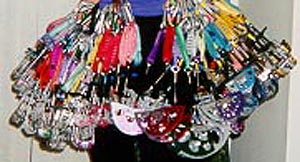
The Rack of Ages
The Rack of Ages


The Saturday before we leave it rains. Todd and I had planned on working on getting my lead head (somewhat damaged by the fall on Honky Tonk Woman the week before) back into shape. Instead we climb at a gym in New Jersey.

The Sunday before we leave it rains. Todd and I had planned on meeting Thor to explore the cracks at Lost City. Instead we find ourselves loitering around The Bakery, contemplating the drive back to Connecticut to climb at the gym there. We run into Kent, someone Steven has introduced me to a couple of times.

“Any trips planned for the summer?” he asks.

“We leave for Indian Creek on Wednesday,” we answer.

“Cool,” he says. “I just got back from a week there. Need to borrow any cams?” We’re flabbergasted but not so much so that we don’t accept. He takes us to his car and hands us his set of Camalots.

“Wait,” I say as he walks away, “Give me a phone number or something so I can get these back to you.” An absolutely astonishingly generous act – he gave his entire rack of cams to two people whose last names he doesn’t even know – no questions asked; no bond required.

We take a tally that night at my house. Between Todd and I and the various donors we’ve amassed 87 cams (and that was before we added Geoff’s and Tom’s – the total would eventually top 100).

Maple Canyon

Todd and I fly into Salt Lake City on Wednesday. Thanks to a hideously early departure time we’re in our rental car and on the road by 11:00 am local time – our destination, Maple Canyon. Maple Canyon is a strange and interesting place. The rock is composite. It looks like someone took a cobble-stone road and rotated it to vertical – rocks cemented together with mud. We head over to an area with a 5.8 and a 5.7, find them occupied, and start up Monkey Duodenum, a neighboring 5.9. The bolts here are reassuringly close together but the climbing is steep and unrelenting. You waste a lot of time figuring out which of those lumps above you are useful and which are just big slopers (although I didn’t have to waste as much time as Todd since he went first and kindly left copious amounts of chalk all over the best holds).

Me leading Primate Grooming Procedures (5.7) at Maple Canyon


Next we do a pair of 5.10c’s (Kissing an Angel and The Angel’s Share), one of which I lead (pink-point) cleanly, the hardest sport route I’ve ever done. There are frighteningly loud cracks of thunder as I lead the second one but by the time Todd has finished it the thunder has died down and the sky appears to be clearing so we move back to the 5.7 (Primate Grooming Procedures) which features a nice, pumpy roof. Todd leads it first and I pink-point it. As I’m cleaning the draws on the way down the thunder starts again, even more menacingly. We pack quickly and end up making the last running strides to the car just as the rain starts falling. The storm is sudden and fierce; the windshield wipers have slush accumulating on them and trees are down already as we navigate the one-lane dirt road out of Maple Canyon. Turning onto the paved road at last we feel safe, but only briefly.

There is, oddly, a roof blocking the road, just a frame and sheeting type roof, the sort that top the turkey houses everywhere, but a strange sight nonetheless. A pickup truck is stopped already and two guys are looking at the situation. Todd puts on rain gear and goes to help them. Before I can finish zipping up my rain shell he’s back – running. The truck drives up and around the downed roof. Todd goes to follow it and the guy behind us (who made no attempt to get out of his car and help) actually cuts him off. Cuts him off and then stops dead when he sees what he has to do. Todd is extremely nervous, shouting at the driver, who can’t hear him anyway, to move. When our turn finally comes and Todd drives around the roof and through a growing stream, he points out the problem to me. There’s an open gas line. Safely away, we find a spot where Todd’s cell phone gets reception and call 911. Later we learn that a tornado came through the area.

Wall Street

Thursday we wake up in Moab and head for Wall Street where Tom and Geoff will meet us. Todd leads Flakes of Wrath (5.9), a crack to some strange roof moves. The jams are butter-smooth and I’m amazed at how soft the rock is. “This isn’t going to hurt at all,” I think as I flail my way up the crack, “except that I don’t have any technique,” I add as I hang to clean gear, unable to hold myself in with just one hand. The strange roof moves make me pause long enough to fall off, even though I know they’re just like Inverted Layback at the Gunks. Well, I didn’t like the inverted layback move when I did it then either – the key is getting the second foot up, but it’s a leap of faith.
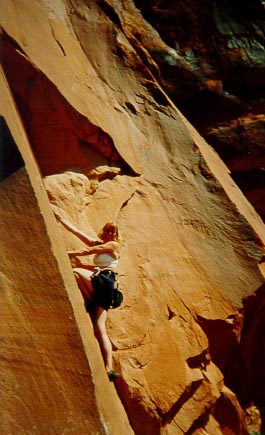
Me on Flakes of Wrath (5.9) at Wall Street


We TR Flakes of Wrath Direct from the same anchor. Todd moves through the crack section easily and eventually figures out a way to handle the crux bulge. I, however, find the slightly overhanging, leaning crack overwhelming on the first try and only barely doable on the second try (the fact that I have to be lowered to the ground after a fall gives me the motivation to pull through it the second time). The upper moves are way over my head and I come down feeling demoralized until a glance at the guidebook reveals that Flakes of Wrath Direct is 11a/b and is therefore supposed to be over my head.

Geoff shows up just as Todd is contemplating leading Bad Moki Roof (5.9) nearby. He does and Geoff and I both do it on toprope. By this time the sun is well overhead and we’re roasting. We decide to take a siesta, so we put on our bathing suits and wallow in the cold Colorado River then lounge in the shade along the bank and drink beer from Geoff’s cooler.
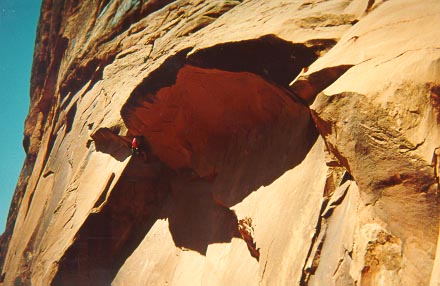
Todd pulling the Bad Moki Roof (5.9) at Wall Street


Siesta over, we start with Seibernetics (5.8). I had planned to lead it but since Geoff hasn’t gotten a chance to climb much yet I offer the lead to him. He starts up but, after scoping out the thin friction moves above the first pin, gets sketched at the idea of me belaying him without an anchor and comes back down. We switch places. With the first pin already clipped I don’t have to face any ground fall fears so I move quickly through the face moves and up to what had looked like a crack. In fact, it turns out to be more of a groove, a groove that accepts neither protection nor jams. I climb the route using a sort of chimney maneuver – butt-scooching and stemming between sections where the groove becomes an actual crack. As I near the top a sudden sharp wind rises. The air is wild and heavy. I feel electrically alive as I make a quick dash for the anchors. Geoff climbs and cleans the route just as quickly, fearful that another downpour is about to start, but by the time he lowers off the whole thing has blown over.
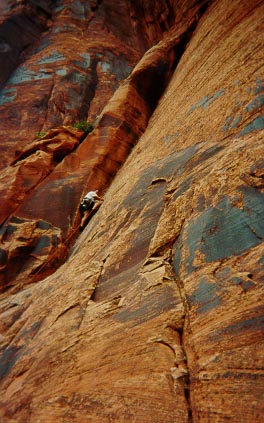
Geoff on Seibernetics (5.8) at Wall Street


Todd climbs the route and we look at setting up Scratch and Sniff (5.11) which requires a long traverse from the Seibernetics anchors. We’d watched the guy on Seibernetics before us execute this maneuver. He spent a long time just below the Scratch and Sniff anchor, obviously scared to make the last move, and finally made a lunging grab for the chains. But that guy didn’t appear to be as strong a climber as Todd, so I don’t expect Todd to have any trouble. I’m wrong. He spends a long time just below the anchor too. There’s no easy way down from his position and a fall means a long pendulum back into the corner. He’s just decided to jump and hope to control the impact when he suddenly makes a quick move up instead and is safely at the anchor. We all breathe a sigh of relief.

Scratch and Sniff is true friction climbing, following a zig-zag line across the rock with little to no hands and the tiniest of feet. Both Todd and Geoff take their turns on the delicate moves, testing first the rock straight up and then the rock to the right and then back to the left again. As Geoff climbs a man comes by and asks if he can take pictures. Sure, we shrug. He snaps a few of Geoff and then, when my turn comes, asks if I’ll put my helmet on. I don’t usually wear my helmet on toprope but I put it on to oblige him and start climbing. It turns out that he’s taking pictures for a German travel guide to Utah. (Why he wanted the helmet, I have no idea.) It also turns out that I’m still wearing my bathing suit, with just a t-shirt thrown on top of it. I’ll bet those are some interesting pictures.

By changing my position on the rock each time I fall (let’s try this section of rock, no this one, or maybe this one), I eventually end up at the top of the route, just below the anchors. My heart nearly stops when I see the move Todd had to make to get to the anchors: thin, almost to the point of non-existent, it was a hell of a move to make 25 feet out from the corner you’re going to smash into. Tom drives up as I’m lowering off and we make plans to rendezvous again at the campground in Indian Creek.

Thanks to beta from Kent, we know about a great, hidden campsite. Private, shady, and sheltered from the wind, it is, as promised, a most excellent campsite, even if there aren’t any amenities like picnic tables and outhouses. Geoff makes us a great dinner and we settle in for the night. Tomorrow is the big day.

Indian Creek

Friday morning we head straight for Supercrack Buttress, figuring the crowds will show up the next day. Geoff leads a tricky 5.9 which we all use for a warm-up and then Tom leads Supercrack (5.10). Once he gets through the difficult move to the top of the ledge where the crack actually starts, he shows good form, stopping twice to hang but appearing calm and in control the whole way up. That is until he lowers off and immediately throws up. “Welcome to Indian Creek,” I think, “this place is going to kill me.” I had already been nearly done in by the unnamed 5.9. I’d put on tape gloves before climbing it (Indian Creek rock isn’t nearly as soft as Wall Street rock) but they’d shredded almost immediately thanks to my bad technique (whether it’s bad jamming technique or bad taping technique I leave for you to decide). Now I set off to try Supercrack untaped.
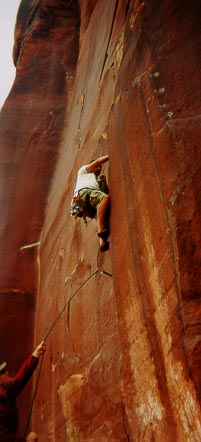
Geoff leading an unnamed 5.9 at Indian Creek


The moves to claim the initial ledge are indeed tricky, the hardest moves on the route in fact since the rest is just jam, jam, jam. I struggle my way through them to get my first up-close look at the monster that is Supercrack. If you ever try this route, here’s a piece of advice: don’t look up. The route isn’t bad at first, then comes the lip. I flail my way over the lip, slipping and sliding, but pulling it. Then the crack gets wider. It’s fists or forearms most of the way for me, a struggle with every move. I set my sights on the anchor, just visible way above me. Each time I stop to rest I look for it. (Did I mention that you shouldn’t look up?) At first it doesn’t seem to get any closer, then finally it’s a manageable distance away, and then I’m there.

Ooops. It isn’t the anchor. It’s the first of two pieces of gear that have been left in as backups to the anchor. There’s another 15 feet or so of crack above me and gear in my way besides. I move my high jam over the first piece, contemplate moving up on it, and just let go.

“You can let me down,” I tell Tom.

“Are you sure?” he asks. “You’re almost there.”

I take another look at those last 15 feet of crack, so identical to the seemingly hundreds of feet of crack I’ve just fought my way up. I think about being able to say that I made it to the top of Supercrack and I look at my arms. Blood is oozing from multiple points on my hands, wrists, elbows and forearms.

“I’m sure,” I say. He lets me down.
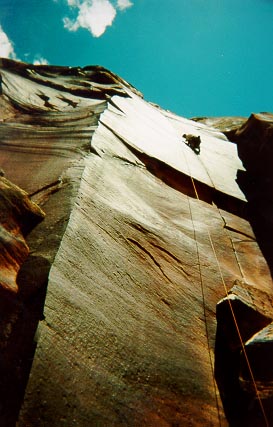
Geoff on Supercrack of the Desert (5.10) at Indian Creek


In the meantime, Geoff has been aiding Fingers in a Light Socket (5.11+). Todd really wants to try this route but none of us were about to lead it. Hey! Geoff had brought his aid gear. He could lead it. After we’ve all had our turn on Supercrack we try Fingers in a Light Socket. Tom goes first, looking strong and balanced as he executes a sort of froggy-style layback the whole way up and falling only from the last, tricky move. I go next. I try Tom’s frog strategy but find that it requires much more strength than it had appeared when he was doing it, so I switch to a straight layback and make quick progress through the first two rests before slipping off. The last move is too much for me until I use my best trick of putting all my hands and feet in the right places while hanging from the rope. How one is supposed to get into that position without hanging from the rope, I don’t know. Todd climbs through the route cleanly, including the finishing move, and Geoff decides he’s already done the route – he doesn’t need to do it the “other” way.

Tom on Fingers in a Light Socket (5.11) at Indian Creek


By now the sun has pulled over the top of the cliff. We’ve been in strong sunlight for hours and we’re trashed. Todd and I decide to drive into Monticello for cold drinks and Geoff and Tom head over to Donnelly Canyon to get some shade and climb some 5.9s. Todd and I come back to find them just pulling the rope on Chocolate Corner (5.9). This was a route that I would possibly lead at some point during the trip. Just as a climber we’d met earlier in the day had said it would be, the crack is a good size for my hands. With my hands still sore and bloody and with my tennis shoes on, I tentatively try the first couple of moves. “I can do this,” I think, but I’m scared thinking it and glad I don’t have to do it right now. The sun is setting so we hike down, back to camp and to another one of Geoff’s gourmet meals.

On Saturday we want to do Incredible Hand Crack (5.10) but we get off to a late start and find it already occupied by a group of three women. Their leader moves smoothly and efficiently, reaching the anchors in what seems like minutes. I take a long, hard look at the bulge in the middle. Overhanging jamming. Ugh.

While we wait for the route, Tom leads Gorilla Crack (5.10b) and Todd leads something to the right of it that isn’t in the guidebook but which he figures is about 5.10. Tom doesn’t have much trouble with his route but Todd is cursing and flailing up his. It seems the crack above has turned out to be much wider than it looked from the ground. Well, he’d been saying he wanted to try an off-width. He anchors in and sends down the rope for bigger gear, then goes back to cursing and flailing. When he sets up to belay me, he pulls out his Gri-Gri. This pisses me off as it indicates that he doesn’t think I can get up the route without an awful lot of hanging. I’m determined to do the route cleanly and I do – right up to the point where he spent all that time cursing and flailing. So, OK, he was right. No matter how much I struggle I can’t make progress up this horrible off-width thing. Eventually he pulls me through the hardest moves and I lower, stomping mad and hating Indian Creek and all things crack-related, particularly off-widths.

We switch routes and I belay Todd on Gorilla Crack. He moves quickly, then stops. “Wide,” he says, sounding desperate. “Wide again,” he says a bit later. Neither section stops him for long though. The first one stops me – I have to take two tries at it – but I get through the second wide section OK. Then it’s just a long stretch to the anchors, jam after same-old jam again. As on Supercrack I let go before I reach the top.

“I want to come down now,” I say

“Why?” Todd asks.

“Because I do,” I say definitively. He lowers me. I had tried taping again but had once again ripped through the tape before getting very far. All of the previous day’s sores had re-opened and the off-width thrashing had added new ones. I was an oozing, bleeding mess.

We move to Pringles (5.11+) which can be TR’d from Gorilla’s anchors. This is a thin layback corner. I try it, since it doesn’t involve jamming. It has a sharp, sharp edge, very nice for holding onto but not comfortable. I go as far as I can before falling and then lower off before reaching the really hard section above. I kind of enjoy laybacking.

By now the sun is over the cliff again and another party has snagged Incredible Hand Crack while we’ve been busy. We discuss our options and I insist that I’ll belay as much as anyone wants but I’m not sticking my hands into another crack for anything. Eventually Todd and I decide to run into Moab to see if I can find Spider Mitts. I’d been warned against trying to use them at Indian Creek but the situation is now desperate. If I don’t find some way to keep a layer between me and the rock I’m not going to have any skin left at all by the end of the trip. What I’d really like to do is wrap my entire body in foam covered with steel.

Wall Street, Part II

Geoff and Tom go to do The Naked and the Dead, a two-pitch 5.10 while Todd and I drive into town. There are no Spider Mitts to be had there (you’d think they’d have them at Indian Creek if anywhere). Rested and with daylight to burn, we stop back at Wall Street where Todd finds a nice friction climb for us. It’s a bolted 5.11R called The White Way but the book claims that you can avoid the 5.11 moves by starting to the left. It rates this variation at 5.6. The R is a “60 foot runout to the anchors with one bolt in the middle” or a 30 foot runout to a bolt followed by a 30 foot runout to the anchors, to put it more sensibly. That’s on the upper part of the route though, well out of ground fall range where it kicks back to a gentle angle.

The idea is for me to gain some confidence and do something more my style. I climb the opening section to the left, avoiding the very, very hard looking face below the first bolt and even placing some pro along the way. I make a dicey step across onto the face and clip the first bolt. Hmm. This is a hard move. “Must have to do one hard move, bolt right there, and then it’ll be 5.6,” I think.

I can’t make myself do the move, bolt or no bolt. There aren’t any feet. I know that if I step up my foot will blow and I’ll slide down the slab and it will hurt. I step back across to the 5.6 bit off to the left and try climbing that section some more but soon I’ve reached the second bolt and there’s no chance of stepping across there. I’m unreasonably freaked and want to come down. I have to downclimb back to the first bolt and I hate that – 5.6 or not. Shaking, I arrive back at the first bolt and step back onto the face. I still can’t make the move. Todd offers to come up and try it and I almost let him but then I know that I have to try the move before I can go down. I put my hands on the holds. They’re good holds, for a slab, one way out left and one way out right so that I’m in a sort of iron cross position. Logically I think I have a chance of staying on even if my foot does blow, but emotionally I’m not able to believe it. Finally I step up, way up, and stay up. Tentatively I reach for the next hand hold and get it. I stand up. I step up again. Next hand hold. Repeat. I’m at the second bolt. I clip it and let out my breath.

“Good,” Todd says. One of my little foibles is that I hate it when people say “good” or “nice” when I do a hard move. I think it makes me fall off, although it’s possible that I’m just not very good and it’s the hard moves themselves that make me fall off. Todd thinks I should get over it but in this case he’s remembered to be quiet and has let me do the entire sequence in silence, not distracting me until I am well and truly safe.

The angle kicks back a little from there and I’m feeling good. My lead head is back together. I’m concentrating on the moves and not the fall, moving from bolt to bolt slowly but calmly. I clip the fourth bolt at a nice stance and look up. This is where the first 30 foot runout starts. The angle does indeed kick way back, but I’m in for a bad surprise. There are absolutely no hand holds here – nothing to do but palm the rock, step up, and trust my feet. I make the first move and am almost surprised that it works. I keep going. Ten feet later I spot holds to my right. They’re too tempting and I traverse over to them, clinging to them, relishing them. Unfortunately, there are no more holds above them – they’re an aberration. Besides that, the angle on the right-hand portion of the slab is much steeper. I need to move back left. I make one move back left, then step up and left at the same time.

Whether the rock is simply sandier there or whether it’s the lessened friction from not being directly over my feet, I don’t know. But as soon as I commit my weight to the foot it starts to slide. The three-points-of-contact rule is all well and good when it’s feasible but on a slab with no hands you have one point of contact and that’s the foot you just weighted. When it goes, you go. I say something stupid like “this is it” and then I’m tumbling down over the rock, flipping across the rope, banging my head twice, and taking the final impact hard on my side. Luckily I make contact on my butt, where there is plenty of padding, and sustain nothing worse than a bruise. I’m seeing stars, glad I wore my helmet (although Todd claims I didn’t hit my head at all, it was not his head that got hit, was it?).

I immediately ask to be lowered and give in to the now-familiar urge to cry. One of these days I’m going to have no choice but to go up and try the move again after a bad fall, but luckily today isn’t that day. Todd can finish the route or we can leave a bail biner. I have a spot of dizziness on the ground, probably more emotional than physical, so Todd breaks out the Gri-Gri again, this time for me to use on him. He takes a quick look at the 5.11 moves under the first bolt and then heads for the 5.6 variation. At the bolt he tells me I’m crazy. “This isn’t 5.6.” I tell him that if there’s any 5.6 climbing on this route he’s already done it. While the moves above the first bolt aren’t 5.11, they’re a long ways from 5.6.

“I’d have backed off right here,” he says, but I don’t believe him. I’ve never seen him back off anything. He does the move, looking much more smooth than I felt, and keeps climbing until he reaches the bolt where the runout starts. There he swaps out the lone, unlocking biner (my shoe biner, in fact) that held my 24 foot fall for a draw and contemplates the long stretch of holdless friction climbing above. Suddenly I’m nervous about the possibility of catching a 60 foot whipper. I know the Gri-Gri will auto-lock but I’m wondering how far up I’ll go flying. He tells me that there’ll be so much friction I won’t get yanked at all and I try to believe him. I’m silently urging him to come down. I want him to say that it’s too hard up there, to validate what happened to me. Then he says it: “I’m coming down.”

“Yay!” I exclaim, although I’m sure he’s doing it mostly for me. He leaves a locking biner and lowers off. In the car I tease him that he only put me on an 11R because Steven put me on a 9R. He says that I need to get on a 10R now to fill in the gap and I say that maybe I’ll just avoid R routes for a while, since I seem to fall off them. We eat a huge dinner in town to cure what ails us and get back to camp late.

Indian Creek, Part II

Sunday morning we learn that Tom and Geoff have plans to do Sunflower Tower. Luckily we have enough gear to equip both them and us. We head, once again, to Incredible Hand Crack. Even though we’ve gotten an earlier start, it’s already taken. Our choices are to stand in line or to do it during the off-hours. We move over to Generic Crack (5.10) instead, already baking in the heat. Todd leads it with only the occasional “Wide!” squeak. Apparently leading the off-width the day before has traumatized him for life.
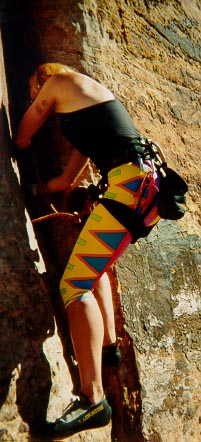
Starting up Generic Crack (5.10) at Indian Creek (the bruise on my arm is from my fall on The White Way)


Generic Crack is the longest route we’ve done at 120 feet. And I haven’t gotten to the top of anything yet, I think to myself, looking up at it with dread. Todd tapes my hands for me. His taping job is more secure than mine and, hey!, it turns out I’ve actually picked up a little technique along the way. I’m using my feet more and rotating my hands less. The tape job holds and my stamina holds and I arrive at the top – no falls, no hangs, no squeaking. Lowering off I’m as excited about it as I’ve been about any of my hardest leads. Maybe I can climb cracks.
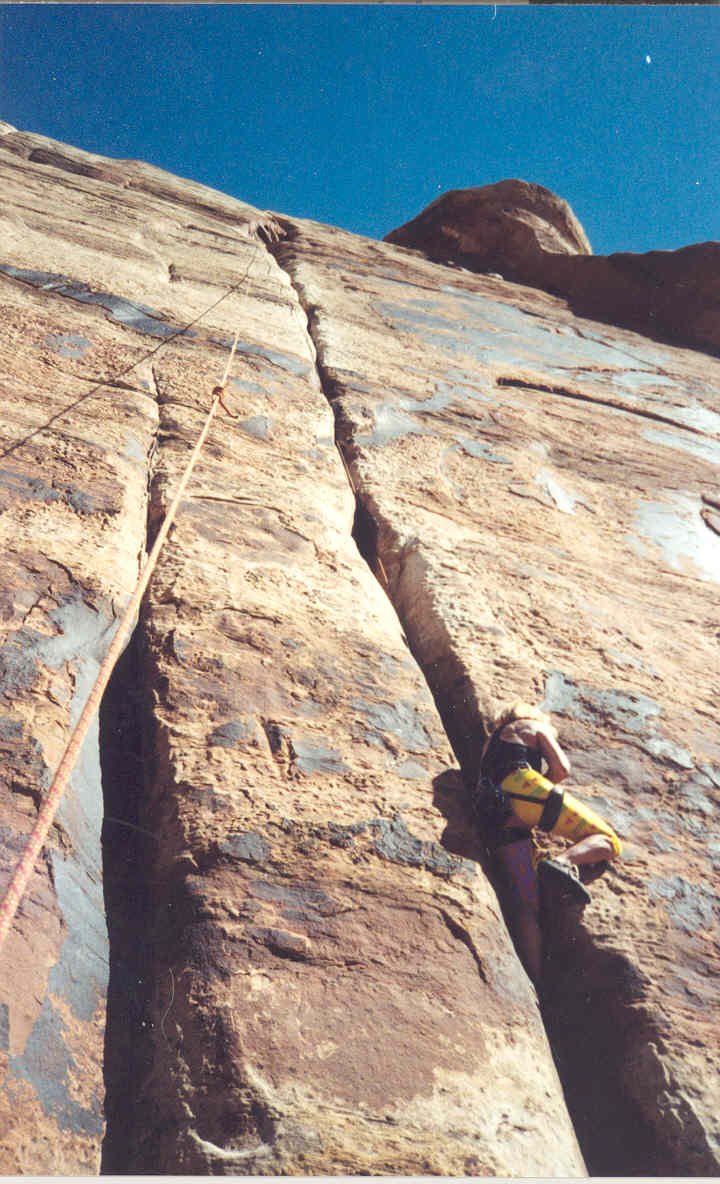
Me higher up Generic Crack, off-widthing like anything


With one whole route under our belts we take our ritual siesta drive into town for air conditioning and cold drinks. We stop at some of the lakes on the (scenic) way to Monticello and enjoy the day, cooler at these higher elevations. Then it’s back to Indian Creek for my big challenge. It’s time for me to lead Chocolate Corner. I’ve been running through it in my mind since the first day. I can image the first few moves. I can do those. I’ve already done them. Then I’ll place a piece and do a few more. Then I’ll place another piece. Then I’ll be fine. I have crack technique now. It’s a comparatively short route. I know I can do it. And I’m scared out of my wits.

We sit in the car in the parking lot. The sun hasn’t moved enough to put that side of Donnelly Canyon in the shade yet but Chocolate Corner, because of the way the corner faces, should be shaded. Still we sit. I’m afraid to make the first move – opening the car door.

As we sit there, Geoff and Tom pull up. They’ve already climbed their route but they’ve got a rope stuck on the summit and have come back for more water and gear. We give them the extra water we’re carrying and they drink an amazing amount of it faster than we can believe. Then they head back to camp for yet more water and we head up to Chocolate Corner.

Todd tapes my hands again. We gear up, flake the rope. I’ve got all the #1 Camalots we have, some #2 Camalots, some Friends that are in between the two size-wise, and a #3 Camalot. Each is individually racked on a biner. Todd gives me a couple of draws to use if I want to hang but mostly people have been clipping straight into the piece. In some ways, this will be the easiest lead I’ve ever done – pull the next cam off the rack, stick it in the crack, clip and go. No thinking involved. With one last warning that I should hang rather than fall ringing in my ears, I start up.

I move high enough that my ego tells me I can place a piece. I stuff in the first cam – it feels good – and try to clip it. The biner keeps hiding in the crack. “Relax,” Todd tells me, “you’ve got a great jam.” It doesn’t feel great from where I’m hanging but I try one last time to fish the biner out of the crack and manage to get the rope through it this time. I climb. I place another piece. I climb. I’m jamming it straight in, although it’s a corner, because by now jamming is starting to feel good to me, but at some point I stop and put a foot out onto the wall.

“You have a crack for your feet,” Todd chastises me, as he has done throughout the trip whenever I try to bail out of the crack for those beckoning face holds.

“I’m resting,” I snap at him. “Is that OK?”

“Is it a good rest?” he asks.

“It’s OK,” I tell him. “There’s a better one in five feet or so.” That motivates me and I put my foot back in the crack and move again. The crack mostly fits me well, although it gets too small for my feet at some points and gets a little wide for my hands at another point. “Wide,” I think to myself and plug in a piece of gear even though I have one only a foot and a half below. Todd tells me later that he thought I was going to hang when he saw me placing another piece so soon, but I’m only thinking of protecting a move that’s a little harder than the rest.

I’m breathing heavily, tired and scared, but not thinking of falling, feeling in control. Then the anchor is in sight. Then it’s in reach. I place a draw on it because they’re closer to the front of my harness than the slings and immediately clip the rope through it. I relax and breathe. Todd cheers. He’s been blessedly quiet since telling me to put my foot back in the crack. I add another draw into the anchor and lower off. The second my feet hit the ground I’m bouncing back up again, excited, like a little kid. I want to relive the entire experience with him, minute by minute. It seems that leading Chocolate Corner cleanly is the most excellent thing I’ve ever done.

Todd makes little whiny noises following the route which pleases me even more. It’s true that the crack is too small for his hands almost the whole way up but I like to think that it’s just very, very hard. I also get the chance to tell him that there’s a crack for his feet when he stops to rest with a foot on the wall.

“Point taken,” he says.

Now we have only one more route left on our agenda – the elusive Incredible Hand Crack. Supercrack Buttress is dead-on in the sun but at least it’s later in the afternoon. The sun is a little lower. And the route is empty. We scramble down one side of the canyon and up the other.

There are no whimpers of “wide” on this route, although Todd complains about the opposite – the crack is a little too narrow for him just over the bulge, but he leads it with only one hang and then it’s my turn. This route has intimidated me since I first saw it but I have new confidence now. Todd suggests that we pull the rope so I can pink-point it but I decide I don’t have that much confidence and elect to toprope it.

I clean as I go, cleaning the last piece on the bulge just as I realize that I can’t possibly hang off my arms for another second. But with the last piece removed, letting go means swinging and not being able to get back on. I have no choice unless I want to climb the whole route again. I remember what I’ve learned – push with your feet, use your abs to pull yourself up, don’t rotate your hands. Fighting desperately I use my last ounce of strength to get to the rest at the end of the bulge. From there it’s easy climbing to the anchor. I am elated with my day, my first good day at Indian Creek.

We get back to camp to find that Geoff and Tom haven’t returned yet. Calculations determine that it’s too early to be worried about them but not too early for dinner so we head into town for the second time that day. On the ride back we talk about what steps we ought to take if they aren’t at camp when we get there but fortunately they are and with all their gear besides.

Sorting gear
Sorting gear


Little Cottonwood Canyon

The next morning, Monday, we sort gear. The mountain of gear is enormous but when it’s all separated into little piles we have the right number of each tape color. Todd and I say good-bye to Geoff and Tom. Geoff is starting his drive back and Tom is going to see if he can hitch a ride on Incredible Hand Crack. We decide to do most of the drive back to SLC that day and hit Little Cottonwood Canyon, where we pick a three pitch 5.7 crack climb.

“You know,” I tell Todd, “for a climb called Crescent Crack this has an awful lot of chimneys in it.” Pitch 1 – chimney. Pitch 2 – chimney. Pitch 3 – chimney. We figure it’s OK – 5.7 and no mention of any R sections. The first pitch is mine. Funny, this should be easy. The rock is solid, with an amazing amount of friction. In fact, if you touch it wrong, it draws blood. My pitch turns out to be steeper than it looked and I have no choice on lead but to stick my hands in the crack for security. I haven’t taped up and I’m regretting it but my newly discovered technique sees me through and I don’t re-open the wounds on my hands, only some on my knees and elbows. Above the crack I find the promised chimney – fun and easy.

The second pitch is Todd’s. He looks dubiously at a move around a block and places two pieces before pulling it and moving out of sight. The rope doesn’t move for a long, long time. I start running through self rescue techniques in my head. Finally I call up to him and he answers.

“I’m going to bring you up here,” he says. “You’ll see why.” I climb up to join him, pausing at what seems like a pretty burly move for 5.7 around that block, and take a look at his chimney. It’s more of an off-width, or maybe a squeeze chimney, and he’s already managed to get a couple of pieces in it. I put him on belay and he moves back up to his high point. He gets in a piece higher up and comes back down. Repeat. I’m starting to wonder if we’ll ever get off this bit of rock. It’s a 5.7 already. The sun is hideous. I can feel the sunburn on the back of my calves deepening and my rock shoes are melting onto my feet.

“Just squirm and push,” I tell him impatiently. Much thrashing that results in mere inches of movement at a time later he finally pulls through the chimney. He puts me on belay. Thank heavens, I think, confidently moving up to the chimney. Where I get very hopelessly stuck. I squirm up and slide down, squirm up and slide down. I have the pack hanging below my harness (where I swear it’s ten times heavier than if it were on my back) but at least I’m not wearing a rack. I’m stuck and not having fun. Didn’t we learn our lesson about off-widths at Indian Creek? Why is it that the rock everywhere else is sharp enough to cut through skin and so smooth in this chimney that your feet just slide off? Finally I take tension on the rope and pull around into a layback position from which I quickly walk up to the anchor.

“I should have placed more gear,” Todd says, jokingly annoyed that I got to bail out of his nightmare.

“All right,” I admit. “It was hard.” The last pitch is mine and it’s a snap to lead – harder to follow since it ends in a down-sloping ramp where I get a toprope and Todd has to down-lead. Then the walk-off through the gully, a steep slope of loose rock and gravel intermingled with bits of pure friction. We’re hot and tired and feeling whipped.

“You know,” I say when we finally gain the safety of the trees at the bottom of the gully, “it’s one thing to have your ass kicked by Indian Creek. It’s another thing entirely to have it kicked by a 5.7 at Little Cottonwood Canyon.” We laugh and vow to learn some off-width technique in the near future. I ask, as someone was coincidentally doing at about the same time on rec.climbing, if there’s any way to learn off-width technique other than climbing off-widths, but we can’t think of any. Oh well, my brand-spanking-new #5 Camalot will get some use, I guess.

Tuesday morning we fly home. I look like something from a freak show, scabs running down the backs of both forearms and covering my hands, wrists, knees and elbows, a big bruise on my arm where the rope flipped me on The White Way and a bigger one (that no one can see, thankfully) on my butt where I hit, plus miscellaneous bruises scattered throughout. I’m sunburned in strange patches and I have a tape glove tan line on one arm. I’m thoroughly beaten, thoroughly exhausted, thoroughly pleased with the trip.

A Postscript

I’m writing this on June 1st, 2000. One Saturday in June of 1999 I spontaneously drove to a local climbing gym and purchased an hour of belaying and equipment rental for $20. I climbed my first wall, heart pounding and pulse racing, with barely enough strength to make it. From the top of that 30 foot wall I saw a whole new world opened up beneath me, a world I don’t ever plan to stop exploring.
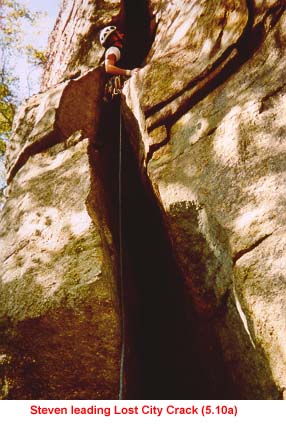
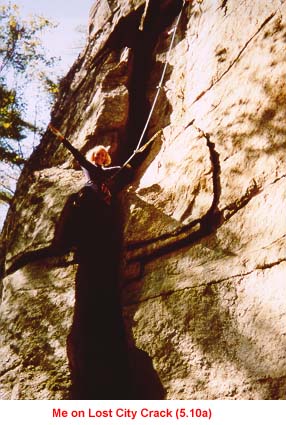
“My First 5.9” or “Good Plans Don’t Make Good Stories”

It was a good plan. I was feeling pretty comfortable leading 5.8 at the Gunks. I’d led many of the well-known “hard” 5.8s, including Modern Times on a second try. I’d done a few routes that were labeled 5.9- in the guide that rates nearly everything harder, and I’d led a 9- at the New. I was ready to lead 5.9, chomping at the bit even.

It was a perfectly reasonable plan. On Sunday when I climbed with Todd, the more aggressive of my regular partners, I was going to lead Ants Line, a 5.9 G that is at the top of most people’s “which 5.9 should I lead first?” list. Ants Line is a corner that sucks up gear. I’d been on it before with no trouble. The crux was pumpy but protected well and the fall was clean. It was a practically foolproof plan.

You see where this is going already, don’t you? Saturday found me and Steven way down in the Nears, seeking respite from the heat and humidity in the vicinity of a chimney, White Pillar (5.7-). Steven led the chimney, I followed, and we set up Harvest Moon, an 11a crack climb next to it, which Steven enjoyed and which made me first rip off my tape gloves, swearing at them for being in the way, and then mourn their loss as I bled all over the crux. I needed an antidote to miserably failing on a miserable crack climb. The slabby 5.9 PG/R Honky Tonk Woman next to us was the perfect choice.

Of course it was.

Really.

Just look at this route with me for a moment:

I have to climb up to the bolt first. It’s a ways up there but the climbing looks easy. I can probably stop and put a nut in behind that flake on the way. It won’t be a good nut but it only needs to protect one or two moves, then I’ll be standing in that totally casual dip thing and I’ll be able to reach the bolt from there. The PG/R rating comes from there not really being any protection after the bolt. The crux isn’t at the bolt, or at least so goes the second-hand beta we have. The crux is up where you go to the left of the little roof and a fall from there would be back onto the bolt. It doesn’t look all that long though. Besides, it’s obviously a cruise move. I mean, you can see from the ground that it isn’t hard at all. 5.9 slab climbing is well within my abilities and there’s absolutely no death involved.

Amazingly, Steven is fine with my leading this route. He’d never been on it either but he agreed with my assessment from the ground. “This is going to make such a great story,” I thought. Instead of my first 5.9 being “the safest 5.9 in the Gunks” and a route I’d been on before, I’d do a 5.9 R onsight. Not only that, but I’d do it with Steven, not Todd. That would throw everyone for a loop.

The first few moves were a little harder than they looked. I hate bouldery starts. I was more relieved than I expected to be when I got to the bad nut placement. It was a little farther off the ground than I’d thought too. And my, look how far away that bolt still is. I make a few more moves up to the excellent dip, the nice stance from which I am going to casually clip the bolt.

Curiously, the excellent dip turns out to be a nasty sloping ramp and I have to work my way up it before I can reach the bolt from what turns out to be a bad stance. Somehow our view from the ground had been skewed. Whereas the route had appeared to be very low-angle and short it was turning out to be close to vertical and with discomfortingly long gaps between features. Anyway, the bolt is clipped now. The next couple of moves, with the bolt comfortably nearby, are very difficult and when I finally reach a stance above the bolt I think, “Well, that must have been the crux.” The beta must be wrong. The bolt was, of course, obviously, at the crux and there I was: through the crux and just fine, thank you.

I move up a bit farther. Strange. The moves seem to be getting harder again and then, right on schedule at the little roof, comes the crux.

I don’t know how long I stood there, longer than I’ve ever contemplated a move on lead before I’m sure. The rock was greasy. I was using chalk for the first time ever on lead and I was using it compulsively, trying to make the bad holds better. That foot was too small, much too small, to step up on. The foot on the other side was slightly better but the hands for that move were much worse.

“It looks like you just need to step up,” Steven said.

“You have no idea how small this foot I need to step up on is,” I told him.

“Well, you’re probably going for a jug, right?”

I eyed the chalked-up thing a few feet beyond my reach. You could call it a hold, but I wasn’t going to call it a jug.

“Not exactly,” I said.

“You’d cruise this on top rope,” he said, which I think meant “do the damn move already.”

“I don’t think so,” I answered.

I desperately wanted down but there was no safe going-down option. I could downclimb and get closer to the bolt, but I couldn’t reverse the hard moves just above the bolt. The only way down was up.

I also desperately wanted to pull the move. My first 5.9, an onsight of a PG/R. It would make such a good story. Then there was my “no lead fall” streak, which stood at an amazing (for me) 40 pitches or so. Now it was in jeopardy. Plus, to repeat myself, the only way down was up. I not only wanted to pull the move; I needed to.

I wasted time looking for gear (the book says the crux is well-protected if you’re adept at placing gear and a friend has led this route with a nut at the crux which he fell on and it held, however small brass nuts are required and we weren’t carrying any). I wasted time looking for a better move. I wasted time looking for a better stance to get some rest. Finally, I told myself I was doing the move.

“One, two, three. Go.”

I hadn’t moved. I tried again.

“One, two, three. Go.”

“Go!”

I went. I stood up. I had done the move but I wasn’t balanced. In a panic, I flailed desperately for the next hold, now out of sight, missed it, and came off.

I had time to scream twice on the way down and Steven had time to run backwards and save me four feet or so of fall. I huddled at the end of the rope in a fetal position.

“Are you OK?” Steven asked me.

“I’m OK,” I said.

“Sure?”

“I’m OK,” I repeated. I kept repeating it, like a mantra.

“I’m going to lower you,” Steven told me.

“OK,” I said again.

He lowered me. I flopped down on the ground, still curled up into a little ball. I was taking great, heaving breaths and concentrating hard on not crying.

“Take a few deep breaths,” Steven kept saying, which struck me as odd because I was practically hyper-ventilating. “Did you hit your knee?” he asked, pointing to my right leg. I followed his finger and saw a small hole in my pants, through which a bit of blood was visible.

“I guess so,” I said. I pulled up my pants leg to assess the damage. In addition to the bloody spot, there were sharp, red dots sprinkled across the knee, perhaps the pattern of the crystals in the rock I hit.

“Am I going back up there?” I asked Steven, pulling my pants leg back down.

“It’s up to you,” he said. “You don’t need to. It’s no problem to get our gear back.” Since the nut had self-cleaned during the fall, the “gear” in question consisted of one locking biner, but he was right, we could easily get even that back. I paused, trying to decide if I’d be mad at myself if I didn’t get back on the route.

“No,” I said. “I’d be mad at myself if I’d backed off without trying the move, but I did the move; I took the fall; it hurt. I don’t need to take that fall again right now.”

“Anyway, your knee’s going to hurt worse once the adrenaline wears off,” Steven warned me. He was right. When I stood up to belay him off the rope we’d left in the chimney, I realized that I couldn’t have climbed the route again anyway. The knee was already throbbing with each step.

Steven did the route cleanly, seemingly without any difficulty at the crux (although he was on top rope, he was looking at a swing back into the chimney if he came off.) That meant that he was probably right originally. I’d have cruised the move on TR. Slab moves are my specialty. I should have been able to pull that one. I just need more practice keeping my head together on hard moves on lead.

I’ll be back to try Honky Tonk Woman again.

Maybe I’ll try Ants Line first though.

And a few other 5.9s that protect well.

It would have made such a good story.

Oh, well. It still does.

Steven leading White Pillar (5.7-)
 

A Taste of Heaven

There were three things I was repeatedly warned about prior to my first trip to Seneca: the sandbagged ratings, the lousy food, and the lack of anything to do there when it rains.

I climb at the Gunks, so how bad could Seneca ratings be? Except that these warnings were coming from other Gunks climbers. OK, maybe a little scary.

Food-wise: red meat, grease, sugar and salt all get gold stars in my book. You can’t scare me with home-cooked-meal type diners and pizza has to go a long ways to actually be bad. Besides, there’s always McDonald’s, right? The subsequent snickers were slightly disconcerting.

And as for rainy-day entertainment, well, the forecast was very encouraging. Never mind that bit about the weather changing every 15 minutes. I was sure it would be glorious. Anyway, every trip is an adventure and for each negative comment about the food, the ratings or the entertainment, I got one positive comment about the summit, so I set off to pick up Todd Wednesday night feeling optimistic and excited.

We got in late, slept little, and stumbled out of the tent on Thursday morning to face my first Seneca challenge – breakfast. A cozy little place called Valley View served up a perfectly reasonable rendition of eggs with sausage, good greasy home fries, and thickly buttered toast. I added on the biscuits in gravy. Hey, when in Rome. A bit much for breakfast but not bad at all. With this hurdle cheerfully overcome, I turned my thoughts to the sandbagged ratings.

By the time we were at the foot of Ecstasy (5.7), I had worked myself into a pretty good state. We stopped at the bottom of a short, steep crack leading up onto an arete. It looked a little hard for 5.7. My nerves cranked up a notch.

“I usually just solo up to that first ledge,” Todd said, pointing up about 25 feet. Oh, great. This wasn’t the 5.7; this was the approach to the 5.7. Well, no, thank God it wasn’t. This was a sort of boulder start to the approach to the 5.7. The approach was on the arete, much less intimidating but still too much for me to solo comfortably with my nerves already so revved up. We started from the ground. Although Todd still didn’t place any gear until after the ledge, I at least got my top-rope.

Todd led the first two pitches in one pitch. I followed nervously. It felt hard. It was steep and sustained, much as promised. Plus none of the holds were where they were supposed to be. Or they weren’t as positive as they were supposed to be. Or something. I was completely unnerved by the time I reached Todd. The third pitch, short but supposedly the crux, was my lead. Todd gave me a quick lecture about placing plenty of gear at Seneca. “The rock’s smoother so pieces pull easier,” he said. My partners are always trying to think up excuses for me to place more gear but in this case it wasn’t necessary. I was fully spooked when I set out from the belay.

I did the traverse at the start. Well, that was fine. Then moved up. Not so bad. Kept going and hey, that was a pretty short pitch. Somewhere along the way I’d forgotten that the holds weren’t positive and that all my gear was going to pull if I fell on it. I was leading; I was happy. At any rate, it didn’t feel anything like the crux pitch to me, although Todd tried to insist that it did to him. I walked away from Ecstasy thinking maybe I’d be able to handle Seneca grades after all.

Next up was the Green Wall (5.7), which I led from top to bottom (or bottom to top), resulting in my first (and only as it would turn out) top out at Seneca. It was everything I’d been told it would be. I was on my own little square yard of rock, Queen of the Mountain, Lord of all I surveyed, loving it. There were a pair of guides with a pair of clients to my left. They were using the descent path so Todd and I spent a little time enjoying the summit while the clients were got down and then we scrambled over to the where one guide remained.

Leading Green Wall (5.7)
Leading Green Wall (5.7

Well, guess who? It was Tony Barnes, of whom I’d never heard a few weeks ago but who had recently had his own sub-thread on rec.climbing and who wrote the guide book that fortuitously arrived from Amazon the day before we left. Todd and Tony knew each other from Todd’s days as a Seneca regular. They got caught up and had a laugh over Tony’s recent guest flame-ee status on rec.climbing. I am constantly amazed by how small the climbing world is and how neatly rec.climbing connects it.

Todd kicking back
Todd kicking back

We were headed to Traffic Jam next. A 5.6, Todd said. 5.7 now, Tony said. They were just about making winky-faces at each over it and Tony said something about the back wall being on or else it was 5.9 and Todd said that the back wall was certainly not on and I had no idea what they were talking about. A 5.6 has to be pretty sandbagged to get to the point of being scary-hard, right? Mmmm, hmmm.

Now, in front of the so-called 5.6 (5.7?, 5.9?) I see that it looks hard. I also see the “back wall” – a completely separate wall of rock that is behind you when facing Traffic Jam but that is within bridging distance. I am given my orders: lots of gear down low, no touching the back wall unless I’m desperate. I begin, place a piece, place another piece. It’s pumpy but it’s fine. Everything here is steep but luckily I’ve been working hard on my strength and I’m still not worried. With the second piece in I eye the next move. The next move is . . . hmmmm . . . where exactly is the next move? After studying and rejecting several options I decide to check on that piece I just placed. It could definitely be better. I adjust it. I go back to studying, try something, slip and almost come off, just catching the edge of the crack and barely hanging on long enough to rebalance myself. I see a possible move – possible if I had any strength left, that is. There must be a 5.6 move in here somewhere. Another look at that last piece. Not so good really. Adjust it. There, that will certainly hold. Study the move again. Try it Todd’s way. Ridiculous. Look at my way again. Much too hard. Definitely feeling desperate now.

I step back.

The wall behind me is beautiful. The stem is sturdy and restful. The 5.6 move is clear. Just push my butt up a foot or two and then step back over to the crack where it gets easier again.

I take a few deep breaths and apologize to Todd. Then I take a few more and accuse him of purposely seeking out the one 5.6 in the world that could scare me out of my wits. Then I take a few more and step back into the crack and pull the move. The route lets up a little after that but not much. It’s in your face the whole way and I probably placed more gear on that short route than I normally do on one twice as long. I’ll agree to 5.7 if the back wall is on. I’ll take 5.9 (minimum) for the crux move if the back wall is off. I would suggest that the guide book should rate the route both ways but . . . what the hell. I’ve done it now and the next time someone mentions a “nice short crack that used to be rated 5.6” I can make winky-faces about it myself. Welcome to Seneca.

We rapped down and around the corner to the Critter Wall where I led Critter Crack (5.6) and Crispy Critter (5.7). Critter Crack was easier than Traffic Jam but harder than Crispy Critter and I was left feeling pretty confused about Seneca ratings all the way around. We still had a couple of hours of daylight left but I was tired and shaky from so much leading on new rock and we had three more days of climbing ahead of us. Somehow the words “ice cream” got brought up and the decision was made. In no time we were back in town where we raided the general store for goodies and beer which we took to the porch of The Gendarme. Todd renewed some old acquaintances and we exchanged the usual climber talk: what routes are sandbagged, what routes are gimmes, what routes we’d done, what routes we were going to do.

Next up was dinner at the Front Porch: good subs and cheese fries with the remainder of the beer. Then early to bed, early to rise, and . . . yuck. Back into the tent to let it “burn off”. A later look showed only minimal improvement – might as well have a leisurely breakfast and let the weather settle. Off to Valley View again. Today’s special is ham and I forgo the biscuits and gravy, but the meal is just as good as the day before and there are breaks in the clouds when we leave the restaurant.

Unfortunately, the cloud cover is solid again by the time we get to our proposed route, Candy Corner (5.5). There’s also someone on Candy Corner so we rack up for Ye Gods and Little Fishes (5.8) instead. There’s a light drizzle by the time I’m ready to go. Our route is slightly sheltered by a roof, only the bottom looks wet. The leader on Candy Corner is bailing from just below the crux as I start up Ye Gods. Ever since my falls on subsequent days at the Gunks, both partially attributable to wet rock, I’m very easily frightened by wet rock. Plus, the crux on Ye Gods is down low, another non-favorite. I move slowly on the route. Beyond the crux I’m feeling better but I’m still moving slowly and placing a lot of gear. I can feel that one of my legs is shaking slightly. Overall I’m giving off more of an appearance of nervousness than I’m actually feeling. I look down to let Todd know that I’m OK, but he isn’t paying the slightest bit of attention to me anyway. That’s fine. Unlike some people I generally prefer to be in my own little world when leading; comments from the Peanut Gallery just distract me. I finish the lead slowly, on slightly damp rock at the top, and lower off. Surprise! I guess I was in my own little world. The sky is beautifully blue. Looks like the rain has blown through and we’re going to have a nice day after all.

Todd cleans Ye Gods and sets up Drop Zone (5.11). He also downclimbs the Candy Corner crux to retrieve the gear left by the leader who just bailed off it. By the time he hits the ground it’s raining again. Amazing. We huddle in a corner while the other group, their gear now restored to them, hides in a nearby cave. Todd whispers to me that we’re lucky we’re not participating in a rescue – the anchor he cleaned could only have held thanks to a lot of rope drag over an edge. The rain doesn’t last long but Todd wants to give the rock a chance to dry before doing Drop Zone so he suggests that I climb Ye Gods again – on toprope in my approach shoes.

After some consideration I decide that I’m in favor of the idea. One of the most irritating things about being a new leader is the way your partners insist on following your leads in their approach shoes. I’ve never climbed anything in my approach shoes. How am I ever going to be able to humble a new leader when my turn comes if I can’t climb without my rock shoes on? It’s a fun opportunity. I’m surprised to find that the route isn’t that hard. I’d never led anything I’d followed or followed anything I’d led before. It’s a good lesson. Perhaps the next time I’m sketched on lead I’ll remember that it’s a mental problem and be able to reason myself into relaxing. Well, it’s worth a try anyway.

Todd then TRs Drop Zone, hanging at the crux to rest. I fall a couple of times at the crux before figuring out the sequence (left, not right – should have watched Todd more closely) but feel good about eventually doing all the moves. By the time I’m down it’s raining again and we spend a little more time huddling. When the rain stops, we move around the corner to The Burn (5.8). Whether it’s because The Burn more closely resembles a Gunks route or because 5.8 seems a lot easier after 5.11, it feels comfortable to me, comfortable enough that I can employ my newest trick of purposely placing gear from bad stances as practice for harder routes. Only the crux gives me anything to think about and it is so very Gunks-like that even it isn’t very worrisome.

Todd sets up Sunshine (10a) from the top of The Burn and we both manage it on TR with only minimal whining. It starts to rain again and we call it a day in response. Friday was supposed to be the worst of our four days at Seneca – the weekend is promised to be better. We can afford to knock off early today. General store for goodies and beer, porch of The Gendarme for kibitzing. It’s a good time. We eat dinner that night back at the Valley View where I have the dinner special – Baked Steak. In case you’re wondering, it’s sort of like hamburger in a baked stuffed shrimp coating. Not bad and with good cafeteria-style mashed potatoes.

Another early night, another early morning and . . . ick. We’ve been lied to. The sky is dark and heavy with rain. We try the other diner for breakfast – the one where most climbers eat – and decide we like Valley View better. Over breakfast we discuss our options. The day’s plans had called for being pretty far from the car, a scenario that is not at all appealing in the face of an eminent downpour, so we bail for Franklin, a sport climbing crag about half an hour from Seneca.

We don’t have a topo for Franklin (anyone? I’d love to know what I climbed) so we have to rely on Todd’s three-year-old memory of the area which goes something like this: that’s maybe 5.9, that’s like a 10, I think that’s an 8, no maybe that is. I lead a couple of (perhaps) 5.9s without much trouble. Todd leads a (maybe) 10a and we pull the rope but leave the draws for my attempt. I don’t get it cleanly but I eventually struggle to the top of it. Todd then leads a (so we think) 5.11. I do this one on TR but we both agree that it’s actually easier than the 10, which is the way Todd remembered it.

At one point on this route, I was cranking off these two little holds with my foot up at my waist so that my center of gravity was way away from the rock and, as I was pulling the move, I was thinking, “I can’t do this move. How come I haven’t fallen off yet? Hey, wow, I actually did that.” I came down pretty psyched. Pulling a move that you know you couldn’t have done even a week before is a most excellent feeling. That strength training is really working.

Next we moved to one of Todd’s old nemeses, a 5.10 (or whatever) that shares a start with another route up an arete and then veers left to a big roof. Todd managed to get up to roof cleanly and even managed to clip the bolt over the roof, although the amount of rope he had to pull up to do it had me wishing I was anchored. He took a few tries at the move, eventually getting up to the good holds over the roof but without the strength left to pull through the final hard move. He lowered off. It was my turn to try.

But how to work the rope? If I climbed on the leader’s end I was risking a big pendulum if I came off before the traverse. The pendulum looked clean, but it was going to be big. If I climbed on the other side of the rope I’d have to unclip as I went by, eventually ending up clipped into only the top-most bolt. Todd had some ideas about unclipping one side of the rope and reclipping the other but I was afraid of getting confused and ending up completely unclipped so I ultimately decided to climb on the leader’s side of the rope. After all, the crux was the roof and by then there’d be no pendulum issue.

OK. So there were really hard moves before the crux too. There I am, hanging off of completely inadequate holds, totally pumped, at the last bolt before the start of the traverse, wondering how bad the swing is going to be if I come off, and Todd says, “Are you at a good stance?” Let me just say that when I read the thread on Monday about “the worst thing you can hear while climbing”, the phrase “Are you at a good stance?” immediately came to mind.

“No!” I screeched. “Why? Are you about to drop me?”

“No,” he assured me. He wanted me to clip a draw from my harness to his side of the rope to try to eliminate the pendulum if I came off. The classic dilemma: I’ll be safer if I do this but I might fall trying to do it. I clipped the draw as instructed. There now seemed to be rope everywhere, most particularly in my way.

“You need to step over the rope,” Todd told me.

“You’re trying to kill me,” I told him. I stepped over the rope. Moved up, moved down. Hard move up there. Bad stance down here.

“You need to step over the rope,” Todd told me.

“I just did,” I told him.

“Yeah, but you got back under it again.” I stepped over the rope. OK. This was too much. I clipped straight into the bolt and hung.

“Rest a minute,” Todd said. I hate resting. One minute of resting, a bit of beta from Todd, and I unclipped from the bolt and pulled the move. Another hard move, then the start of the traverse, not bad, then up to roof, hard moves but footwork-hard so my kind of hard. Ah, the roof.

I already had the beta from Todd. I was to stick my left foot into the big horizontal under the roof. It would be good enough to hold me but not good enough to break my ankle if I fell. I stuck my left foot into the horizontal.

“The other way,” Todd said, “with your toe pointing right.” Impossible to switch now. I came off into the void. Todd had lowered back down to the end of the traverse after each fall but I stubbornly managed to get back on under the roof.

Left foot into the horizontal, toe pointed right this time. Yes, it’s good enough to hold me. I reach up over the roof to the next hold, which I can’t find. I let go and learn that my foot will not, in fact, break if I fall from this position. Good to know. Another attempt nets me “the hold”. Hah! It’s a tips-only slopey sidepull. I tell Todd that he can pull me over the roof now. Between the two of us I’m brought up to the level of the bolt. From here I can reach both the so-called hold for the left hand and a better hold for the right hand. Still can’t move off it without any feet though. I clip a sling into the bolt and stand up in it. Now I can reach the way-better holds that Todd got to. All I have to do is do a pull-up, lock-off, bring my left foot up to a teeny edge at my waist, and stand up. Uh huh. Maybe straight off the ground if I were totally fresh.

The backup plan is for me to escape right onto the other route and climb over the roof from the side. Luckily, this plan works. From there I’m able to thread through the anchors at the top of our route and lower off to clean, difficult in itself since there are no holds with which to pull myself back into the rock to take the tension off the draws. I finally arrive on the ground, my earlier triumph of strength all but forgotten in the face of this travesty. I’m laughing on the way down about what an epic the whole thing was and Todd agrees that it was about as epic as sport climbing gets.

We retreat to what may or may not have been a 5.8 which may or may not be called Barnacle Bill. My mind tells me it’s only 5.7 at the worst; my arms are saying “This jug isn’t big enough. I’d like a bigger jug, please.”

We can see a patch of blue sky in the approximate direction of Seneca. Todd really wants to get me on Triple S so we pack up, make a quick stop at 7-11 for snacks, and head back that way. Even with uncooperative weather, it’s hard not to be pretty damned happy driving along windy country roads, feet up on the dashboard, good music in the CD player, a cherry Slurpie in one hand and the other hand dipping into a bag of Hot & Spicy Pork Rinds, somewhere between a sport route that just thrashed you and a challenging trad lead, but safe for now. It’s a lot like heaven.

Naturally the sky was dark grey when we arrived at Seneca, but we threw rain gear in the pack and made the slog up to the start of Triple S anyway. This route had come with far too much pre-publicity for me. It was certain to be ugly. Todd warned me to take the rests where I could get them and I thought that perhaps now, following the great roof debacle, was not the time to do a strenuous route at my leading limit. Besides, I hate resting. Oh well, at least the crux is farther off the ground this time.

It’s all stemming with some chimneying and a bit of laybacking or a face hold here and there if you feel like giving your hands something to do. There isn’t a strenuous move on the route if you don’t want there to be. There are moments when it occurs to you that if your right foot, the one that’s just resting against that little bump over there, were to suddenly blow there’d be nothing to keep you from falling past your last piece. It was at those moments that I’d look down and decide that my last piece was too far away. I placed quite a bit of gear (including placing two pieces from the same stance which made Todd laugh – I call it “nest building” when he does it), always waiting for that crux that was above me. I pulled up onto a ledge and spotted cold shuts. Looking over the edge at Todd I found him, surprisingly, actually watching me.

“There are anchors here,” I said.

“That’s the top,” he said.

“Oh,” I said, surprised then relieved then happy. The only part of me that was tired was my right foot. It was a perfect antidote to THE ROOF. I lowered off and the weather immediately deteriorated. “Climb fast,” I silently urged Todd as a cold mist blew into my face. He did, of course. We went straight back to the car.

We repeated the by-now tradition of beer on the porch of The Gendarme and then had pizza at the Front Porch. The pizza wasn’t great by Connecticut’s high standards but it was a long way from bad and I sweet-talked the waitress into bringing us garlic bread even though it wasn’t listed on the menu as a separate item.

On Sunday the weather hadn’t improved so we finished the trip with a last breakfast at Valley View (today’s special features bacon) and left for home.

Therefore, in summary:

Seneca ratings: although there are the typical variations from route to route, once I was used to the rock I didn’t find the ratings in the most recent edition of the guide book to be particularly off except that Traffic Jam is not 5.7 unless you get to use the back wall. I’m putting my foot down on that one.

Seneca food: must have been OK because I think I came back five pounds heavier.

Seneca entertainment: the porch of The Gendarme is a great place to spend time. Climbers everywhere are fun and friendly people. The instant rapport still amazes me. And a warm tent is not at all a bad place to be on a rainy evening, especially if the company is good.

Furthermore: the summit is everything they said it would be; the place is beautiful; the climbing is great. I loved Seneca and I can’t wait to go back.

Triumphant on the summit of Seneca