Jean, another round

Saturday was cold but clear and still. Steven, Todd and I started with Maria Direct (5.9). This was my third attempt at the route. And I don’t mean leading it. I mean trying to get up it at all, in any style. The thin, reachy move near the ground has always stumped me. The only time I’ve been higher than that move is when I used a draw as an extra hold.

The last time we were on it, at the end of the day, Todd found what he claimed was a better way to do the move. At that time I was too frustrated with the route to try again, but on Saturday he led the route using his “new” way and I found myself following it easily. Perhaps this route really is 5.9. I always thought it was 5.11.

It was a nemesis kind of day with me because after Maria Direct we moved over to Jean, another 5.9 I’ve never been able to pull, even on top-rope. The crux on Jean involves long, thin moves over a roof. I came close to doing it once but it had just started to rain and the holds over the roof were wet in addition to being small and a long ways away.

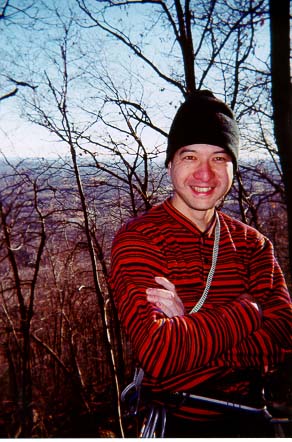
Todd at the Gunks
Todd on a nice winter day at the Gunks.

Todd was still fiddling around on Maria Redirect (5.11), which he can do but I can’t. Steven didn’t feel like leading Jean, and I was impatient. So, what the hell. I decided to try to lead it myself even though I probably couldn’t even climb it.

Todd on Maria Redirect (5.11)

And no, I couldn’t climb it. Steven finally got over the roof on top-rope (Jean is a nemesis from his more distant past) but I never got over it at all. But I did go up and come down safely. I even took a short lead fall on a last-gasp attempt to get over the roof. Lead falls have become pretty impossible for me these days. I just can’t bring myself to commit to any move I don’t feel confident of doing. Even at Potrero Chico, climbing on bolts, I twice found myself grabbing draws rather than risk a fall.

There was a time when I would have been upset about backing off a lead like that (Todd finished it for me), but not anymore. Instead, I was pleased. I tackled something I knew I probably couldn’t do but believed I could safely attempt and I attempted it safely. I was calm and in control the whole way. I protected the crux so well that Steven only felt compelled to add one piece when he went up to try to lead it. I even forced myself to take the perfectly safe two foot fall that awaited me if I blew the move. All in all, it was a pretty good lead.

Todd finishing my lead on Jean (5.9)

I’d still like to get over that roof someday though.

see Jean: The Life-Cycle of a Route for more on leading Jean.

Fried Shoes and Other Luxuries

I’ll never make a good alpine climber. I’m always cold and I can’t travel light, the two being not completely unrelated. Prior to taking up climbing I figured that the convenience of having my things was worth the extra weight and limited my luggage only to what I was capable of carrying myself. Not much has changed except that my definition of carrying has expanded to include dragging.

But I’m the one who insists that we leave the big packs behind for this trip–one checked bag and one carry-on each. So it’s no one’s fault but mine that I’m struggling to decide whether to pack my pillow or my winter coat. Visions of 80 degree Mexican days and nasty wads of clothing in a stuff sack to sleep on dance in my head. The coat stays, the pillow goes.

We’ve been planning this trip for over a month. We’ve bought a supply of Pringles and beef jerky in case we can’t figure out how to feed ourselves without a nearby McDonald’s. We’ve been through the Mexico Rock guidebook looking for routes in our range. We’ve asked friends for beta (mostly on how to feed ourselves). Somehow it doesn’t occur to me until two days before we leave that I should brush up on my high-school Spanish.

I’m complacent. The story of the climbers taken hostage in Kyrgyzstan exemplifies my attitude–“We’re Americans! We’re Americans!” Surely the airport personnel, the customs and immigration officers, the locals in Hidalgo accustomed to climbers, the staff at Rancho Cerro Gordo, will all speak English. We’re Americans. Accommodation is owed to us.

The first hint that I am wrong comes in the taxi. How can a taxi driver in Monterrey not speak English? Why doesn’t he know where Potrero Chico is? Todd puts me up front next to the driver. I’m the one who speaks Spanish after all. I’m glad for the Spanish directions I printed off of the Ranch’s website. Though it becomes increasingly apparent that our driver’s ability to read is pretty limited, between the directions, my few words of Spanish and his few words of English, we finally turn a corner and see Potrero Chico spread out in front of us. Imposing, stunning, dramatic, it rises from the mist to greet us. It looks like someone took Seneca, stretched it in all directions, replicated it repeatedly, and then fanned out the results like a deck of cards.

“Las montañas!” I say excitedly, pointing at the formations, trying to explain to our driver why we have come to this backwater town. He laughs. I hope that he’s responding to the enthusiasm in my voice, not laughing at my Spanish, but the laugh restrains me. We bump slowly down the rocky driveway and arrive at a tidy, freshly-painted pavilion. The bright, clean building is a welcome change from the dirty, half-built neighborhoods we’ve been driving through.

Outside the Rancho Cerro Gordo
Rancho Cerro Gordo–our home away from home

A woman approaches us. She is warm, welcoming, and speaks no English at all. Todd backs up and points at me in what is to become a familiar gesture. I’m our official ambassador and I’m wholly unprepared for the task. I remember my high-school Spanish teacher telling us how friendly Mexicans are.

“If you even try to speak Spanish, they’ll fall over backwards to help you,” she’d tell us, tacitly comparing the experience to trying to speak French in France. If the taxi driver worried me, Mercedes reassures me. We limp through the check-in procedure with good will and only minimal frustration.

“Ask her about the other guidebook,” Todd says. He has a higher estimation of my ability to communicate in Spanish than is warranted.

“Hay un libro?” I manage (There’s a book?).

“Sí,” she answers, adding “guidebook” in heavily accented English. What do you know? One word of English and it’s “guidebook.”

That night, after a walk into town to procure groceries and toilet paper (not supplied, bring it), we meet our fellow inmates at Kurt’s ranch and are introduced to the saga of Rich. The airline has lost one of Rich’s bags. Unfortunately, it’s the bag that contained his rock shoes and harness in addition to his tent. He and his two traveling companions slept three in a two-person tent the night before. None of them got much sleep but tonight, with a loaner tent from Kurt, Rich is feeling optimistic. They’ll climb single-pitch stuff tomorrow, swapping out their two harnesses. Todd lends him a pair of shoes. We feel rich with two pairs each and lucky to have arrived with all our baggage. Although we carried shoes and harnesses on the plane, both our ropes were checked through. And the tent, of course.

The next morning we start our first day of climbing on a 5.8 called, portentously, Old Bolts. The rusted bolts with homemade hangers are widely spaced. The rock feels weird, sharp and yet without edges. I lead the route nervously but cleanly. Then Todd leads the first pitch of Joe’s Garage. The first pitch is 5.9, the second is 5.11a. We stop with the first pitch. New areas are always a little scary. As we prepare to move along, Rich’s two traveling companions show up. Rich isn’t with them. He’s decided to walk into town and call the airline again.
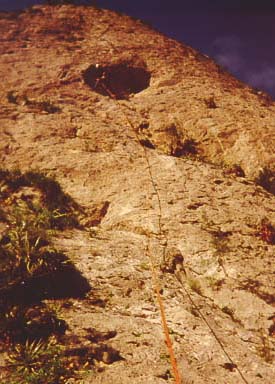
Todd leading the first pitch of Joe's Garage (5.9)
Todd leading the first pitch of Joe’s Garage (5.9)

Todd and I knock off a few more routes. I venture into leading 5.9 and he tries a 5.10+. These routes have shiny new bolts, spaced much more closely, at least where it counts. The holds are so positive that even the smallest lip feels like a jug. I stop worrying about finding edges for my feet and just count on them sticking. It’s not just sticky rubber on high-friction rock; it feels like dozens of little razors are embedding themselves right into the sole of my shoe with each step. We finish the day with the first four pitches of the classic route Space Boyz. I lead pitch three, rated at 5.9+, with no trouble at all and we rap off with daylight on our hands.

Me at a belay on Space Boyz (5.10d)

The pavilion at the Ranch is a congenial place to hang out and even more so tonight. Kurt and Elena are celebrating their engagement with free beans for everyone. The Mexican version of beans is nothing like a can of Campbell’s Pork and Beans. It’s a chunky soup with meat, beans, vegetables, and plenty of spice, especially if you get the ladle with the jalapeño in it. With the last slurp of bean juice finished, we throw steaks on the grill and socialize.

Rich is back at the ranch with news of his bag. It’s been delivered to Monterrey. Unfortunately, it’s been delivered to Monterrey, California. It’s hard not to laugh and in fact we don’t succeed.

“You should have just climbed today,” I tell him.

“I think that’s what I’ll do tomorrow,” he says, disgusted with another wasted day.
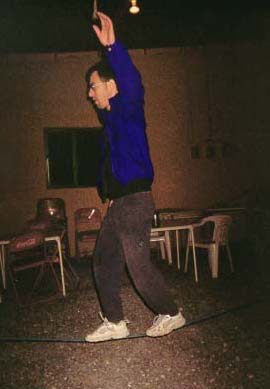
Todd walking the slack line at the Rancho

The slack line is a popular diversion and the night is punctuated with the sound of feet hitting the gravel underneath it. I’m chatting with a French-Canadian whose English is excellent. Here at the Rancho, amongst the climbers, is the “everyone-speaks-English” atmosphere I was expecting. But following our recent ordeal purchasing steaks from a cut-to-order butcher shop (“Tell him to cut it this thick,” Todd whispers. I just roll my eyes.), I’m sensitive to how hard it is to communicate in a foreign language. I speak carefully and slowly to the French-Canadian.

We are interrupted by shouts from the showers. Someone has discovered a centipede in one of the stalls. People rush to get a look.

“What is ‘centipede’?” the French-Canadian asks. This word has stumped him.

“Um, a long bug with lots of legs,” I answer helplessly, knowing how inadequately that describes the creature I’ve just seen in the shower. “Go look at it” is a better answer. If ever an insect’s appearance said “back off or I’ll hurt you,” it’s this one’s.

Frank checking out the centipede

“If you get stung on the finger, your whole hand swells up for days,” someone tells me. We are cowardly standing on the far side of the center island as a group of Real Men (TM) tries to wrestle the thing out in a towel.

“They bite with the back end, not the front end,” someone else warns me as we gather round the centipede, now in the dirt outside the pavilion. No one wants to walk away from it. It seems best to know where it is.

“They’re not really aggressive, just defensive,” I’m told as I watch the group of Real Men (TM) tease the thing into becoming aggressive. It’s twisting like crazy, trying to find something to sting. Eventually everyone gets tired of playing with the centipede and forgets about it. But Todd and I don’t take showers that night and we inspect the vestibule closely before crawling into our tent.

The beauty of Potrero Chico is multi-pitch bolted routes. Now on day two we decide to try one, picking, for some reason, the newly opened Estrellita rather than one of the classics. With twelve pitches at a maximum required difficulty of 5.10b, and with an optional 5.11a section, it seems about right for us. We see Rich as we head out for the day.

“Going climbing?” we ask. He shakes his head. He’s been sick all night with vomiting and diarrhea. It’s all he can do to stumble back to his tent and try to get some sleep.

“Just remember,” I tell Todd, “if we never climb another thing this whole trip, we’ve already done better than Rich.”

With both my health and my gear at hand, I lead the first pitch. Todd follows wearing the pack.

“We’re never going to get through 12 pitches carrying this thing,” he says in disgust as he arrives at the belay. He insists on leaving it. My extra layers! The first aid kit! The headlamp! The camera! Not to mention the water. We take a bit to eat stuffed in Todd’s pockets, the topo for the route, and our street shoes for the walk back down the other side of the canyon. We gulp as much water as we can and leave the rest behind. Suddenly I’m traveling light after all.

The route goes without incident. Todd leads the 5.11a variation and I follow with a bit of struggling. We swing leads all the way and I sail through the two 5.10b pitches that fall to me. The rap down is more of an adventure as the rumors of rope-stretching raps even with two 60m ropes prove to be true, but we arrive safely on the ground, two canyons over from where we started. Still no water until we walk back to our starting point and Todd re-leads the first pitch to retrieve our pack, but it’s a cool day and we’ve moved quickly so no one is suffering.

Rich is up and feeling better when we get back to the Ranch. He’s been given a magic single-dose antibiotic and is optimistic about tomorrow.

“They’re supposed to deliver my bag tonight,” he says, jumping up to look every time a taxi bumps down the road. But that isn’t exactly how it works out.

“Feeling better?” we ask him the next morning. He nods and holds up a strip of baggage routing tags.

“They brought my bag last night,” he says.

“You see?” I say cheerfully, patting him on the shoulder. “I told you things were looking up.”

“You don’t understand,” he says mournfully. “They brought it, but they didn’t leave it.” Apparently they tried to deliver the bag to Kurt’s house but, not finding anyone home to accept delivery, ended up bringing it back to the airport. This small strip of adhesive paper is all that Rich has to show for their attempt.

Today is market day. Hidalgo is peppered with depositos (small stores often called Super-Mini) but they all carry the same few items: Coke, beer, and chips. There’s also a grocery store where you can buy meat, fruit, vegetables and a few canned goods but overall your shopping selections are pretty limited. There’s nothing like a Wal-Mart there. But on Tuesdays and Fridays, market comes to Hidalgo.

We hitch a ride into market and feast ourselves on fair-type food while we shop for staples. We sample small, round things stuffed with what looks like shredded beef.

“Ask what it is,” Todd says, poking me, but I decline. I can come up with the words for “meat” and “chicken” and nothing more. I wouldn’t understand it if they told me and perhaps we don’t want to know. Whatever it is, we eat it and enjoy it. Next is a sort of fruit sundae, like an ice cream sundae piled high with whipped cream and covered in sprinkles but containing fresh fruit rather than ice cream. Good also. Then the ever-present corn-on-a-cob-on-a-stick. But we make a mistake by going with the boiled rather than the grilled and by not getting the chili powder.

We are just buying fried chicken from a fried-everything (don’t want to know) stall when our ride hurries us along. We have to wait to eat the chicken until we’re back at the Ranch, which is too bad because it’s delicious and now we wish we’d bought more to keep in the shared refrigerator for later.

After all that food it’s time for a siesta. We stagger back out of our tent, groggy, some time in the afternoon and decide to get some climbing in. And lo and behold! Rich’s bag has arrived. Rich is also going to get some climbing in. He has two days left before his flight back home.

Todd and I end up at Black Cat Bone (5.10d, 9 pitches). At first we only intend to do the first four pitches–it’s already afternoon–but the fourth pitch is actually a 3rd class scramble and we aren’t ready to quit after three pitches so we keep going. At the end of the sixth pitch we’re through the crux and I assume we’ll be heading down.

“I want to go to the top,” Todd says. Once again we’ve left our pack at the first belay. That means we have three pitches to get up, not gimmes at 5.10b, 5.10b and 5.9, and then eight pitches to get down before we’re back at our headlamp. I eye the sky. There’s no sign of impending darkness yet so I give in. We go to the top.

The top is beautiful, with a summit register and everything. We have a grand view of Hidalgo and the whole valley, but we can’t enjoy it long. The first tinges of color can be seen in the west as we start rapping down. The raps are a nightmare–rap down 10 feet, pull up 190 feet of two strands of rope and heave them for all you’re worth. Watch them catch on the next Yucca plant 10 feet farther down. Repeat. Eventually the two strands of rope tie themselves into a knot which must be painstakingly separated, while hanging, before you can continue.

We hold our breath on every pull but the pulls go easier than the raps themselves.

“Plenty of time,” Todd says, as we walk into camp in darkness. “We even had time to deal with one stuck rope.”

“You think so?” I ask.

“One,” he says. I’m glad to have done the route, which turns out to be our favorite.

As the last ones out of the Potrero Chico park that night, we inherit the small dog that haunts the place. Todd has named it Benji, although he usually calls it Pero. Todd means to say ‘perro’, Spanish for dog, but he hasn’t quite got the hang of the double-r and it comes out as ‘pero’ which means ‘but’. I happen to the think that ‘but’ (I haven’t got the hang of the double-t) is not a bad name for this dog. It’s scruffy but cute, somewhere between puppy and dog, completely friendly and clearly addicted to climbers.

Benji Pero follows us to the Ranch. He belongs to Homero’s in a “I’m not taking him; you take him” sort of way but he’s ours for now. One of the other climbers cuddles him in his lap.

“He’ll never survive here,” someone says.

“He will if he keeps hanging around climbers,” someone else answers. Benji has been fed tonight. “They just can’t afford to keep pets here. Pets are a luxury.” He sleeps in the vestibule of our tent that night. It’s a cold night and windy, as it almost always seems to be here. Todd and I are snug in our sleeping bags and over-engineered four-season tent with expedition fly. The dog snores, but we haven’t got the heart to evict it.

We think we’re getting an early start the next morning but find that all the classic long routes are taken so we fritter the morning away on harder, single-pitch stuff. Todd leads Motavation (5.11a) cleanly and I follow it cleanly. Then he leads Fat Boy Slim (5.11b) with one fall while I take two on TR. We want to warn a Spanish-speaking leader on the route next to us that we’re about to pull our rope down but I don’t know the Spanish word for rope. We wait until he clips a bolt before we pull.

“Ropa!” Todd shouts.

“Ropa means clothes,” I tell him flatly. The Spainards are unconcerned.
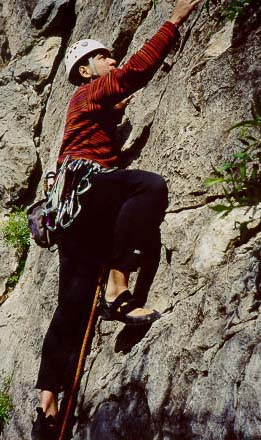
Todd leading Motavation (5.11a)

We look across the way and see a party bailing from the top pitch of Jungle Mountaineering (4 pitches, 5.10-). One of their members can’t pull the crux moves. Seeing that the Jungle area is now free, we head over and start with Jungle Boys. The first pitch, a roof rated at 5.9, disappoints us. The roofs here just can’t touch our Gunks souls. We rap down without doing the second pitch.

Jungle Mountaineering is another thing altogether. This is one of those old routes with sporty bolting that they warn you about. We pause beneath the final, crux pitch.

“It’s OK if you don’t want to do it,” I tell Todd, whose lead it is. Easy 5.10 hasn’t stopped us yet, but Todd’s first lead on this route was a 5.9 with four bolts. I topped that on the next pitch, a 5.9+ with 3 bolts. He shrugs me off. The pitch has more bolts than its predecessors and isn’t a problem for either of us. Although Potrero Chico is sport climbing there are many, many places where you don’t want to fall. Luckily, we’re finding the ratings pretty soft.

We beg a ride into town from Frank that night. He takes us to his favorite truck stop taquería. Frank seems to speak no Spanish at all and never carries any Mexican money, but he does alright somehow.

“The french fries here are great,” he says, ordering something called “café con leche” from the menu. I’m pretty sure that he’s ordered coffee with milk and tell him so. He de-orders it. I scan the menu for something that looks like french fries but don’t see anything remotely similar. Finally I attempt some free-style ordering.

“Zapatas fritos?” I ask. The clerk repeats my order. I can tell he’s corrected me slightly but don’t catch the nuance. Later I check the dictionary and find that the word for potatoes is “patatas”. What I’ve ordered is fried shoes. Luckily it is french fries, and not fried shoes, that arrive at our table and they’re as delicious as Frank said they would be.

Back at the ranch we’ve become popular for beta on long routes. Frank and his group of three are after Black Cat Bone for the following day and are planning an early start.

“We did it in a few hours,” we tell them.

“Yeah, but I’ve heard you guys are hard and fast,” another climber confides to me. I’m flattered and amused.

“It’s just that we’re used to trad climbing,” I tell him. Sport climbing is a kind of luxury. What’s to dally with? Clip the bolt and move on. No route finding, no dickering around with gear, no anchor building. Belay changeovers involve handing over the few draws that weren’t used on the last pitch. The climber doesn’t even bother to anchor in at the belays but simply grabs the rest of the draws and climbs on. The softer ratings and perceived safety inherent in sport climbing allow me to lead very close to Todd’s level. We calculate from the bottom so that Todd will get the crux pitch and then swing leads all the way. It doesn’t seem hard to be fast here.

“There really isn’t any trad where I live,” someone sighs. I think how we’re blessed to be trad climbers first and sport climbers second. It’s easy for a trad climber to take a fun-in-the-sun sport climbing vacation. Not so easy the other way around.

We wake up Thanksgiving morning to the first really nice weather we’ve seen. We’d like to get on another long classic but don’t expect to be that lucky. Climbers have been arriving with the holiday. Amazingly, Space Boyz (11 pitches, 5.10d) is completely open.
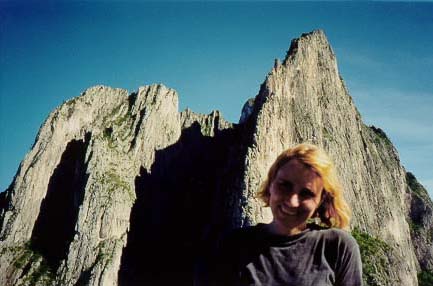
Me on the summit of Space Boyz (5.10d)

In deference to the heat, we actually bring along a Nalgene bottle half full of water this time. We take one swallow each at the fourth belay, the seventh belay, and the summit. We seem to be moving more slowly today. Perhaps it’s the heat, or the flattery from the night before. It’s afternoon before we’re back on the ground. Today, our last day, we’ve finally gotten a rope stuck. Todd has to re-lead and then downclimb four bolts to deal with it. One stuck rope in more than 50 pitches of climbing–not bad for a place with such a bad reputation.

Although there is daylight left, we’re more than satisfied with the sum total of our trip and settle in to the chore of eating Thanksgiving dinner at both Homero’s and Kurt’s. Homero’s wins for us meat eaters but Kurt’s wins for the vegetarians who would be dining on nothing but tortillas at Homero’s.

“I don’t think there’s even a word for it in Spanish,” Mike says over dinner, referring to the fact that he’s not just a vegetarian but a vegan. “It’s a luxury really, to be able to be vegan. I realize that it’s just not possible for the people here.”

We fly home the next morning, somehow negotiating our way through the airport and onto the correct plane, then off the plane and through the maze that is customs and immigration. Todd is suddenly enamored of speaking Spanish, now that there’s no one here but me to hear it. For my part, I hesitate between ‘thank you’ and ‘gracias’, even when speaking to him. It seems I’ve become bilingual in my very small way.

“A qué parte de Mexico?” the immigration officer asks me and I answer “Monterrey” automatically without noticing the incongruity of being asked a question in Spanish by an employee of the US government in Atlanta, Georgia. She congratulates me on understanding Spanish and I think to myself that she’s wasted here in the US-Citizen’s line. She should be handling the Visitor’s line. I worry about the Mexican man I noticed on the plane whose only English seemed to consist of “Bud Light” and “Thank you.”

How did we manage to get there and back? How will he manage? But Todd and I are safe now, through immigration and officially back on American soil. We can handle anything that happens from here. We are Americans after all.
Oops

Todd and I intended to take it easy this weekend, since we leave for Potrero Chico on Saturday, but we didn’t intend to take it this easy.

First it rained Saturday. Then Sunday we went with Steven and some other friends to Peter’s Kill, where I’d never been before. After a half day we realized that we just weren’t enjoying ourselves and called it quits.

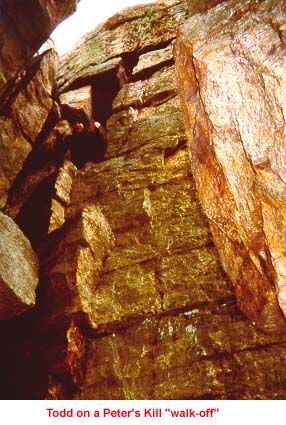
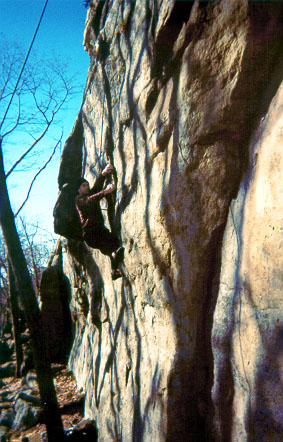
Todd on a Peter's Kill walk-off

If you go to Peter’s Kill, be warned that some of the routes are sandbagged even by Gunk’s standards. I thought Todd was going die on a 5.8 he led (I think he thought he was going to die too). There was a 5.9G (Oops) I thought about leading. I’m glad I didn’t try it since I fell on TR and, although it does seem like you can put gear in anywhere when you’re standing on the ground, I think you’d have to trust a blind placement to protect that particular move.

The guidebook author was climbing right next to us. Apparently a second edition (that will bump up the ratings on some of these routes) is in store.

Surely it’s a glorious day

“Did you do any more 5.9s this weekend?” a friend emails me on Monday.

No, but I struggled through some 5.8s and knocked off a nemesis.

On Saturday I led Farewell to Arms and Eastertime Too, both 5.8. Eastertime Too wasn’t too hard to take, but Farewell to Arms had its moments. The route goes up a left-facing corner for a short distance before making a long traverse to the left and into a right-facing corner. Steven told me there was a pin to protect the start of the traverse and told me a story to go with it. Apparently, a Gunks regular placed the pin after someone took a serious fall back into the corner before getting any gear in on the traverse.

But the pin is missing Saturday. After some deliberation, I decide to climb higher into the corner and place a piece overhead. I know I’ll feel it in rope drag later but decide the extra safety is worth it. I’m even happier with this decision when my first piece along the traverse is a black Alien. From there it’s only a couple more moves before more reassuring gear becomes available.

The crux of this route is supposedly the finishing moves around the corner under the roof. Why then are these moves up the corner so hard? I’m stuck at one point. The chalk goes in conflicting directions. I look down to ask Steven which way to go but he’s not watching me.

“Be a big girl,” I tell myself. “Your route-finding skills need work.”

I check both directions – straight up or around the corner to the left into another corner? After a quick reconnaissance around the corner I decide that that’s the way to go. I put a four foot sling on the pin that will be my highest piece and start around the corner. Quickly, I’m gripped. I scurry back down to my last stance and re-consider. Once again I look down to check with my mentors, Steven and Todd, on the ground. Once again, no one is watching me.

“Be a big girl,” I tell myself. “Make yourself feel safer.”

I swap out the four foot sling with a two-footer. For the second time on this route I wonder how much rope drag I’m letting myself in for and, also for the second time, decide I’ll take my chances. With a shorter potential fall and a more careful examination of the moves, I’m able to get around the corner and to a stance.

A few more rough moves finally bring me under the roof. The last of these is particularly long and scary. I over-grip the horizontal under the roof and fire in a cam. Steven has raised the idea of placing gear in the middle of the crux, letting me know that there’s no gear after the crux, so I don’t place a second piece from this stance and don’t extend the runner. I begin the crux sequence and, one minor move later, am done with it. Whew! The crux isn’t bad at all – it’s just getting up to it that’s hard!

As I make the final easy moves to the anchor I realize that I have, finally, done myself in with rope drag. The last piece under the roof was the kicker. Luckily the moves are minor and the anchor is close. I clip in, downclimb back under the roof, and extend that “final straw” piece before lowering off.

Later in the day Todd mentions that there’s a pin at the start of the traverse again. Apparently another Gunks regular stopped by to replace it shortly after I got off the route.

On Sunday, a nemesis falls! After leading the second pitch of Son of Easy O (5.8), cleanly but with a bit of climbing up and down, I suggest City Lights (5.7). This route has had it in for me from day one. I’ve been on it three times (twice on lead, once following) and have never pulled the crux move on the first try.

Even as I suggest City Lights, a light rain begins to fall. Did I tell you this route has it in for me? We get ready, ignoring the rain. I re-rack the gear. It rains harder. Todd flakes out the rope. It rains harder. I tie in. It rains harder. I step up to the crux, place the crux gear, and test the rock. Slick, of course.

I’ve never found a graceful way to do this move. The only way I can do it is to smear way up high on my right foot and throw every bit of strength I have into mantling off that pod. So I place my right foot up and start to weight it. Slip. Again. Slip. More pressure, get a bit of height on it. Hell. What am I supposed to do next? Back down. I try again, get a bit higher still, place the left foot in a slick, damp dent. Hell. What am I supposed to do next? I come back down.

“Maybe today isn’t the day to do this route,” I say, resigning myself to being beaten by it once again.

Todd starts to explain how he does the move.

“I know how to do the move,” I say. “At least, I know how to do it the only way that works for me.”

And suddenly something clicks and I remember that every time I’m surprised by how brutal, how graceless the move is. Every time it is like discovering the move anew. And I throw myself at it, full-on brute-strength, step up into that mantel, left foot even higher, and I’m there.

“Can I come down now?” I ask. But the rain has stopped, the sky has cleared. I lead all the way to the top in one pitch with the sun shining down upon me. Surely, it’s a glorious day.

Moving up a grade

Sunday’s challenging lead was the first pitch of Birdie Party (P1: 5.8+). Dana belayed me encouragingly while I tried to find a brass nut I could believe in. Eventually I got one that was perfectly good–as long as it never felt so much as an ounce of outward force. Suddenly I was longing for Snooky’s Return. At least there I’d have another piece between me and the ground. Here my life depended on a) a brass nut, b) my ability to pull the crux move without falling, or c) Todd’s spot. It was “c” that ultimately gave me the courage to try the move.

The funny thing was that, having done that move, I discovered that I was only then at the crux. Us shorter folk have an extra thin move to get to the crux. The lucky thing was that, having done that move, the crux wasn’t really that intimidating. At least I had hands for it. Lecture all you like about trusting your feet, on lead I’ll take a nice set of hands any day.

Todd led Welcome to the Gunks (5.10). It was a good lead, that I couldn’t follow! After falling a few times before I even got to the first of the four roofs, I decided that today wasn’t the day to work a route. I felt too bad about Todd being stuck so far off the ground without even a hat (I saw actual snowflakes on Sunday – boo!) and Dana stamping around on the ground waiting for his turn to get moving. So I decided to come down and save it for another day. I was awfully proud of Todd though who led the intimidating route with confidence and style.

With me getting my first 5.9, Steven ticking off a few 5.10 triumphs, and Todd breaking into 5.11s, it’s been a great October for the whole team. Of course, it has occurred to me that if Todd and Steven keep moving up a grade every time I do, I’ll never catch up to them. That’s OK though. As this weekend proved, it’s not how hard someone climbs but how much fun you have climbing with them.

Red Cabbage right, left, and center

On Saturday Steven, Todd, and I climbed with a guy doing his first trad leads on his brand new rack. On Sunday, Todd and I climbed with a guy who’s been leading for 20 years and carries a set of the original rigid Friends. And yet, the two days had more in common than they had different.

Fresh from my first 5.9 the weekend before, I had the urge to keep pushing, so while Steven belayed HJ on Horseman (5.5), Todd and I went to do Red Cabbage (5.9-). After a thorough examination of both guidebooks, I have come to the following conclusion: the 5.9- variation of Red Cabbage pulls around the arete to the left face when the crack ends before the bulge. This, however, is not at all what I did.

I led up to the end of the crack, placing gear every few feet and ending up hugely pumped as a result (steep, man).

“You might want to extend that,” Todd said, referring to my last piece at the top of the crack.

“Not right now, I don’t,” I told him. I was ready to fall off any moment and had no desire to add to the length of the fall. Taking a deep breath, I started pulling over the bulge. A couple of desperate moves brought me to a spot where I could pull right to what looked like a Thank-God stance. It wasn’t. On top of that, there was no gear there and the next move promised to be powerful.

My last piece wasn’t far beneath me but was off to my left. The fall was clean and I didn’t want to take it. I stepped down. The stance wasn’t much better but I was able to get gear.

“You might want to extend that,” Todd said. I didn’t even have the strength to answer. “If you step down again, you’ll have better feet,” he added. This was a much more helpful suggestion. I milked the rest for all it was worth (not that much, unfortunately), then bravely extended the piece and stepped back up.

I still didn’t feel like doing the next move. I had the hands in hand. I could envision the move. What I couldn’t envision was myself pulling through it in my current exhausted condition. But wait! This time a protection opportunity presented itself. I fumbled in a nut at chest height and, fortified by its presence, found a slightly less powerful way to do the move. Finally, a stance! I threw in a nice tri-cam and moved easily to my left and around the nose to finish the route.

I thought I’d been off-route when I stepped down. Todd thought I was on-route when I stepped down because I’d been off-route when I started pulling over the bulge before moving right. Steven thought I was off-route when I stepped left over the top the bulge because the route finishes up the center of the face. It turned out we were all wrong – everything after the end of the crack was off-route. Leading Red Cabbage was a real confidence booster for me, but I could have made it a lot easier on myself if I’d looked at the guidebook.

Later in the day I followed HJ on Arch (5.5) with its wild traversing moves. He did an excellent job leading it, handling both the scary runout and the intimidating finish. He also learned a bit about the evils of rope drag by not extending the pieces he placed in the corner. I’d never been on the route before and had a great time following it. At the Gunks, following a 5.5 can be every bit as much fun as leading a 5.9 (maybe more fun, now that I think about it).

5.11s

I led a 5.8 at the far end of the Nears named, dramatically, “5.8 G” in the Swain book (Outsider according to Williams). Todd led Mac Reppy (5.11) clean, clean, clean. His first 5.11 onsight on gear. We also screwed around on the two Voids (Void Where Prohibited and Void Where Inhibited, both 5.11). I won’t bore you with the details. Let’s just say that I eventually pulled through two of three. Which one couldn’t I do? The one the guide book describes as “the easiest looking 5.11 in the Gunks.” (Sorry, can’t remember which route is which. It’s the left of the two Voids).

The route has an excellent horizontal crack (totally bomber gear, dude) below a tiny little roof, above which is a seriously low-angle corner. How hard can it be? Heh, heh, heh. Go find out for yourself. And bring along a 5.8 leader to sandbag.

Gunks 5.9

Here is how I came to lead my first Gunks 5.9 on Saturday. I suggest CCK (5.7), a classic I’ve never been on. Steven agrees, but we find a group of three racking up at the base. Steven counters with Erect Direction, the first pitch of which is 5.8, a favorite of his, and will deposit us on the GT ledge from which we can traverse to catch up with CCK.

Steven is positively rabid about Erect Direction. He’s made me promise to “save” it for him. This promise hasn’t been hard to keep as no one else ever so much as mentions the route. The thing is, I signed on for 5.7, not 5.8, but I see the route is very G and I’m feeling good. What the hell?

Steven calls it a mini Double Crack and it’s easy to see why. The stances are closer together and the route is shorter but the climbing is much the same – a steep, broken crack with the crux coming close to the ground. I cruise it.

I’m silently urging Steven to climb faster as he follows me. I want to beat the party of three to the second pitch of CCK. But I’ve taken longer and placed considerably more gear than the CCK leader, who is clearly climbing well within his abilities on 5.5. They win.

We’re concerned about his two followers, who both appear to be beginners. I start to scheme about using CCK Direct (5.9) to pass them while they’re at the second belay on CCK. CCK Direct climbs to the top in one pitch from the GT ledge, while CCK takes two pitches. I’m foiled by Steven, who for some reason talks their leader into taking the Direct route himself. Now there’s no way around them.

I have plenty of time to think while they climb. I’m torn between moving on to something else while there’s still daylight left (that’s an exaggeration, since it’s about 11:00 am) and leading CCK Direct.

“Maybe I should do CCK Direct,” I finally say (directly) after skirting around the topic for awhile.

“Maybe you should,” Steven says. He neither encourages nor dissuades.

I bombard him with questions about the route. The most frightening part, he tells me, is what he calls the “5.8R start.” He points out the gear placements for me – there’s the first one; there’s the next one. I’m convinced that I won’t actually hit the ledge, though it’s clear that it would be close. Besides, the climbing through that section looks easy (warning, warning: delusion in progress). He gives me no specific move beta, but I learn everything I can about the gear, the stances, and the way the route goes.

I am strangely calm, despite the enforced wait. I don’t know if I can lead the route cleanly, but I’m convinced that I can lead it safely. This is perhaps the greatest benefit of my lead head crisis experience. I now understand that leading the route safely is my goal and I’ve developed some faith in my ability to do that, even on a route that may be slightly over my head.

Finally it’s my turn. OK, that isn’t fair. The group of three is actually remarkably efficient and it’s my turn before I expect it to be. I climb through the easy opening moves. There’s the horizontal where my first piece goes. Eeek! I’m not keen on doing the move to get to the horizontal. I manage to sneak a piece into the close side of the horizontal at full extension.

Thus fortified, I start the traverse. The traverse is steep, much steeper than it looked from the ground (oh, but what isn’t?). I stop at a jug, sit on my foot, and throw another piece into the horizontal before I’m out of range. I know this is my last piece for awhile and I want it to be good.

Huffing and puffing I finish pulling the small roof at the end of the traverse and plug in another piece of gear. I have to put a four foot sling on it to prevent rope drag, but I’m out of groundfall range for the moment and at the end of the “R” section of the climb.

It’s the second roof that nearly gets me. Steven has said that I can get gear over the roof before pulling it. I feel a bomber horizontal just over the roof but am unwilling to commit to moving up to look at it without gear below. I throw a cam into the corner under the roof and step back up. This is when I discover that the “bomber horizontal” is a great hold but a lousy place to put gear. It’s more of a ledge than a crack. Still, the holds are so big that I’m not concerned.

With the cam a ways below and off to my right, I pull over the roof. Ack! Here’s the hard move: a hideous layback off a tiny sidepull to finish. I do it, relieved. That one was close and I should have come back down and reevaluated the gear situation. (Steven later tells me that I could have placed a small nut in the vertical seam that splits the roof).

Now I’m on to the section that is shared with the regular CCK route, a layback/jam crack/flake thing. Steep. This is 5.7? Musn’t place gear more than half way up or I’ll slaughter myself with rope drag. Must be brave. Only 5.7. Tiny little roof at the top. Steven says there are jugs. I can do this. Don’t need gear. Want it a little, but don’t need it. Whew!

After the middle roof, the final one is almost anti-climactic, although it takes me more than a minute to figure out how to start the traverse. From there, it’s pumpy but straightforward. And that’s it. Pull the final roof and the route is over. 5.9. Me. 5.9. So there.

Gunks 5.9 (to the tune of Lying Eyes)

Gunks climbers just seem to find out early
How to pull a roof without a sweat
A big old jug and you don’t have to worry
Throw yourself onto the ledge and have a rest.

And, my oh my, we sure know how to arrange things
Never 20 feet without a stance
A bomber crack is there to put your gear in
So step up to the roof with confidence.

But you can’t climb no Gunks 5.9
Cause your style is not as good as mine
Vist here and you’ll start to whine
There ain’t no way to climb that Gunks 5.9

No, you can’t climb no Gunks 5.9
Cause your guns are not as big as mine
If you visit here, we know you’ll whine
There ain’t no way to climb that Gunks 5.9

Ain’t it funny, you can’t climb that Gunks 5.9

Women leaders

We climbed in a group of 7 on Saturday, which worked out better than you might think. We landed in the Broken Sling area. I’ve pretty thoroughly led the routes in my range in that area, including both pitches of Broken Sling (5.8+) in one long pitch during the apex of my leading career.

The route has a “bouldery start” which means that you’re past the crux before you get any gear in. From there the difficulty eases up considerably. During this recent period of lead head woes I have stated more than once that you couldn’t get me to lead that route again. Much of that had to do with the second pitch, though, which features a long runout traverse, not hard but the fall would be serious. So on Saturday I stood at the bottom of Broken Sling, considering the possibility of leading the first pitch, bouldery start and all, and decided to try it.

I sketched through the opening moves, needing a little more encouragement (and a spot) than I had the first time around, but I did resist the urge to place gear immediately upon its becoming possible. I remembered that the gear, and the stance, were better if I stood up first and had the faith in myself that I needed to do it.

Since I had led the route before and was actually feeling pretty strong and calm, I decided to try the direct variation which goes through the first roof instead of around it to the left. This variation is described as “no harder than 5.8”. The gear was good, so I started up, remembering that I could downclimb if I didn’t like what I found, but I had no problem pulling through it. I’ve learned better than to think that my lead head problems are solved because of one success, but I felt good about re-leading this route which was undoubtedly one of the most challenging I ever led.

Everyone led something or other and there were plenty of ropes to choose from throughout the day. Although the parking lots were congested, the Nears were strangely quiet and we didn’t seem to be in anyone’s way. We had a bad moment when we realized that Todd’s rack was missing. After a half hour of searching it was eventually discovered farther down the cliff. Apparently another climber had moved it, mistakenly believing it belonged to a friend of his. Thanks to everyone who helped look for it and especially to those people who graciously opened their packs for us.

Todd put a rope up on the first pitch of Inverted Layback (5.9). There’s no fixed anchor at the top of the first pitch, so we knew that eventually two people would have to go up and finish the route to the top. I had led the second pitch (5.8) before (again during my “leading is easy” days). No one else was jumping at the opportunity, so it fell to me to be the leader who would finish the route.

I was followed by a guy from our party who has 20 years of climbing experience. At the first belay he said “I’ve never followed a woman before.” I thought this was odd. I knew he had a regular woman partner and that he has followed (i.e. cleaned gear for) her before, so I questioned Todd about it later. Todd’s take was that he was referring to a multi-pitch situation. Even so, I was surprised he’d never swung leads with such a regular partner, or followed her up a multi-pitch route at her leading level.

Eventually I decided he meant that he’d never had a woman leader before, meaning that he’d never arrived at a belay to have a woman start barking orders at him – “Sit there. Clip into that. Hold this.” This was interesting considering a recent discussion on rec.climbing (see All Women CLimbers of SF Bay Area UNITE!!! if you’re feeling masochistic). But it wasn’t a problem. I led and he followed and we both arrived at the top safe and sound. Now he’s followed a woman and he’s none the worse for it.

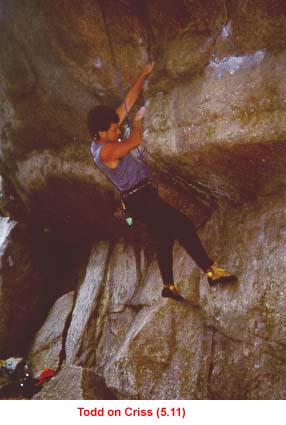
Todd on Criss (5.11)

Another highlight of the day was taking a second stab at Criss (5.11) which I think I’m really close to getting clean if I can just remember the exact sequence I need to use. The lowlight for the day was the traffic from the cliff to New Paltz. Fear of traffic, combined with soreness, general malaise, and the Cowboys/Giants game, kept me and Todd at home on Sunday. The Cowboys lost, BTW. Guess we should have gone climbing.

Return of Snooky’s

On Sunday Todd led the first pitch of Snooky’s Return (5.8) for me. This was the route I backed off of leading a couple of weeks ago because of thin pro protecting a thin move at the crux. Todd hemmed and hawed at the crux fiddling with the gear. He placed a brass nut which seemed like a much better placement than the steel nut I placed. Someone had emailed me suggesting Lowe Balls at the crux, which Todd carries. He did try a Lowe Ball but neither one of us has any faith in them (well, that’s another story) and eventually he took it out and threw it at me (OK, not me, the ground). Instead he placed a black Alien above the brass nut. The Alien was placed such that it would rotate in a fall and probably fail, but it did seem to be helping keep the nut in and the combination looked more confidence-inspiring than my gear had (but maybe that’s because I was safely on the ground, huh?).

I also got to see that this gear, as questionable as it was, would only be at his waist when he finished the move so it wouldn’t have to hold much of a fall. I could also see that the bomber gear below the crux gear would keep him off the ground. When you’re leading it’s not always easy to judge whether or not your next lowest piece is high enough to keep you from decking.

When it was my turn to follow, I had no trouble at all with the crux move. It was a simple step up move, just like Steven had said. It didn’t even feel thin to me. I decided that I will try leading the route again soon. It’ll be a good exercise for me. Hopefully I’ll remember that the move is easy and will do it with confidence.

I was supposed to lead the second pitch of Snooky’s but we couldn’t figure it out, so I just led straight up from the belay to the rap station. It was a little run out in places but the moves were mostly easy and I kept my head together except for one spot where I really wanted some gear. Todd suggested a placement opportunity and I got in the black Alien and one of those Lowe Balls. How far do you want to climb above a black Alien and a Lowe Ball? I had to climb a lot further than I wanted to, I can tell you that.

Todd thought our variation was maybe 5.9 R but I didn’t think it was any worse than 5.7 PG. Either way, I was pleased with the lead. I think I actually have an easier time leading when I don’t know what the rating is. It allows me to deal with what comes up as I go, rather than anticipating the worst from the outset.

Gunks rock has such nice friction compared to Yosemite. It was a pleasure to climb on it this weekend and even though climbing trips are fun it’s also nice to be home.