All me

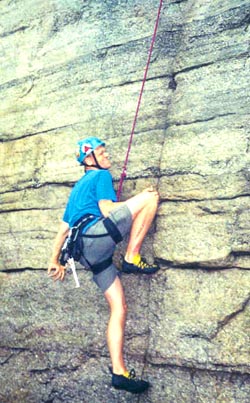
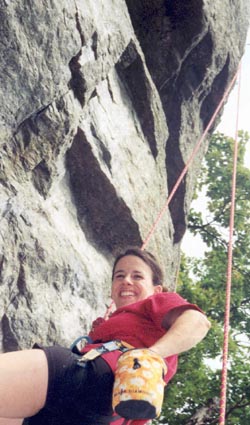
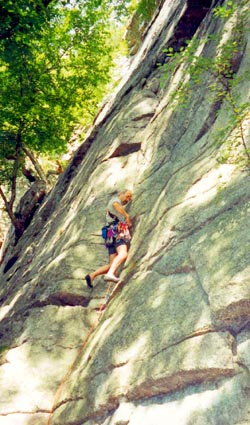
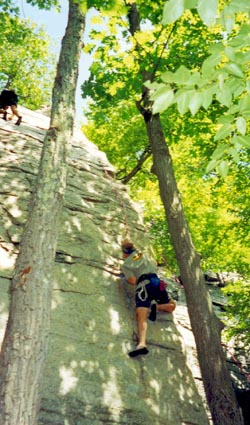
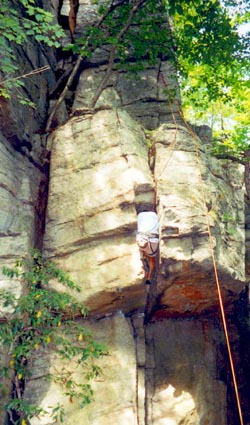
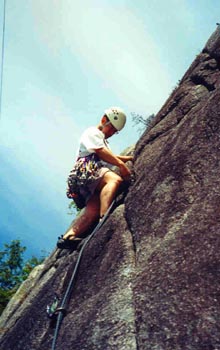
OK, this is it. It’s time for me to take over the leading duties in deference to Todd’s finger injury. One way and another, through toproping at smaller crags, climbing with other people, and muddy days at the Gunks, I’ve managed to mostly avoid it. But today it’s just me and him and a beautiful day at the Gunks. So this is it. All me, all the time.

We start with Bunny because it’s open and it’s 5.4 unless you pull the roof, which I don’t commit to doing before leaving the ground. When I get to the roof I know that I can protect it and pull it, so I do it. I lower off so that we can avoid a tangled rap situation with the next party. While I’m belaying Todd I listen to the next group get ready to go. A woman is going to make this her first lead and I smile to myself as she plans her placements and talks her way through the route.

Next we mosey on over to Horseman (5.5) because it too is open. What’s with this day? The crowd at the Uberfall is strangely small for such beautiful weather. We do Horseman to the top and walk off. As we’re cleaning up to move on I drift back over to Bunny. The new leader is nearing the top. I ask her belayer if she pulled the roof. She did! I’m happy for her and impressed by her nice straight line – better than mine.

I’ve got this funny urge to do Dennis (5.5). I guess because of its recent mention in R&I but also because it’s one of those routes I’ve only heard about, never seen. The trouble with partners who can climb harder than you is that you don’t often get the chance to do the easier classics. Todd’s injury is a perfect opportunity.

Dennis isn’t very far. In fact, it’s right there, sandwiched in between a bunch of other routes I do all the time. I guess I just never noticed it before. And why would I have? That’s a 5.5? Holy Cow. Gunks roofs are out of control. This one is humongous and right off the ground.

I place a piece from the ground. It protects nothing but I want the extra directionality because there will only be one piece between me and the ground when I pull the roof. Well, OK, two pieces, but they’re right next to each other, so they kind of count as one.

“5.5,” I tell myself, “5.5. Must be jugs, must be jugs.” And actually the roof goes easier than expected. It’s a cruise from there and I move quickly to the belay ledge with the tree.

“You just passed half way on the rope,” Todd yells up.

“I’m almost there,” I respond, making the last couple of moves to the ledge. Why is he telling me this? Oh, right. He wants me to run the pitches together. Of course. Always.

Grumpily I downclimb back off the nice cushy ledge with the tree and extend my last piece which is now out of line from my intended direction of travel. I head into the second pitch, labeled 5.4 in the book and punctuated almost immediately by a small roof.

Although this second roof is minuscule compared to the one on the first pitch, it feels trickier and scarier to me. Half way over the roof begins a traverse right. My last piece under the roof ends up being a pivot point. Damnable rope drag! Will I never escape you?

I meander up the remainder of the second pitch, not really knowing where I’m going but happy if I run into a bit of chalk or an old pin every now and then. It’s pleasant climbing but not very memorable.

Back on the ground we figure on doing one more route. Continuing the oddity of this day, both Jackie (5.6) and Classic (5.7) are open. I realize how much better I’m feeling after all this leading. Still, I’ve had enough trauma on Jackie to last a lifetime and I don’t care what the ratings say, I’d rather lead Classic.

But wait. The rest of the dead tree is gone – this changes everything. I used to unashamedly step up onto the dead tree until I could clip the first pin. Who didn’t? But now I have to do actual moves to get there. Luckily, the last time I followed this route half of the tree was already missing and so I did the route without using the tree as practice, envisioning that this day would come. I make two shaky moves to get the pin clipped and then concentrate on the two crux moves above that. Funny how different Classic feels from day to day. Today it goes well.

At the end of the day I look back and realize I’ve led 6 pitches without any major trauma, feeling stronger as the day went on. Perhaps Todd should get injured more often.

Peter in the Mist

It’s that sort of day. Between ourselves, Todd and I have agreed not to even bother driving up to the Gunks on days like this. We know what we’ll find. It used to surprise me, then frustrate me. Now it’s simply accepted: on foggy days there will be an extra band of mist that trails along the cliffs, leaving every inch of rock lightly coated with water.

But today we’re supposed to meet Peter, who’s coming all the way from Nova Scotia. Well, not this morning. This morning he’s coming from Danbury, but he only has two days to climb at the Gunks. He won’t know about the fog-slimed rock, wouldn’t understand it if we tried to explain it, and probably wouldn’t care if he did.

We don’t expect to climb anything.

We park in the one-hour overlook lot (see above). As we’re hiking up the trail to the Uberfall we hear the unmistakable clink of trad gear. Sure enough, there’s a lone, tall figure walking down the carriage trail. I’ve only seen Peter in pictures but there can’t be more than three of use here today so it’s worth a try.

“Peter?” I call up. The figure stops. We’re met.

Todd, me, and Peter on a foggy day at the Gunks


Somehow we’re climbing. OK, honestly, I epxected it (see above). Somehow I’m leading. What else can we do? It would be uncharitable to send someone new to the area up in these conditions and Todd’s still nursing the finger injury that led to the premature cancellation of my leading hiatus. So, I’m leading.

I rack up for Rhododendron (5.6) and move steadily up to the crux, which is funny because before today I didn’t know that Rhododendron had a crux. I’m not liking the move at all and am getting tired trying to find a stance. Finally I hang on my gear, pull through the move just high enough to place another piece, and then immediately hang on that. One move later and I’m through all the hard stuff and cruising to the top.

It’s not exactly a triumph (Peter has probably been wondering just how long leading a short 5.6 can take) but I made it safely up and back down again, so who cares? A bit of downclimbing and traversing has allowed me to set up Laurel (5.7) as well, so we have hours of entertainment for me, Peter, Jason, his partner from yesterday who’s just shown up, and Helen, who we don’t know but who was moping around because her guide cancelled on her.

Peter on Laurel (5.7)


Eventually everyone has tried everything and we pull our ropes. Peter is itching to do some real Gunks climbing, i.e. multi-pitch. I’m a long way from wanting to sit on a damp belay ledge but Jason’s arrival has saved us all. Peter and Jason trot off to do Easy Overhang (5.2) in the mist. Todd and I head for the bar. And Helen? Hopefully her guide showed up the next weekend.

Peter looking down at Jason on the second pitch of Easy O (5.2)

Visiting Virginia

The Google search I did before leaving for DC wasn’t very encouraging. When someone says “by almost any criteria imaginable, Great Falls sucks” it doesn’t leave much room for hope. But the advice to drive the extra three hours from DC to Seneca isn’t for me. Tanya and I might be able to sneak away for a half day of climbing, but Seneca is out of the question.

I almost say the hell with it altogether. The east coast is in the grip of the worst heat wave I can remember and just the thought of leaving my brother’s air-conditioned house is unattractive enough. Add an 8:00 am start and the summation “short, crowded with bodies, ropes, and sweat, and often hot and humid” and the temptation to pass is strong. But some of Tanya’s friends are going and I won’t be back this way again soon, so I stagger out of bed and into the 100% humidity like a trooper.

The funny thing is, with everyone scurrying around the top attaching static ropes to trees and unfurling miles of webbing, and after Tanya has introduced me around as her sister-in-law and someone has responded, “Oh yeah, the one who climbs a lot”, the funny thing is, I’ve never set up a top rope before. Not as such. Not by myself. Not exactly. I might normally play the newbie and “assist” someone else’s setup but everyone else is busy doing their own thing and Tanya is looking at me expectantly. She’s waiting for me to combine a couple of trees, her rope, the handful of static rope and webbing I’ve borrowed from Todd, and the locking biners from the daisy that I keep girth-hitched through my harness into something we can climb.

The trees are sickly looking and about 50 feet from the edge. There’s a great looking crack at the top of the route I’ve been assigned. If you gave me a rack, a few draws, and a cordelette, I’d have the rope down in five minutes or be apologizing for taking so long, but I don’t have a rack with me. I ask around tentatively and one guy tells me that he has a few nuts with him but “I’d never use gear in a TR.” This is either baffling or frightening, I don’t know which. Is it that he’s afraid the top-roping will hurt his gear? Baffling. Or is it that he trusts his placements so little? Frightening.

It turns out that there’s a history of gear being taken from TR anchors at Great Falls. OK, I can understand that. You don’t want either your gear or your anchor to disappear. So it’s the trees then. I just posted the FAQ entry on setting up a toprope for heaven’s sake. I remember particularly liking Dave Fasulo’s elegant solution. I can handle this.

A ridiculously long time later, though still quicker than my co-workers, I have an anchor. Tanya and I scramble down the steep but short downclimb. “I’ve led stuff harder than this,” I mutter as I grope my way down, “and I was placing gear on it.”

Bravely, I climb on my own rope first. We’re in the Cornice area, but I never get to try Cornice itself. It looks interesting but a pair of climbers not in our party have it and they take turns not climbing the route, proving that a party of two on one rope can be just as big a hindrance as a large party with a lot of ropes. Amongst our own party there’s always a rope open somewhere.

Tanya on Darius Green's Flying Machine (5.10)
Tanya on Darius Green’s Flying Machine (5.10)

I try a variety of routes, struggling on the 10s and mostly not getting them, then finally blasting up a 5.7 to finish the day in style. Despite the oppressive atmosphere, cooler finally today but even more humid if that’s somehow possible, I enjoy myself. The climbing is interesting and varied. It reminds me of Potrero Chico except that all the sharp, little flaky holds are turned sideways. With all the small sidepulls, body tension is supremely important.

Tanya on our variation of First Blood (5.10-) which none of us could do

We’re only able to stay a few hours but at the end of that time I’ve climbed four routes and thoroughly trashed my arms and fingertips. I leave happily, knowing I’ll always have a place to climb in Virginia.

Me on Conroy Wasn't Here (5.7)
Me on Conroy Wasn’t Here (5.7)

Totally Trad

“Will you climb for Dawn?” the gym manager asks Lisa. I graduated from belay class last week and have to take my mandatory re-test before I’m set free to belay at will.

“Sure,” Lisa says. She climbs slowly, giving me time to go through the elaborate ritual of pinching and sliding. She pauses. She falls.

Since then I’ve climbed for a few people myself, so I know the drill. You have to fall without warning. I also know that, even knowing the tester is backing up the testee, it’s not that easy to let go.

I catch Lisa and pass the test. Ordinarily I’d probably be left to my own devices now but this is a friendly gym and Gary, the gym manager, knows I’ve been worried about not having a partner.

“Do you have anyone to climb with?” he asks. I shake my head. “You can climb with Lisa,” he offers on her behalf.

“Sure,” she says again. I know Lisa better now. I know she isn’t crazy about climbing with beginners because of how much time they spend hanging on the rope. So maybe it’s not surprising that I get handed off to Dan. Dan has a way with beginners.

“Nice lower!” he says as he hits the ground. “Good belay!” I glow in response.

Flash forward two years to Sunday at the Gunks. I’m belaying Todd as he leads Hurdie Gerdie (5.8+). I should really be paying attention to him as he makes thin moves above thin gear but my mind is on Lisa and Dan around the corner on Bunny (5.4). Between the two of them, they probably have more years of climbing experience than I have of life experience, but today they’re reacquainting themselves with trad climbing and I’m feeling like a mother hen.

Dan leading Bunny (5.4)

“I should have stayed where I could see them,” I fret guiltily. Finally Todd lowers off and I can check on them. They’re fine, of course. Dan is off belay and Lisa is getting ready to follow him.

I follow Todd on Hurdie Gerdie. The irony is that I’m not leading anything today. I’ve become so scared, so scarred, my psyche so broken, that we’ve deemed it advisable that I take some time off and learn to enjoy climbing again without fear. I’m the wrong person to be guiding Dan and Lisa on their rexploration of the wonderful world of trad.

While we wait for Dan and Lisa to come down, Todd and I work on Nurdie Gerdie, the 5.10+ with the infamous single-finger-pocket move. I skip the first crux by using the arete. I’m really only interested in the finger-pocket move. It takes a couple of tries but I get it.

Dan on Nurdie Gerdie (5.10+)

“That’s the sort of move you could hurt yourself on,” I say as I lower off.

Todd pulls the first crux but falls at the finger pocket.

“Shit!” he explodes.

I’m surprised he’s reacting so dramatically. It’s not like I got it clean, after all.

“It popped,” he says. “Fuck.” He’s holding his hand funny and finally I get it. He’s not pissed about blowing the move. He’s hurt himself.

“We’ve lost our rope gun,” I tell Lisa and Dan mournfully while Todd goes to soak his finger in the stream. More to the point, I’ve lost my rope gun. So much for my leading siesta.

But for now we have a rope up on Nurdie Gerdie, which Dan and Lisa are willing to try despite what the route just did to Todd, and on Red Cabbage (5.9) around the corner. As they’re finishing up, I’m surprised to see that Horseman (5.5) is about to be open. I snag it for them.

“Classic,” I tell them. I flake our trail rope out for them. “Now you know how to do a double-rope rappel, right?”

“Dawn,” Dan says flatly, rolling his eyes at me. OK. They know. He leads the first pitch and Lisa the second as Todd and I tinker around on the ground. We run into a friend. She’s injured with a healthy partner and I’m healthy with an injured partner. I follow her partner’s lead of Apoplexy, allowing us to put a rope up on Apoplexy and Coronary.

Lisa cleaning on Horseman (5.5)

This turns out to be a slight tactical error on our part as it doesn’t take me long to run up the two routes (which I seem to climb almost every weekend) and now, leaving the rope up for Dan and Lisa, we’re out of ropes for me. As soon as they hit the ground, we grab their rope to set up Low Exposure (5.11-).

The last time I got on this route I made almost no progress at all. Today, with some hanging in the middle, I finally make it to the top. I’m so thrilled. I’ve never been high enough on this route to be able to hang before, so hanging alone is an accomplishment.

Todd getting the rest on Low Exposure (5.11-)

Lisa and Dan have thoroughly enjoyed their trad experiences so far but they can’t be talked into trying Low Exposure, not even after I describe it as “brutal, awkward, and painful – totally trad.”

Low points

I haven’t led anything since we got back from Squamish. It’s time to lead something now. I’ve always wanted to lead Outer Space (5.8-) at the Nears. I don’t know why exactly. Maybe it’s because no one, not even Steven, seems to know exactly where the route goes.

“Easier than it looks,” the guide book says. Well, sheesh, it would have to be. Standing below the Kansas City roof it’s hard to see a 5.8 way out. I sit on a boulder and try to match the route description to the available rock.

“Any idea where Outer Space goes?” I ask climbers passing by. One guy gives me an opinion that’s something near to one of the two possibilities I’d been considering. He sounds so confident too. But after consultation with the other guidebook and Todd and after spotting some pins, I finally decide that it’s my other possibility. The Williams guide mentions that the route starts behind the tree with three trunks and that’s the deciding factor. It’s a much more clear description than Swain’s “middle of the slab” which seems to point to the other choice.

So now I know where the route goes but the question remains: am I leading it? “Easier than it looks.” OK. But how’s the gear? PG, which could mean anything.

“So you go up and if you don’t like it you come down,” Todd says.

Yes, yes. That’s the sensible answer, make rational decisions as you go, don’t get yourself in a situation you can’t get out of, don’t try to climb it all from the ground, climb it as you find it. I know how to do all that now.

Fine. I will lead it. Without much ado and with some decent gear along the way, I make it up to the first of the pins I could see from the ground. I clip the pin, even back it up, then start to pull over the little blocky roof.

“I think you should be going left from here,” Todd says.

“But there aren’t any holds that way,” I say, “and there’s a pin up there.” Indeed, there are two pins up there, if only I could reach them, and a single hold up there, if only it led to another one. I pull as far over the block as I can and lock off on the single hold. The pins are just out of reach – I need to lock off a little higher; I need to let one foot leave the rock; I need to bounce. No fucking way.

I back down and add another piece. This is bomber gear and a nice looking pin. I really should be willing to chance falling on it. But I’m so not. Frankly, this is a move I’d be hesitant to make on TR and I never have been any good at risking falling intentionally.

“I really think you should go left,” Todd repeats.

It’s true that the slabby ramp goes left. It’s true that the route goes left, actually. It’s just that there aren’t really any holds over there. I suppose I’m meant to just step up on the slab . . .

I try it and find one lousy hold up there somewhere.

“That looks good,” Todd says as I scurry back to the safety of my gear. I still didn’t see a second hold. I try again and find a side pull from which, in a very gym-like move, I’m able to hang a draw through the pin. As I pull the rope up to clip it I realize that this is the first time I’ve ever seriously considered the possibility of falling while clipping on a trad route.

Clipped. I should be relieved but, Oh my God! I clipped the wrong the pin. There are two pins side by side and it’s clear why. Pin #1, the one I’ve just clipped, probably because the eye was so damned accessible, is pulled half way out and is a twisted into a semi-cork crew shape. Now I’m scared because I’ve just added rope out to clip into a highly dubious piece. I’m too pumped to add a second draw and too uncertain to downclimb.

Finally I say take, but softly. Todd takes me so softly I slither down too far to reach the pins. I heave myself back up using the small portion of the miniscule horizontal crack the pins aren’t taking up and let him take me a little harder. Hanging from the questionable pin so I can fix the fact that I’m clipped to it. Pure genius.

Once I’m safely backed up to the second pin I survey the route. I still don’t really see where it goes. It certainly doesn’t go up here. I can vagely see how it goes to the left but don’t like the looks of the gear situation. I have nothing to climb towards, no safety net in the forseeable future.

“I want to come down,” I tell Todd. I add a piece to the two-pin anchor and lower off. Todd goes up to rescue me.

“Now I see what all the issue are,” he says, after popping his head up over the block to look at the top pins. He cleans some of the mass of gear I’ve left in this five foot section of rock and then sails off to the left.

“I think you made all the right choices,” he tells me when he hits the ground again, but I’m not so sure when I follow it. Yes, there’s a runout after the pins, a potentially dangerous runout. But only the first move of the traverse left is really hard and that one is protected from above by the pins. Yes, the little roof-notch thing farther on is tricky and a stretch at my height, but that one’s well-protected and I did it, didn’t I? I should have been able to lead Outer Space, I tell myself. I should have tried harder at least.

We make a pact that I’ll quit leading for a while, to restore my joy in climbing which has been damaged by all the drama and angst. Then we trot off to the swimming hole, a much nicer place to spend such a hot day anyway.

Sleepy Hollow

On a muggy but clear day we make the steamy tromp through the minor Gunks jungle to Wegetables (5.10) which Todd has in mind to lead. Supposedly, the crux is the poorly protected section near the ground and the intimidating roofs at the top are 5.8. Not.

After spending a lot of time fiddling in a couple of questionable pieces, Todd commits to the opening moves and finds them not too bad. I’m relieved that he’s through the worst of it and settle in for some casual belaying.

Shortly after he pulls the first roof sounds of distress start filtering down to me. He throws in a piece below the second roof with lightening speed. I expect him to clip it and move along to what must surely be a good stance above the second roof but suddenly he’s downclimbing.

“Pumpy,” he says. He climbs back up to the piece, clips it, and says “take” almost simultaneously. More climbing and taking finally get him over all three roofs (or was it four?) and to the top.

“I thought that was supposed to be 5.8,” he mutters as he lowers back down.

I climb like a mad-woman, figuring that to move fast is my only hope. I’m yanking gear out, not even bothering to rack it, trying to find a rest under any of the roofs and not finding one. Half way over the last roof my arms give out.

Damn. Perhaps any single one of these roofs, with a nice rest before and after, is 5.8 but we Gunks folk just aren’t used to such sustained climbing. Todd gets it clean on TR and is already scheming about another attempt on lead, but even on a second try, knowing where the jugs are, I can’t pull that last roof without a rest. It’s a nice route but not to be snickered at at 5.10.

Next we TR Tennish Anyone next to it, also pumpy at 5.10 while I chew over the idea of leading a nearby 5.8. The route starts off a block with a step across into a corner. I stand on the block and consider the starting holds across the chasm. I look down at the ground, miles below me, so much to hit. Scary. Should I or shouldn’t I?

It starts raining while we’re working on Tennish Anyone. Where did this rain come from? The clouds are moving fast overhead, must have come in while we were concentrating. We’re protected under the Wegetables roof but the crux of the 5.8 is exposed to the elements. No leading for me today. Oh well.

I watch Todd step across to the corner and back again like it’s nothing. Saved from the prospect of actually leading the route, I too make the step across and find it no more challenging than stepping over a puddle on solid ground. My fear is blowing everything out of proportion lately. With great courage I even mimic Todd’s casual hop back over onto the block. Nothing to see here. Just don’t look down.

Death by Granite

There’s a limit to how many times you can eat dinner in a day – let’s say two – and a limit to how many hours of sleep you can usefully get in one night – let’s say twelve. This still leaves 10 hours of daylight to climb in during July at Squamish. It’s maddening to walk out from dinner and see the sun so bright, so firmly overhead, to know that it’s going to be there for another four hours, mocking you. Which is why, purely in defense, we were sometimes required to have a second dinner.

Death by granite. You could climb yourself to exhaustion here. If only it would rain . . .

The Gunk’s weather forecast has read the same for weeks now: Saturday rain, Sunday rain, Monday through Friday beautiful, repeat. Between returning from Red Rocks and leaving for Squamish we’ve managed to get about three days in on real rock, thanks to an ill-timed rest weekend during what was apparently the last nice weather scheduled until September. And now we’re heading to the rainiest climbing destination in North America.

The trip doesn’t start well. A lost bag takes our lead rope, Todd’s harness, and our tent with it. So on our first day of climbing we head timidly to Krack Rock at Smoke Bluffs with only our trail rope, half of a set of 8.8 doubles, to climb on.

Todd leads a 5.6 for starters. It feels a little stiff for 5.6 so when I lead up the 5.7 next to it I’m nervous and hesitant but my 5.7 turns out to be more straightforward than Todd’s 5.6. From there, Todd decides to hop right on a 5.10 called Koko Crack.

“I must be on the wrong route,” Todd mutters half-way up. “This is like 5.7.” I check with the folks next to us.

“Is this 5.10?”

“No way,” they laugh.

Todd leading Koko Krack (5.10a), listed as Popsikle (5.7)

Back on the ground we review. The supposed 5.7 next to the supposed 5.10 looks pretty dosh-garn hard so Todd tries it next. Bingo. This is the 5.10, called Popsikle Crack in the book.

Todd leading Popsikle (5.7), listed as Koko Krack (5.10a)

Next we move farther right to an area sketchily labeled “5.7 to 5.10c” in the book. There’s a line there that looks leadable – a pair of parallel cracks diagonalling slightly to the left. The gear is good so I start up it, hoping it leans more towards 5.7 than 10c.

Me leading an unnamed 5.8ish route at Krack Rock

We started the day by leading on a single strand of rope, figuring that since we’re only climbing single pitches we can’t take a fall worse than factor one, so a single double rope is perfectly safe. But now that we’re climbing harder stuff we’ve switched to using the rope doubled and clipping both strands, like twins. This theoretically increases the impact force on the top piece, so it might actually be less safe, but it feels safer and besides the gear is bomber and what about the rope cutting over an edge, not that there are any, and oh, hell. It’s too complicated to figure out. Hopefully our lead rope will arrive tonight.

Lacing the route up with all the gear it will take, which is plenty, I arrive at a pumpy sequence I can’t pull through. This route is steeper than it looks. I place two pieces and still can’t bring myself to try the move above.

“Take,” I say finally. I hang from my top piece more pleased with overcoming the psychological hurdle of hanging on my gear than annoyed with my failure to pull through.

“Climbing,” I say after a few minutes rest and move up. A few more moves leads to a great stance and easier climbing above. If anyone wants to give me credit for the first ascent, I’ll call it More 7 than 10c (5.8+).

All in all we manage to soak seven routes out of this chunk of rock before happily calling it a day. Back at the car I shuffle through Fern’s detailed email to see if she mentions the 5.7/5.10 route mixup in her “Some errors in and changes to McLane’s Squamish book” section.

“The Krack Rock section is completely messed up, crappy climbing too, avoid.” Hoo boy. If this is the crappy climbing, we can’t wait for the good stuff.

We drop by the local gear shop to return the harness we rented (yes, rented!).

“Was it really crowded?” the clerk asks sympathetically. Today is July 1st, Canada Day. It’s also Sunday, the week of July Fourth, and totally gorgeous.

“Not really,” we shrug. I guess we did see some other climbers.

The next day, with our lead rope restored and another cloudless blue sky above us, we decide to get to the good stuff, targeting the Smoke Bluff’s Connection (5.10a), a four pitch “route” that actually consists of four separate routes on successively higher tiers, starting with Mosquito (5.8). The guidebook calls the Mosquito area highly popular and warns that Mosquito itself “suffers death by top-rope most days.”

Forewarned, we almost walk right past it.

“I think this is it,” Todd says.

“It can’t be,” I answer. “There’s no one here.” We see a guy belaying off the ground above the line we’re eyeing.

“Which route are you on?” we call up.

“Mosquito,” he answers. We’re beginning to suspect that Canadians haven’t the vaguest idea what crowded means. We’re from the Gunks. If you don’t have to wait for your route and you can’t touch the climber on the route next to you, it ain’t crowded.

The lead is mine after some dithering on my part. Looks hard, looks complicated, looks steep in parts, looks like great gear all the way up. So fine, I’ll do it.

I’m steaming along. Well, plodding really, but making progress and throwing in gear with dedication, when all of sudden a foot slips. Right here the crack pinches down too small to jam and my left foot has skated off the smeary-jam-toe-hook thing I’d been attempting. I catch myself. I still have two hands and the other foot on, after all, but now I’m panicked.

I start to step back down but don’t have anywhere to place my foot, which was the whole problem to begin with. Then I start to climb up, only one or two moves to a stance, but it’s too scary. Why, I’d be yards away from my gear. I stop in the middle.

“I can’t,” I say.

“Yes you can,” says Todd.

With a death grip worthy of the highest soloist and with gear at my knees I lower myself down till my left foot finds a spot where the crack opens up. Safe. I place a higher piece and climb easily to the next stance. Now for what I thought would be the crux – the bulge. Once I figure out the move, it’s tricky but not hard. In fact, nothing on the rest of the route is as hard as what I’ve already climbed through and it’s smooth sailing to the top.

Every pitch on the Connection is a work of art. Now we understand why Krack Rock isn’t a more popular area; the climbing really does get better than that. The final two routes, Jabberwocky (10a) and Wonderland (5.9), are particularly good. Another party catches up to us as I’m belaying Todd on Wonderland but we’ve just climbed a four pitch, three star route five minutes from the car in near solitude.

We walk off from the top and return to our packs. Plunking myself into the dirt at the base of Mosquito I notice an odd, airy feeling. A bit of prodding confirms my suspicion: I’ve ripped the back seam on my pants. Thank goodness for the cordelette, chalk bag, prusiks, and other sundry items that are hanging off the back of my harness.

I tie a jacket around my waist and we walk back to the car. After a quick bite to eat, we decide to try one of the other Squamish climbing areas – Seal Cove.

“I’m a little worried it might be crowded,” Todd says. “I think it’s kind of a destination spot” but there are no signs of life at Seal Cove – no climbers and, sadly, no seals. The 5.9 traverse that takes you to the start of most of the routes looks too scary and runout for me to either lead or follow. I’m almost certain to end up in the water and I’ve already been through one pair of pants today.

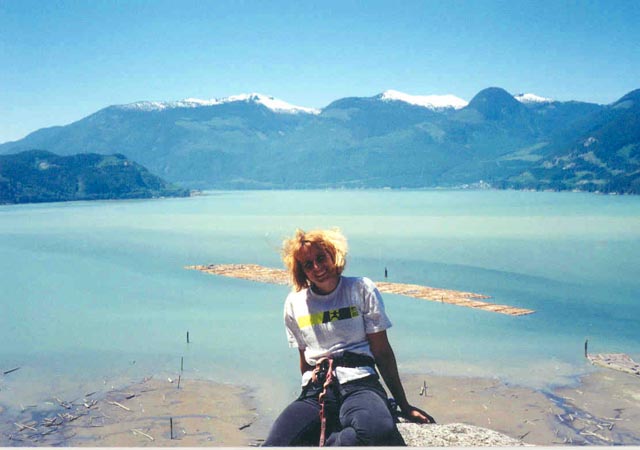
Todd leads a route that can be reached from the shore, Lost Horizon (10b). So far all we’ve done are cracks. This is our first look at Squamish friction. The route is called “Sport +’ in the book, meaning “bolts, but bring your gear.” Todd leads it with only a little hesitation at the crux friction move and I follow with the same. From the top we get a beautiful view of the sun setting behind the mountains across the channel from us.

Todd leading Lost Horizon (5.10b) at Seal Cove
Sunset from the top of Seal Cove
from the top of Seal Cove

“Now that we know we can handle 5.10 friction, we should be fine on the Apron,” Todd says. We’re getting used to the rock here. This is not Yosemite granite, slick and polished. This rock has texture, as the backs of my hands and the seat of my pants can attest to.

But we’re not ready for the Apron yet. We’ve targeted Wednesday for that, somehow calculating that it’ll be the least crowded day. So on Tuesday we check out Starr Wall and Stooges Slab in the Upper Malmute area.

What I’ll remember most about Starr Wall is that I didn’t lead High Mountain Woody (5.9). I should have. My head hasn’t completely adjusted to the idea that I’d be fine leading anything here because bomber gear goes in everywhere. High Mountain Woody might have stumped me at the crux, but it sure wouldn’t have killed me. Should have. Those are the worst. Sometimes I lead things just because I know how bad the “should have” will be if I don’t, but this time another party arrives, rushing me to a decision before my waffling reaches that conclusion. As it turns out, the other party isn’t interested in High Mountain Woody anyway. Should have.

At the top of the Starr Wall

I lead a 5.8 at Stooge’s Slab. This is the friction area supposedly designed to encourage beginning leaders. I’m thinking to myself that beginning leaders might like their bolts a little closer together but the moves aren’t hard.

“I guess that might be fun,” I mutter as I bring Todd up, “if you’ve never led anything else before in your whole life.” It’s like a handicapped ramp. No holds – just walk up it. We move on without trying the other routes.

Next up is Shannon Falls. We want to climb to the right of the falls which means we have to cross the river. We walk up the tourist trail to the designated waterfall viewing area and crawl through the fence. I feel guilty about doing it, setting a bad example for the children, but these are the approach instructions given in the guidebook. Now we’re supposed to cross on the big log. Crossing the first half of the river on the log is no big deal. It’s a really big log. But the second half of the river is higher than the log in the middle and the current racing over the log is swift. This is not the way to go.

We walk downriver along the shore until we get to a shallow, slower-moving section and cross there. I take off my shoes and roll my pants up to my knees. Todd, wearing shorts, forges across in manly fashion with his shoes on, while I tiptoe delicately across the slick boulders. Once across the steam, we walk along the other bank until it’s possible to scramble out of the water and pick up the trail.

There’s a pair of climbers working on the classic Local Boys Do Good (5.11a). Very funny. The leader is at the first belay and it’s apparent that he’s never climbed a multi-pitch route before in his life. He can’t figure out how his partner is supposed to join him at the belay.

“I don’t know how we’re going to build an anchor for you, dude. There’s only two bolts here.” We lend them one of our cordelettes and then try to ignore their antics completely while I lead Klahanie Crack (5.7). Klahanie Crack isn’t hard and it isn’t steep but it sure is long. My initially casual attitude towards a low-angle 5.7 crack deflates as I climb.

The low angle is working against me. With every move the rack swings forward and into the crack. First, I step on a blue alien still attached to the rack and can move neither up, nor down, nor reset my foot to free the alien. Finally I plug a piece in overhead and hop-step the alien clear. Next, pieces of the rack start placing themselves. At one point when I can’t move I look down and see two nuts stacked in the crack. Cool. I’ve never placed stacked nuts before. I wonder if any of this self-placed gear will actually catch me if I fall off while trying to disentangle myself from it.

Finally, I’m just exhausted.

“I don’t know how much more I can do,” I complain. It’s my feet that are the worst. Luckily, a small horizontal seam appears and I grab a rest on it before finishing. By the time we’re done with Klahanie Crack, the folks next to us have given up on their attempt at multi-pitch climbing and are rapping back down. We negotiate to swap ropes with them. Todd had planned to lead the first pitch of Local Boys Do Good (10b) and then maybe take a stab at the second but “I’m not proud,” he says and we take the top rope. As it turns out, getting to the first bolt is sketchy enough that, without a stick clip, we’re glad for the TR.

Me leading Klahanie Crack (5.7) at Shannon Falls

The route is hard and fun. Todd shows me a picture of it in the guidebook later. “It wasn’t that low-angle when I was climbing it,” he says. It certainly wasn’t. In the book it looks no steeper than the 5.8 at Stooge’s Slab but in reality it was a helluva a lot trickier. For some reason, Squamish suffers unusually heavily from the foreshortening effect.

Todd leads a 5.8 crack on the next wall and then we head back down to re-cross the stream. Wading barefoot down the far bank I slip and land butt-first in the river. My pants are soaked – my second pants disaster in as many days. As I drip back to the car I just know I’m being pointed out as “why you don’t play in the river” by mothers across the park.

Todd leading Cardhu Crack (5.8) at Shannon Falls

Finally, the big day dawns – our Apron day. The long route day. The Chief itself. It’s another beautiful day, though windier, and our plan is to start with The Bottom Line (5.9) and climb our way up to the ledge where Diedre, Banana Peel, and all the rest start. Finding The Bottom Line takes some work since there are no people nor signs of people, just dirty slabs with the occasional clean streak to indicate a route. Todd leads the first pitch, which the book recommends gear for. Then I lead the second pitch, which the book (amazingly) doesn’t recommend gear for. I carry the rack anyway because I’m leading and someone has to carry it and I’m awfully glad to have it since clipping the first bolt is one of the hardest moves on the pitch and the first bolt is some 30 feet above the belay.

I backclip the bolt and spend a frantic few minutes trying to fix it without killing myself. Even with the gear I’ve placed, I’m a long way up with a treed ledge to hit on the way down. Finally I clip a second draw to the bolt to protect me while I rearrange the first draw and get it right. A few hard moves lead off from the bolt and then it’s easier, but very runout, climbing to the belay. The last 30 feet are pure unprotected friction. I move with the utmost caution, remembering my long fall on the White Way at Wall Street. Of course, this is bullet-hard granite, not crumbling sandstone. As I belay Todd up I’m annoyed to see him walk up those last 30 feet without touching his hands to the rock.

Once at the top of this three pitch route we traverse across the small forested ledge to the start of the other routes. What we find is unexpected. I can’t emphasize this enough. We absolutely didn’t expect to find . . . people. Yes, here indeed are the crowds we’ve been repeatedly warned about but haven’t encountered. There are people everywhere, including two waiting parties totaling five people at the shared start.

We’re offered Snake, a “scary 5.9” with a separate start but decide we’ve just done “scary 5.9” and pass. After sorting through the people a bit we realize that everyone waiting, including the party currently climbing the shared start, is heading for Sparrow. We plonk down to wait, figuring that once they’re out of the way we’ll have a long stretch of Diedre clear ahead of us. It’s our turn quickly and I lead the short, unprotected first pitch and Todd follows. Unfortunately, during all this time, the lowest party on Diedre hasn’t moved. At all.

We can still bail from here. Todd figures he can belay me down and then downclimb off to the side a bit, using the tree we’re anchored to as protection. Instead we make a hideous mistake. We see that there’s no one on Banana Peel (5.7) for as far as the eye can see and we decide to climb it. What we don’t know is that just beyond where our eyes can see sits the slowest moving party of three that has ever climbed rock.

There’s no escape from the Apron, no rap lines, no way out but up. We climb maybe 10 minutes for every hour we sit. The pitches seem short, although some of them are almost a full rope length, because they’re so easy as to be uninteresting and so runout that no time is wasted on gear placements. We TR random bolt lines not documented in the guidebook that we run across at belays. We share our first on-belay pee. Somehow we end up doing the 7 pitch route in 9 pitches. By the end I’m desperately offering to simul-climb, something I’ve never been willing to do before, if only it’ll get us past them.

Finally, I pull onto the last ledge at the tree line. The guy belaying next to me is from the party who was in front of us at the starting line. I guess their route to the top hasn’t been any faster than ours. I can only hope it was more interesting.

“Banana Peel?” he asks. I nod. “How was it?”

“Mind-numbingly boring,” I say.

If the climb up nearly put me to sleep, the walk down is certainly an eye-opener. You just walk down the slab. Face out. Unprotected, totally exposed, for a long, long way. It’s steeper than the route. I swear it is.

We’ve climbed 13 pitches today, including the sidebars, but it feels like we haven’t climbed at all. I wonder if we should have held out for Diedre. At least it looks like the climbing would have been more interesting.

“Oh, well,” I say. “It was a good rest day anyway. I haven’t stuck a single body part in a crack all day.” Then, the kicker. Back at the car I take off my harness and feel that familiar breeze. Yes, I’ve ripped the butt out of another pair of pants. Butt-scooching on this rock is death for pants.

The next day, our last, is another beauty.

“Doesn’t it ever rain here?” Todd asks our waitress at breakfast. She looks stunned. Stumbling over her words she tries to explain that it rains all the time. Earlier in the week a passing soloist claimed that it had been an unusually rainy season so far. But we’re not buying it anymore. We suspect the bad weather mystique is a hoax perpetuated to keep potential visitors away. As proof of the this theory, the weather forecast for Squamish, as viewed from Connecticut, was 65 F and mostly cloudy for the whole week. The actual weather, as viewed from Squamish, was 75 F and cloudless. It’s all an elaborate conspiracy.

What to do with our last day? Something more interesting on the Chief like Calculus Corner or Rock On, both highly recommend? The Lower Malmute, beautiful lines but mostly hard? Try to find our way to Star Chek, the route Fern recommended that climbs out from the Cheakamus River in three bolted pitches? I vote for a return to Smoke Bluffs, which I’ve enjoyed best of all the areas we’ve sampled so far.

So we do a Smoke Bluffs whirlwind tour, visiting Burgers and Fries, the crag you can watch from McDonald’s, where I lead its namesake route (5.7); Alexis, where we TR my favorite route of the whole trip, White Streak (10c); High Cliff, where we completely fail to get up Red Nails, the 11c “test piece” finger crack; Island in the Sky, where I pop off the first moves of Fissureman’s Friend (5.8), scaring myself when I unexpectedly land on my butt but not hurting either myself or my pants; and finally The Zip, where Todd leads The Zip (10a) as an excellent finale to our trip.

“You could have led that,” Todd says. And in a way it’s true. It’s easy to see how a person who calls Squamish home could become a confident leader. The bomber rock, placement opportunities so boundless you have to limit your greed, soft landings on dirt made spongy by (supposed) regular rain, the fact that you can almost always scramble to the top and rap clean your gear if you decide to bail. Add to that short approaches, gorgeous settings, and a two minute drive from fast food alley to cliffside. What happens when Squamish climbers try to climb somewhere else? It must be a rude awakening.

Not that you should climb at Squamish, because you shouldn’t. It’s mine, all mine! I mean, it’s crowded and the weather sucks. Yeah, that’s it. Big crowds. Rains all the time. Bad. Squamish bad. Very bad. Trust me on this one.

Maria, Indirect

I’ve never climbed the third pitch of Maria (5.6). In fact, I didn’t even know Maria had a third pitch. I led the second pitch once and finished at what seemed like the top. We walked off at any rate and if that’s not the definition of “top” I don’t know what is.

But a thread on Gunks.com about favorite pitches has since made me aware that not only does Maria have a third pitch but that said pitch is supposed to be stellar. Todd leads Maria Direct and I follow him up to the belay. It occurs to me that I’ve never climbed the first pitch of Maria either. Maria, in my mind, consists solely of the second pitch, an easy, beautiful, well-protected corner.

“Go as far as you can,” Todd says as I’m leaving. Yes, yes, run the pitches together. It’s his mantra. So I intentionally run it out a little in this secure corner, knowing I need to conserve gear and slings. I pull onto the ledge that marks the end of the second pitch and look around. Above me the rock has ended but to the right I see another short outcropping.

I climb back down and extend the sling on my last piece, then walk across the ledge ten feet or so to where the route starts again. It’s a right-facing corner, short and capped by a roof. I climb as high as I dare before placing gear. I’ve been in ground-fall range since starting this third pitch, since the ledge beneath me is effectively ground. The concern, of course, is rope drag. I need to get high enough to allow the rope to form a straight line between my last piece on the previous pitch and my first piece on this pitch.

I place a tri-cam in the corner, throw four feet of sling on it and know that I’m still screwed. The rope runs from the end of the first corner, across the ledge, under a lip formed by the start of this corner, and then up to the piece I’ve just placed. Two right angles.

The sensible thing is to come down, set up a belay on the ledge and climb the third pitch independently, as it was meant to be done. I’m not feeling sensible. The top of the route can’t be more than 30 feet above me. Surely, there’s a way to get there from here.

Aha! There’s a horizontal on the left face around the side of the corner. I can place a cam there and keep the rope out of this second corner altogether. I clip the cam and unclip the tri-cam. I’ve been standing here forever already but it’s my duty to clean the tri-cam if I’m not going to clip it. It was a really good tri-cam (figures). Out comes the nut tool. Poke, poke, poke. Clean! Ooops!

Right. I’d unclipped the tri-cam. It slips backwards into the crack, bounces down the inside of the corner, falls out of the bottom, and lands somewhere on the ledge. I suppose I have to go find the damned thing. Todd is a million miles away and out of sight. There’s no way to communicate that he should look for the purple tri-cam on his trip across the ledge.

I downclimb. I find the tri-cam. I climb back up. I climb higher than the cam. Woo hoo! Upward progress for the first time in 15 minutes. I have to stop every move to reflick the rope out of the corner but my strategy has been successful. I’m rope drag free.

I go all the way up to the roof without placing any more gear. The pitch is so short, the runner on the last piece so long, that I’ve more than likely been in groundfall range the whole distance anyway. Don’t think about it. Protect the roof.

I place a piece, a cam in the crack beneath the roof, clip it with only two feet of sling. This is the scary part after all and rope drag be damned. I start the roof. I stop the roof. Roof hard. I place another piece, just over the roof. Two feet of sling, the last two feet I have.

I make another false start over the roof. I don’t think I’ve ever taken this long to climb 30 feet before. Todd must be wondering what’s going on. I wedge myself into the chimney-like alcove beneath the roof and try to place a piece even high. It’s nearly no-hands wedged in like that and I’m able to get a lot of height over the roof without any effort. I try to fish in a nut. Higher, little higher, little higher. Damn. You know, I’m practically over the roof at this point. I put away the nuts and pull over the roof in one simple move. My namby-pamby shilly-shallying has unlocked the mystery of Maria.

It is indeed a short distance from the roof to the tree line. Rope drag is bad from the last two pieces but its bearable and doesn’t have to be borne for long. But now we have a new problem. I’m out of slings and the only anchor options up here are trees. You can’t wrap a draw around a tree. I suppose I could make a draw chain but . . . No, that doesn’t seem like the way to go.

I decide to use the rope itself and start pulling it up. I need to pull up quite a bit to get it wrapped around the tree and tied off. Suddenly the drag changes from bearable to unbearable. I can’t pull up any more rope. Am I out? I just manage to tie off using the rope I have. I use my prusik’s girth hitched together to sling a smaller tree as a backup and anchor in.

The clock is ticking. If the rope came tight on Todd, he’s climbing now. It’s the rule.

“30 seconds,” he said the other day.

“Couldn’t we make it two minutes?” I argued.

The issue is how long Todd will wait before climbing after the rope comes tight when he can’t hear me. I feel an extra minute can’t hurt. He feels it shouldn’t take more than 30 seconds to stick the rope through the belay device. His argument doesn’t account for what has just happened, the rope going tight before the belay is finished.

Tick tock. Tick tock. I slam the rope into the belay device, give everything one last frantic look, and start pulling. Sure enough, I’m getting rope now. I pull until the rope stops and then yell down “Belay on” uselessly. He’s climbing already and I know it.

I pull in slack wearily, feeling like the old man in the Old Man and the Sea except that I’ve won my epic battle. I’m reeling the fish in now.

Welcome to the Gunks

I’m sitting on a belay ledge halfway up Travels with Charlie (5.8-R), contemplating the nature of climbing R-rated routes. Somewhere above me Todd is contemplating the R-rated route itself but it’s not him I’m worried about. What he’s doing, he’s at least doing intentionally.

I’m worried about the guy to my right, the one leading Strictly from Nowhere (5.7). This guy ran it out from the big belay ledge with about six people on it to just under the roof, then accidentally lifted the single piece under the roof out with his foot as he climbed past it. I figure he’s looking at a sixty foot fall as he wrestles with the route’s crux. I don’t want to watch him die. Tangentially, I’m worried that if he falls I’ll instinctively tighten my own belay and pull Todd off.

The guy pulls the roof and I sag back against the ledge with relief. I think about the YOSAR dictum “Did you plan to solo today?” and wonder if this guy planned to climb an R-rated route today. Then he calls down “off belay” while standing on the lip of the roof before placing a single piece and I decide he’s not worth worrying about. When I hear about Steven’s accident on Monday I want to find this guy and shake him.

Todd is in some kind of R-rated mood today. We started with Drunkard’s Delight (5.8), not actually rated R because the potential for damage comes so close to the ground. We call that “a bouldery start”, which means “at least we won’t have to lower you down on a litter”. Todd sketches on it. Then Travels with Charlie. And now, for some reason, Welcome to the Gunks (5.10). After feeling jittery on 5.8R, I personally would stay away from Welcome to the Gunks and its 5.9R section. But there it is, the difference between Todd’s lead head and mine: he’s trying to get his lead head back by pushing it, not by babying it.

It’s like a circus here, starting with the topless woman who raps down to our left as we’re gearing up.

“Don’t stare,” I say. I saw her first and have already thoroughly checked the situation out, so I can afford to take the high road now. Eventually she puts a shirt on and we’re able to continue.

Todd dithers up and down through the first roof. We’re constantly distracted by ropes and rocks coming down on us from a nearby rap station. First the hail storm of rocks, then a single rope, followed by “rope!”, then a long pause. What are they doing? Finally, the second rope comes crashing down. It’s a nice clean throw apparently. Every party manages to land their rope in our midst in one dramatic burst.

Now Todd is facing the single 5.9R move on the route, trying to find a sequence he can commit to. Up and down, up and down. I don’t really worry about him in situations like this. Todd doesn’t fall off when falling off would be a bad idea, a skill I don’t have.

Whap! Another set of ropes arrives with a flourish, this time bringing a battered, bloody body with them. A leader fall, not serious but not pretty. The guy has road rash across his back and a lump the size of an egg growing on his elbow.

“Why don’t you come down?” I say to Todd. Even if he pulls through this section there are still three more roofs to deal with. I’m tired of belaying at attention. I’m nervous from seeing warning signs everywhere I look. I don’t want to be the timid, nagging girlfriend but enough is enough.

“One more try,” he answers and I think I hear relief in his voice. Maybe enough was enough for him too. He traverses off to an anchor on the right and Andrei and I at least get a chance to work on the first of the Welcome to the Gunks roofs and later we all take a try or two on the Laughing Man (5.11) roof, directly below this anchor.

The onslaught of ropes and rocks continues. People we know, and people we don’t know, rap in, wander by, grab a ride, and stay to watch the show. Welcome to the Gunks.

Not-so-Trad Girl: A Confession

So the question is: would rapping Epinephrine really be a betrayal of the name Tradgirl and everything it stands for? There are people who think so, but I’m not one of them. I only wish I hadn’t asked if it was possible in the first place. Now I feel like the whole world is waiting to see if I can live up to the Trad in Tradgirl.

Trad. It’s a loaded word. I only ever wanted to get farther from the ground, and I thought that trad would take me there. I didn’t know the label would come to weigh on me in a million little miserable ways. I mean, I knew I wasn’t an alpine climber. And it didn’t take me long to discover that I wasn’t an aid climber. But I thought, well, I thought, that I could climb trad.

“Let’s just do it,” I say to Todd. We’ve gotten a typically late start somehow, despite getting up at an ungodly early hour. Now it’s well after 10:00 a.m. and we’re at the base of Epinephrine (5.9) trying to decide whether or not today is THE day. “I just want to get it over with,” I add. “Then maybe we can enjoy the rest of the trip.”

Another party is just starting the chimney. As Todd leads the pitch that will take us to the base of the chimney we can hear them moaning and groaning above us. Someone up there isn’t having much fun. I had planned on taking the first chimney pitch, but when I join Todd at the belay he tells me that he wants this lead. We can still hear lamentations from the party above us. They’ve gotten the pack they’re hauling stuck. We firmly expect to catch them by the top of the tower.

So Todd sets off and soon I’m hearing even more moaning coming out of the chimney. Sometimes I’m pretty sure it’s Todd and sometimes I’m pretty sure it’s not and sometimes I think they must be moaning in concert. He says later that it took him an hour to lead the two pitches as one but I’m at a comfy belay spot and I don’t notice the time flying by. With about 30 feet of rope left he starts complaining about being runout and not seeing an anchor.

“You’re almost there,” the party above him calls down and sure enough it’s only a few gasps later before he tells me that he can see the anchor. Then it’s my turn to start huffing. The chimney begins innocently enough, a nice width. I move quickly: butt, feet, hands, butt. So okay, this is a little tiring. It takes an awful lot of . . . what? Thigh muscle, maybe. And then it gets bad. The chimney narrows and now it’s knees, butt, hands, squirm. Thank God for the kneepads at least.

Todd at a belay in the Epineprhine chimneys

The party above us has escaped. I’m the only one groaning now. What made me think I could lead this? I’d be terrified, stuck here, wedged in, no gear in sight below me and the tantalizing prospect of gear above me that I can’t reach because I’m stuck here, wedged in. I’m glad I’m on toprope but would be even gladder still to be out of the chimney altogether. A brief respite in the form of ramps up the back of the chimney and then one more burst of that hideous narrow stuff and I’m at the belay, gasping and heaving, slumping down on the 6 inch belay ledge like a rag doll. Only 200 feet to go.

Me at a belay in the Epineprhine chimneys

Confession: I don’t consider suffering to be a necessary, or enjoyable, part of climbing. Chimneys count as suffering.

Todd offers me the sharp end and I hem and haw over it. Not if it’s anything like that, and yet I want to do this. I’m so torn between the need for safety and the desire to be a full member of the team that I can’t make a decision. Finally, we agree that I’ll try, aiming for the next belay rather than the top of the tower.

My pitch is certainly the easiest of the chimney pitches. I have only a brief section of comfortable chimneying before I get to escape through a series of cracks to the anchor. Some tricky moves in there but my feet are firmly beneath me where they belong, not jammed into my butt like I’m some kind of contortionist. When I reach the anchor I consider continuing. There are bolts up there. But when Todd suggests that I bring him up, I happily agree.

Me leading the third chimney pitch on Epinephrine (5.9)

It has already sprinkled once today and now, as Todd leads through to the top of the tower, it starts again. Only a few drops of rain fall but the wind picks up and the temperature drops. Todd is stuck at the move to get out of the chimney. He goes back and forth, unhappy with the gear, unhappy with the move.

“OK,” he says, more to himself than me, “I’m just going to do it.”

“You really need to,” I think, but don’t say. The winds are nearly gale force; I’m shivering in my t-shirt and I’m prepared for the deluge to start at any moment.

Finally he commits to the move. “Easy”, he says and he’s gone, moving quickly to the top of the tower and off belay. My hands are shaking as I dismantle the anchor. I’m eager to climb, just to be moving and to be warm again. This stretch of chimney is much easier than the double pitch at the start and as I climb I think “yes, I could have led this. I should have kept going.” But then I’d be the one at the top of the tower now, exposed to the elements.

When I reach the top I ask Todd what time it is. 3:45. On the one hand, we’ve done the first half of the route in a little over 5 hours, an acceptable time. On the other hand, we haven’t made up the time we lost by getting a late start. We don’t stand a chance of finishing the route.

“We could see how high we get,” Todd suggests.

“I just want to go down,” I say. The hell with what anyone thinks or expects of me. The wind is whipping around us and although no more rain has fallen than those first few drops, the air is heavy and moist. We begin a tense descent. The ropes stick on the very first pull and Todd has to climb back up 30 feet to free them. We’re very concerned. Neither one of us wants to re-climb any portion of the chimney under any circumstances. The wind is strong enough to pick up the cams hanging from my harness and fling them into my back. The rope ends below us have a life of their own. We rap cautiously, not skipping any stations, always careful to pull the lead rope. When I hit the anchor from which I first belayed I know we’re safe. From here we can rap on one rope if we have to by slinging the trees on the ledge, but it isn’t necessary. Miraculously, both ropes end up on the ground with us.
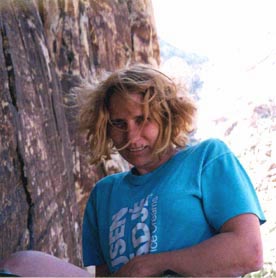
Just about being blown off Epinephrine on our wild rap down

We walk out feeling somewhat demoralized. Every part of my body hurts; I have bruises all along my spine. The wind keeps blowing us into pointy bushes and leg bruising boulders. We’re still waiting for the rain. We did not climb Epinephrine to the top, but we climbed Epinephrine. It’s done.

The next day I’m belaying at the bottom of Frogland (5.8), which we’ve found surprisingly empty, when I hear another party approaching. An older guy and a younger guy clamber on up to the ledge. One of them asks about our MEC pack and somehow we end up on the subject of ordering gear from foreign websites.
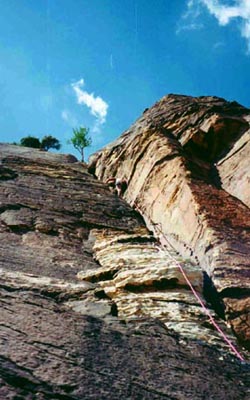
Todd leading the first pitch (5.7) of Frogland (5.8)
Todd leading the first pitch of Frogland (5.8)

Confession: I like the easy sociability of places like the gym and the Gunks. I don’t climb to get away from my fellow man.

Todd is quickly off belay so we don’t talk long before I’m heading up to join him. I’m sorry to say goodbye to the first climbers we’ve met on this trip but I don’t expect to see them again. They’re only just starting to unpack and we’ll certainly be faster than some old guy and his partner. As I pull onto the ledge where Todd’s belaying I give a quick glance back down to the bottom of the route.

“They’re still racking up,” I tell Todd as I grab the rack and lead through. A pleasant low-angle corner leads to a short hand crack. There’s a cam fixed up there so I step up to clip it but have so much trouble fishing the sling out of the crack and find myself so unstably jammed that I have to step back down. After another false start, I finally remember enough jamming technique to hold steady and clip the cam. Another few moves and I’m through this short section of crack but during the pause I’ve become aware of the fact that not just one but both of the other climbers are at the belay with Todd.

Todd following me on the second pitch (5.6) of Frogland (5.8)

“How the hell did that happen?” I ask myself. Aside from this one bumbly section I’ve been leading smoothly and quickly. Luckily the anchor is fixed so I don’t have to muck around with gear for long. The slowest part of my leading is usually getting the belay arranged.

Confession: I think convenience anchors are the greatest thing to happen to climbing since we gave up the hip belay. Finding a nice set of bolts never detracts from my enjoyment of the climb; it enhances it.

As I belay Todd up I’m dismayed to see that George, the old guy, is following along about 10 feet behind him. When Todd pauses for a moment I shout down “Forget about trying to clean that cam.” Like most men, he’s incapable of leaving behind a piece of potential booty.

“Don’t worry, I’m already past it,” Todd answers.

“Should we let them pass us?” I ask him as he joins me. “They’re really fast.”

“If you want to,” Todd says, but we’re saved from having to decide when George detours to another belay below me. He and his partner plan to take the original route, which the Swain book describes as a variation. As an added bonus, George’s partner spends some time fishing for the fixed gear. Despite all that, their leader starts up from their belay before Todd is finished leading the next pitch.

Now I’m worried. The other leader’s path is going to intersect with ours and I need to beat him there. Otherwise, well, otherwise it’ll just be a mess. He diddles around a bit with what looks like an intimidating roof above him while I quickly pull the intimidating roof above me and scurry madly for the intersection point. Got it! By about 15 feet.

So now three of us are at the next belay and it’s my lead and this looks like the crux. One of two 5.8 pitches, it starts with a spooky-looking runout to a bolt and then heads up to a spookier-looking roof. I’m supposed to “fingertip traverse” under this roof according to the guidebook, which sounds like a godawful thing to have to do at 5.8, and I can’t tell from here how high I’ll be able to get gear in.

“Maybe I shouldn’t”, I say. I’m afraid of slowing this circus train down if I get scared under the roof. I don’t want a whole belay ledge full of witnesses to my soggy lead head. Todd leaves it up to me and I figure the fastest way to go is to just go, so I grab the rack and cast off, only barely ahead of George coming up the pitch behind us.

Fortunately, once I leave the belay I forget about the audience. The climbing up to the bolt is easier than it looked and the runout doesn’t bother me a bit. I get gear in nearly under the roof and pause. The guidebook makes it sound like I’m supposed to be right under the roof, but the wall meets the roof so tightly I can’t imagine being able to crimp across it. Instead I scope out the chalked line a few feet below.

“Here are the hands,” I think, “but where are the feet?” There’s a bulge down there. Not edges–beautiful secure edges–but friction is what’s going to get me across this thing. Mindful once again of how many people are waiting for me to move, I take a deep breath and go. The traverse isn’t that long. One piece in the middle might be nice but it’s not to be had so keep going, sketchiest move at the end, fingers in the crack, an edge for my left foot, phew!

I’m shaky and want gear. The little crack above me looks hard and I’m thinking of my duty to Todd besides. I try to fish in a nut but the crack is too small.

“Aren’t we carrying the brass nuts?” I ask Todd, unable to find them in the typically messy state I leave the rack in. OK, we’re not carrying the brass nuts. But there’s a pocket and I have tri-cams and that’s what they’re meant for, right? I put in a very unsatisfactory red tri-cam.

“Is that a good piece?” Todd asks, which is what he says when he wants me to know that now would be a good time for a good piece.

“No,” I tell him. “But it’s all I’m getting.” By now I’ve realized that I’m going to climb the arete just to the left of the tiny crack and not the tiny crack itself, which makes me feel a lot better. That’s 5.6 climbing over there and then a dash up a much nicer crack to the unfixed belay. I scope it out as quickly as I can and even get in a piece for upward pull. Nicely done.

“George says most people undercling the roof,” Todd tells me when he gets up there.

“Then why is all the chalk three feet below the roof?” I ask him.

“Maybe the undercling is so great you don’t need chalk,” he says, sticking his tongue out at me, and then he dashes off for the next pitch since we can hear George below us practically at the crux already.

“Dawn?” George calls up to me. I can just see his head below me. He’s at the tiny crack after the traverse. “What did you get in here?”

“A tri-cam,” I tell him, which is too bad because he isn’t carrying any. I find it funny and flattering that he would ask me since it’s become clear by now that he could solo the route blindfolded in his tennis shoes. But it’s also becoming clear that he’s a careful leader who doesn’t skimp on the gear out of foolish pride. I don’t know what he gets in but soon he’s just beneath me and with no way to a stance except to go through me.

At my invitation, and with an incredible amount of apologizing, he climbs over my belay to a stance where he can sit but not, unfortunately, get in enough good gear to set up a belay of his own. He has to wait for me to clear out so he can use my stance but he spends the time re-apologizing for climbing over me (“terribly rude” he says again) instead of fuming over the fact that we’re holding him up.

Confession: I don’t think there’s any one “right” way to share a route and I’d much rather deal with a pleasant, polite person like George than with someone who has a rule book printed on his forehead.

“We’ll see you on the descent if we get lost,” I tell him as I’m leaving, which, as it happens, we do. Todd and I cruise through to the top but make a false start down the wrong side of the formation and have to climb back up to check with George before starting down again. The right way this time.

They catch up to us on the descent and we let them pass. They’re making it look as “surprisingly quick and simple” as Swain says it is, though Todd and I are slow and miserable–slipping, downclimbing, butt-scooching, trying to follow George and his partner, but eventually getting so out-distanced that we have to find our own wandering way back to the base of the route.

“A descent like that takes all the fun out of a route,” I say.

“I may be done climbing,” Todd says, looking at the blister that’s popped on his little toe.

“Trust me,” I tell him seriously. “We’re both done climbing.” I’m thinking that we still have to get down the hill and make the long walk out of the canyon before we’re back at the car.

Confession: I love rapping. I’d rather rap than walk off any day. And don’t tell me how much safer walking off is. You haven’t seen me do it.

I’d say that the best part about climbing Triassic Sands (5.10a) was rapping back down from it in two easy raps but that would be selling the route short. This beautiful route starts with a sparsely protected but secure 5.7 pitch up to a ledge, which is where the real fun begins. I’d heard a lot about this route, including Todd’s opinion that I could lead the 5.10 pitch.

“It’s one move of 5.10,” he said.

“So what’s the rest of it?” I asked sarcastically. “5.9+?” 5.9 is my absolute leading limit and by the time we struggle up to the base of the route I feel like I’ve had my fill of excitement for the day. These long, hot, uphill, uncertain approaches are going to be the death of me and we sit for 15 minutes before we even think of gearing up. I take the first pitch and leave the 5.10 for Todd.
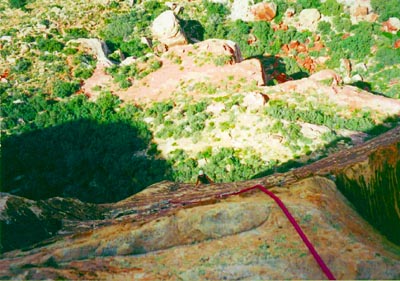
Todd following me on the first pitch (5.7) of Triassic Sands (5.10a)

Although the short crux section is protected by two pieces of fixed gear, it’s certainly more than one move long and it’s not soft like some people would have you believe. Todd takes it seriously enough to place gear in between the two fixed pieces and when it’s my turn I struggle with the moves and only barely get them clean on toprope.

Above the steep section is a nice crack, surrounded by those classic Red Rocks varnished edges. Take your pick: jam or crimp; it’s all up to you. I do a bit of each on my way up to join him. The climbing feels sustained and I’m a little pumped from the hard stuff below. I’m glad I didn’t lead this pitch.

The next pitch, which is the last we do (if you continue on, the fixed anchors end and you have to walk off), is the most beautiful pitch I’ve ever led. Much like the end of the crux pitch, a highly featured crack runs straight up for miles. The only downside is that the crack is fairly parallel and same-sized for much of the way.

I start off from the belay conscious of the fact that I need to ration out the gear in that size. On the other hand, I know I should place a piece shortly after leaving the belay. I climb until the two concerns balance out and stuff in a cam.

“Hey, I get bolts,” I say, looking up. “Three bolts in about three feet.” I climb a little farther. “Actually, it’s like four in four feet.”

“Must be the old aid line,” Todd says.

“Or there’s something really hard up there,” I answer.

I clip the first bolt, an ancient, rusted looking thing and then bravely skip the next one. I don’t want to run out of draws. I clip the next two and continue merrily on my way.

Confession: Sometimes I trust the oldest, mankiest looking bolt you ever saw more than my own freshly placed gear.

Some lower angled climbing leads to a change in crack size and a corresponding change in gear size. Then my crack ends and I traverse left, placing a pink tri-cam along the way, into a similar crack and from there up to the belay ledge.

“I could lead that pitch all day,” I tell Todd when he joins me. We rap off easily and debate what to do to finish out the day. We finally decide to run up the first two pitches of Prince of Darkness (5.10c). It was on the to do list but we never got over to it. Now we begin the trudge down and around to that area of the canyon. Even though we’re making it up as we go along, this turns out to be one of our more successful trudges.

Me following on the first pitch (5.6) of Prince of Darkness (5.10c)

There are three parties up there, which is odd because we’ve only seen a few other climbers on the whole trip. They’re spread across multiple routes but are all converging on the top and the rap back down. Todd flies up the 5.6 approach pitch and then hands me the sharp end for my taste of Prince of Darkness.

The guidebook says there are 14 bolts in 110 feet. So I ought to be fine, right? Todd hands me the small rack he carried for the 5.6 pitch.

“I think some of the pitches take gear,” he says.

“14 bolts in 110 feet,” I say. He hands me the gear anyway.

I climb confidently to the first bolt. Even the second bolt isn’t so bad. Then it gets steep. From below you can see that the wall bulges out and, although it doesn’t actually feel overhanging, it feels very, very vertical. Stances are hard to come by. Only a few moves, then a clip, but I’m starting to strain.

“How many bolts have I done?” I ask Todd, tired and ready to be at the anchor that I still can’t see.

“Four.”

“Four??!!!” I have a long ways to go.

I climb it in short chunks, from bolt to bolt. At each bolt I consider saying “take” to rest and re-gather my courage. Then I remember that I’d really like to get this clean and that I’m safe for now and I agree with myself to climb to the next bolt and see how I feel there. Every once in a while there’s a stance and at one point I step up and am sorely disappointed by the hold I was going for and panic briefly.

“I’m not happy here,” I say gloomily.

“You’re doing great,” someone rapping off to my right shouts. “Good, strong leader.”

“The bolt’s about a foot below your waist,” Todd adds, less inspiringly but more practically.

The combination reassures me and I shuffle around and move on again. Eventually Todd yells up that I’m at the half way mark. By then I can see the anchors, out of sight for most of the pitch, and better yet I can see that the angle eases off again for the last two bolts. I clip into the anchors and belay Todd up, dreaming of the water that he’ll be bringing before I remember that we left the water on the ground.

“Otherwise, it’ll be too easy to keep going,” Todd said. And sure enough I’m looking up, not down, and thinking that we could squeeze in at least one more pitch. It’s a shame not to climb the whole route but at least I get the gist of it.

As we walk out on our last day, I’m once again cursing at the branches that keep leaping out to snag and wound me and at the unsteady footing in the wash.
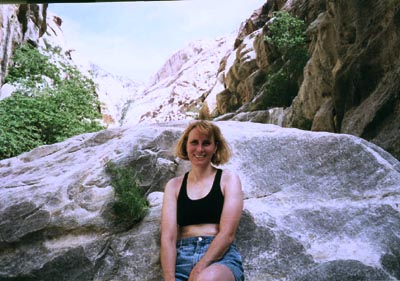
A peaceful moment in Black Velvet Canyon
A peaceful moment in Black Velvet Canyon – no bushes are attacking me!

“The climbing here is great,” I say, “but I’m not sure it’s worth the walking.” On some days I think we spent almost as much time walking as climbing. In my opinion, Red Rocks would be greatly improved it if were moved closer to the road. Of course, I realize that most of my trad buddies wouldn’t agree with me, but dammit Jim, I’m a climber not a hiker.

And I’m not a trad climber, not anymore. Just a climber. Sometimes I climb on gear, sometimes bolts, and I’ll gladly take a toprope, especially on something that’s too hard for me. If you see me, say hi. But if you want to tell me what’s wrong with climbers today, give it a miss. I’m what’s wrong with climbers today. And I freely admit it.

Looking out from a belay in the Epinephrine chimneys. Can you spot the rock that looks like a school bus about to drive over the edge?
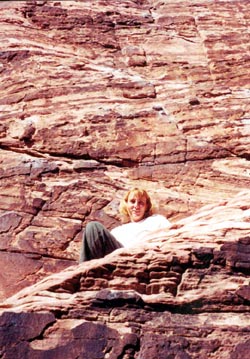
Dawn at the Cat and Dog crag
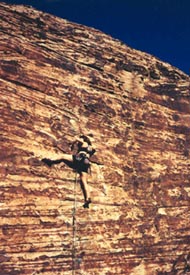
An unknown climber at Cat and Dog crag