5.9 minus

“Well, it was 5.9 minus,” I qualify. “5.9- is easier than 5.8+.” This isn’t just a one-liner. It’s the honest truth as I’ve lived it today.

We started with Triangle because I was looking to try leading some 5.9s that I hadn’t ever been on before and Triangle was 5.9- G, which seemed like the perfect sort of 5.9 to start with. I chose to take the right side up to the top of the triangle, because it seemed both easier and more esthetic. Now, standing at the top of the triangle, with a pin and something else at my feet, I’m confused.

“There’s pins everywhere up here,” I yell down to Todd.

“That’s good,” he replies with an obvious lack of interest.

“But they go different ways,” I explain. “I don’t know which pins to follow.”

“That’s not really something I can help you with from down here,” he says, an attitude he’s been taking more and more lately, which I suppose is both good for me and grounded in reality.

So I must find my own way out. This is what I know:

1. I can’t reach any pin from where I’m standing now.

2. There’s no gear in between me and any pin.

3. My last piece is at my feet.

4. It’s hardly a clean fall.

So much for G, is what I’m thinking but my survey has decided me on one thing at least. The pin on the left is only one move away off a bucket whereas the pin to the right is at least two thin moves away. I’m going left.

I step up, clip the pin, and step back down. I hang the rope and resolutely step back up again. Only problem is, there’s no move up there. Honestly. I swear. It’s not just a matter of my being afraid to fall, which I am, there really isn’t a move up there.

So I step back down.

I’ll spare you all the ups and downs. I’m becoming more and more convinced that the route goes to the right but I like having my friend the-pin-on-the-left clipped. I don’t wish to unclip him and chance the moves to the right. Ultimately Todd suggests that I just go check it out to the right and I do, find myself committed but climbing, and pull through the whole thing, clipping several more pins along the way but never unclipping the pin to the left.

I pester Todd about it the whole way home: what would you have done. He says he would have done the same thing I did–clipped the pin to the left and then gone right. I still feel a little like I cheated but when I give beta to a friend a few weeks later, that’s exactly what I tell her: clip left, climb right.

For all that, I didn’t really have any trouble with the moves themselves on Triangle, so later in the day I step up to lead Absurdland, 5.8+, with something like confidence. For one thing, it’s only 5.8, not 5.9, and for another, I’ve been on it before once when Steven led it. I remember that Todd and I were, well, I hate to use the word snickering, but underwhelmed let’s say, by the route’s difficulty that day. What with it’s reputation as an ankle-breaker and the way Steven had sewn it up, we were expecting something that was at least a little bit hard.

Why do they keep taking away all the easy routes at the Gunks and replacing them with harder ones? That’s what I want to know.

At least I know where the hard part is: close to the ground. It’s an ankle breaker, after all. So I put some gear in from the ground, then put a second piece in, then take it out cause it’s in my way and sucks anyway. I sketch around and go up and down and whine and complain.

“If that gear will protect that move, and it’s good gear, then why do people keep breaking their ankles?” I ask doubtfully.

“They probably don’t bother to place anything,” Todd answers. (Later we get a glimpse of why else they might be breaking their ankles. Listen guys, if the leader places a piece that close to the ground, it might behoove you to stand up and take the slack out of the rope. “You weren’t belaying me like that, were you?” I double-check. But of course he wasn’t.)

Eventually I make the move and place a piece from a shaky stance. Todd wants me to place a second piece, but I’m feeling good now. Through all the hard stuff on a 5.8+, pulled off a 5.9- earlier, I’m cruising to victory. Just this one kind of pumpy move. Then this next one, then this next one, really bad stance now, place gear, burning out, place another piece, shit, scared, pumped, downclimb, bad stance, bad stance, how far do I have to go?, dammit, take!

And I wish Todd wouldn’t argue with me when I say take. I wish that. I really do.

Somewhere up there the route did get easier, but not until it whipped my butt. By the time I lower off there’s folks racking up to take their turn.

“You looked smooth up there,” they say.

“You weren’t here for the ugly part,” I tell them. We exchange the story of our days. I tell them about hanging on Absurdland, about the other routes we did, about getting Triangle clean.

“Well, it was 5.9 minus,” I qualify. “5.9- is easier than 5.8+.” This isn’t just a one-liner. It’s the honest truth as I’ve lived it today.

Never Again

I literally hate this route. It brings nothing but failure and disappointment to all who climb it. And what’s worse is that it’s getting worse. Let me tell you about my enemy: Criss Cross Direct.

It all started because of a friendly wager as to whether or not Steven could lead a 5.10 cleanly before the end of the season. I don’t know why Steven picked Criss Cross Direct particularly except that it starts with a crack and he’s always trying to prove that there’s jamming at the Gunks.

To make a long story short, Steven didn’t get it cleanly and neither did I following him, but on my second attempt I discovered the “trick” to pulling through the crux. After that I dismissed the route as easy. I think Steven even did it a second time on TR to try out my trick, and we both walked away feeling certain that we’d never have any trouble with that route again.

Steven aiding over the roof on Criss Cross Direct - the only way to go if you ask me.
Steven aiding over the roof on
Criss Cross Direct – the only way to go
if you ask me.

I did it with Todd shortly thereafter and my confidence by then was palpable. I quote from the TR I wrote about that weekend:

I figured I could probably do the route cleanly – once you have it wired it’s maybe 5.9 – and I did. Todd thought I should lead it next but I thought that would just be a gimmick. I wasn’t ready to lead 10s, even if I could do this one, so why bother?

Ahem.

So now all three of us were set with the route. Todd onsight flashed it so smoothly that he couldn’t even pinpoint where the crux was. Steven will lead it cleanly on the next try, thus winning his wager with something like 6 months of season left to go, and I’ll probably make Criss Cross Direct my first 5.10 lead, perhaps before I even get around to my first 5.9 lead.

Ahem.

It’s not like I remember every time I’ve been on Criss Cross Direct individually. It’s more of a general pattern, a descent, a disintegration. Steven did not lead it cleanly on his next attempt, nor his next, nor, I’m pretty sure, even his next. In fact, in the end he won his wager with a different route altogether. As stressful as it got to be to belay with my fingers crossed, what was harder for me to bear was that I was no longer following the route cleanly either.

At first it was just a foot-slipping sort of thing, a moment of carelessness, I-could-have-done-it-if, but eventually I had to admit the truth. This route was better than I was. It wasn’t just the crux that was getting me either. There was something below the crux, that dark ugly crack in the corner, that had it in for me as well.

It got worse for Todd too.

“That was kind of hard,” he would say, puzzled, after his attempt and before mine which would end with a temper tantrum. He would run laps. I would refuse to climb the route at all if I fell off even once. Different strategies with the same result. “I think this route is getting harder.”

A couple of Saturdays ago, after what had been a good day so far, Todd says he wants to lead Criss Cross Direct.

“But why?” I whine. “I hate that route.” I hate worrying about falling off of it, I hate falling off of it, and most of all I hate the fit I throw after I’ve fallen off of it.

Somehow we go do it any way and, get this, Todd ends up hanging on it. Then I fall repeatedly, and I do mean repeatedly, trying to follow it, in brand new places even, and then Todd decides to run up it on TR and he still can’t get it clean. And so I ask you, what the hell is up with that route?

Never again. Never, never again. Todd thinks we should keep fighting till we conquor it but I say it’s time to admit defeat. If we had any sense we’d have quit two years ago while we were still ahead.

MF and Calisthenics

It’s a nice day and the three of us, Todd, Andrei, and I, are walking along trying to decide what to do. Andrei doesn’t want to do anything pumpy, which doesn’t exactly explain what happens next, except that it’s sort of my day to choose and what I want to do is lead MF.

MF has been on my to-do list, though not in any immediate way, since my first lap on it two and a half years ago when Steven led it on a misty but warm day in January. From the trip report I wrote about that day:

The move around the corner was terrifying, even on TR. It was burly, blind, and exposed. I pulled through it and moved up to the second crux, where I fell while trying to substitute brute strength for footwork, and then I finished the route. What a great route that is. I’m going to be pretty proud of myself the day I lead that one.

Burly, blind, and exposed. That pretty well sums up MF even all these climbing miles later. I have a goal this season of leading the following routes: Ant’s Line, Roseland, Directissima, Jean, and, of course, MF. In short, all the reasonably well-protected 9s I’ve already been on. So far I’ve done Ant’s Line.

But I learned something leading Ant’s Line that’s going to stand me in good stead. What I learned is that, when you’re leading, the crux isn’t always the crux. Sometimes when you’re leading the crux is getting up to the crux, and often the crux is just making yourself leave the ground in the first place.

That’s why I’m leading MF today, even though Andrei specifically said he didn’t want to do anything pumpy: because I told myself I would and because it would be too easy to tell myself I don’t have to.

I’m slow like molasses leading up to the crux, particularly trying to force myself to solo the start, which Todd always does. Really, it’s just faster if I put in gear, which I eventually do. Some guy walks by and says, “This is what’s so great about climbing today – more women. And more women leaders!” which thoroughly embarrasses me because I’m on the verge of wigging out.

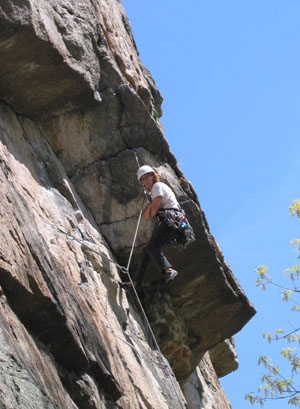
Me giving up on soloing the start of MF, 5.9

Eventually I get to the crux and get the pin clipped and grab the jug and try to haul myself around the blind corner, but I can’t seem to find a thing over there to haul myself with, so I downclimb back to the pin and hang, arms crossed, sulking.

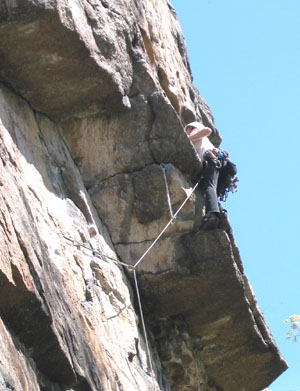
Me sulking while I hang on MF, 5.9

Todd offers up beta: get your right foot more right, get your left hand more right, in short get your whole body more right. Eventually I decide it’s about time to start climbing again, so I put my hands and feet on the rock and start to pull back in, but I can’t go anywhere. Todd has me so tight I can’t move.

“You’re pulling on me!” I scream at him. The situation doesn’t change, so I slump back down on the rope. At that very moment he gives me slack after all. “Now you’re dropping me!” I screech.

The crowd goes wild. I have the idea that they’re laughing at his inept belaying, but his idea is that they’re laughing at me: Give me slack, damn you! Shit, you’re giving me slack! He’s probably right.

“You’re supposed to say climbing,” he says by way of explanation. I think he’s supposed to be watching me in my monumental struggle against the great 5.9 and shouldn’t need to be told that I’m climbing.

Realistically I never watch him when he’s hanging either, but to be further realistic, he never says climbing. At least, he rarely says climbing and then actually climbs, so who listens to him? I puzzle the situation out while I continue swinging gently on the rope, a little lower this time after the slack incident, and eventually figure out that this situation is different because I’m hanging in space and need slack just to get back on, whereas normally the process of getting back on creates slack, alerting the belayer that something is about to happen.

“Climbing!” I say emphatically. I try the sequence again, this time getting my right foot more right, my left hand more right, etc. I can feel the rounded, pebbly edge that I’m supposed to use to pull myself the rest of the way around the arete but I don’t have enough strength left to do it.

Me trying to pull the crux on MF, 5.9

Naw. It’s probably more true to say that I don’t have enough courage left to do it. If I could believe that I could do it, I could probably do it, but since I can’t, I can’t. I have further to downclimb, which makes it a lot harder, so eventually I slip and swing. Wheee! If only all falls were this clean, falling wouldn’t be scary.

Hanging even lower this time, I go back to swinging and sulking. It seems I’m getting farther away with each attempt.

“I’m so thirsty,” I moan.

“If you backup the pin, you can come down and get something to drink and then either you can go back up or I’ll do it,” Todd answers.

I’m insulted. I only mentioned being thirsty because it was the God’s honest truth, not to use it as an excuse to bail. Have I been so long leading this route that my time is up already?

“Let me try once more anyway,” I say. I get back on again, get my right foot even further right and my left hand even further right and fondle that bumpy undercling and slowly, very slowly, start to pull myself around the arete until I’m standing, barely breathing, on my right foot.

Now for the hard part. Luckily I knew I’d feel panicked here, so I don’t actually feel so panicked. As badly balanced as I am, I have to clip the pin to my right. This is a rule. We don’t know why it’s a rule, why one should not simply step up a few moves to a good stance before trying to place gear, but there you go. A rule’s a rule. Everyone stands in this same spot, delicately trying to pull the rope across their body without dislodging their body from the wall. I’m no exception.

Around the arete but not quite done on MF, 5.9

Once I’ve got the pin clipped, I’m hugely relieved. To me, the challenges of the route are over, even though Todd is more worried about the upper crux than the lower one. The reason I’m not so worried about the upper crux is because it’s kind of slabby and I know I can step up and down as many times as I need to. The reason Todd’s worried about the upper crux is because it’s kind of slabby and he thinks I’m going to deck or something if I come off. I have to explain to him that it’s no more slabby than the 7s and 8s I normally lead. That’s the kind of fall we moderate leaders are always looking at.

Calisthenics

“Two pink, two red, one brown, one purple,” I insist to Lisa. “All sane Gunks climbers carry two pink, two red, one brown, one purple.” And then I tell her the story of Calisthenics.

“This is Calisthenics,” Andrei says. “5.7”

“Five seven!” I squeak. I’ve actually seen this route before but don’t believe in the so-called 5.7 start any more this time than I did the last time. The route starts with a dyno from the ground, about a foot for me, to a rail, then your feet must be heaved up to about waist level for a long move to a jug. Then it’s pretty much over.

“It’s a clean landing,” he points out.

Andrei and I throw our packs down and try the start. He goes through the first two moves casually. I surprise myself by hitting the rail on my first try.

“It’s a little run out after the start,” Andrei warns me, “but it’s like 5.6.” Run out 5.6 slabby face moves don’t scare me. After all, I’ve led City Lights ever so many times. So what the hell. I’m wicked strong these days. 5.7 though it may not be, still I’ll give it a shot. I take Andrei’s rack, array myself with runners, tie in, lace up, make sure Andrei has given me plenty of slack, position myself beneath the dyno, and jump.

Oops. This is the ground. Jump again. This is my butt on the ground. Hmmm. Why was this so easy before and so hard now? Oh yeah, it’s because I’m wearing about 20 pounds of gear.. I keep missing the rail, or just snagging it with my fingertips, and toppling back over. This is getting silly now.

Finally Andrei gives me a boost.

OK, then. All difficulties behind me I begin the process of wandering around the face above looking for the line of least resistance offering the best chance of gear. I do very badly. After clawing my way through mud and a series grass hummocks, I gain a big ledge whereupon I traverse far to my left to sling an enormous tree. This tree gives me immense satisfaction as a truly bomber piece of gear. It’s to be the last one.

No matter which way I go, tempted by the lure of gear, I am disappointed. When the chance of gear does arrive, it is very poor. At my first opportunity after the excellent tree I’m stumped by not seeming to have the piece I need. I have a cam that’s too big and a cam that’s too small. But I haven’t placed any gear yet, right? Leading on an unfamiliar rack can be so exasperating. I cram in a too big cam and carefully balance a too small tri-cam and trudge onward.

While the moves aren’t hard, the lichen coated slab is unpleasantly slick. Twice I have a foot skate off beneath me. City Lights is a bit run out, yes. It may be 20 feet between pieces and not every piece is as bomber as you might hope it would be. But I’ve never soloed 100 feet of climbing before.

In time the lichen-y slab tapers off into the other kind of Gunks rock, the pretty orange, sharp chunky stuff. Although it’s a bit too broken up here to feel really good about any piece I place, I at least feel good about having positive holds to grab onto and clean rock under my feet. Towards the end of the pitch is a nice corner, attractive from the ground but only about 20 feet long in reality. At the top of the corner I place my second great piece. I’m 3 feet from the belay.

“Todd’s here,” Andrei yells up. “We’re going to do the second pitch.”

I pull up the slack for Andrei and put him on belay. I’m looking up at the second pitch with its classic Gunks roof and I’m thinking about not being able to find the cam I wanted early on the first pitch and I’m also wondering what I did with the purple tri-cam. I remember placing the brown one. Did I drop the purple one while I was fiddling with the brown one? That’s a move I’ve pulled before.

“Todd?” I yell down.

“Yeah?”

“Bring up the Camalot Juniors with you.”

“I can’t.”

“Why not?”

“Because I’m already off the ground and I don’t think I can reverse those moves.”

Really! The number of times I’ve told him not to leave the ground before he’s on belay !

“How many times have I told you not to leave the ground until you’re on belay?” I yell down. His answer is unintelligible, which is probably just as well under the circumstance. Fine then, let him lead the second pitch.

“Now Andrei,” I ask as Todd racks up. There’s this cam and then there’s this cam. But what goes in between them?”

“That’s the one I don’t carry because the trigger wires are broken.”

I see.

“Well, where’s the purple tri-cam then? Did I drop it? I know I placed the brown one . . . “

“I don’t carry the purple.”

I see.

From the belay we can tell that there’s water running down the side of the second pitch crux, but it’s clearly running down the side of the crux, not the actual crux itself, so Todd marches himself up there. He moans the whole way. Loose blocks this, and mud that, and blah blah blah. He should try 100 feet of dirty slab where the only pieces you can place are the ones your partner doesn’t carry.

When he gets to the crux he says something about having a good piece of gear at last, which is all very nice for him, having a good piece at the actual crux. He pulls through the corner/roof system with the water running to his left. He needs only stand up above the roof and he’s done.

“Water,” he gasps..

Well, yes, we could see that.

“Like a lake,” he insists.

He’s right. The entire ledge is on a flood watch. How it doesn’t all run over the lip, I can’t quite figure. Even the cam he placed in a crack above the ledge is swimming in a half inch of water.

“It was either that or put it behind a loose block,” he says later. “The only decent piece I had on the whole pitch was the one below the crux. I sure could have used those Camalot Juniors.” Which only serves him right.

“That route had nothing to recommend it,” he declares emphatically. “Nothing.”

“The start is interesting,” I argue, feeling defensive even though we only picked the route because nothing else was open. “And those crux moves on the second pitch would be nice if they were dry.”

“Nothing!”

And so we learned two important lessons that day: “don’t recommend Calisthenics to anyone” and “all sane Gunks climbers carry two pink, two red, one brown, and one purple.” And a set of Camlot Juniors, of course.

Good save

Today something wonderful happened, something scary and mysterious but, in the end, wonderful.

It was one of those days when no one seemed to have a plan, so after Todd led Columbia, not for any reason in particular, we happened to walk past Hyjek’s Horror (8- PG) and Steven suggested it for me.

The problem with Hyjek’s Horror is that all the hard moves come before any of the gear. Some slabby little start off small holds leads eventually, perhaps as little as 15 feet off the ground, to easier climbing. I don’t know that the route has anything to recommend it. About the best I can say is that for a route calling itself Hyjek’s Horror you get what was advertised.

The something wonderful that happened didn’t start out that way. It started with me clinging to a couple of small holds about 10 feet up the wall wishing I could find something that would work to further my progress other than a balancy high-step. But ain’t that just slab climbing for you?

Eventually I made the move, using my patented “one small step for Dawn” method, where I transfer my weight to the new foot but only barely lift the toe of the old foot, leaving it poised for a quick retreat. Since I didn’t start sliding down the rock immediately I lifted the old foot, I went ahead and stood up on the new foot, which happened in this case to be my left foot, my right hand on its miniscule edge meanwhile rotating into a sort of mantle.

At first I felt that I had made it, my left hand finding the next hold, a sort of a sidepull thing to further my standing up, and then the something scary happened. My left hand lost its grip and I started to fall off, backwards worse yet because I had been pulling against that left hand so.

I had time to think about Todd beneath me and the rocky landing beneath us both. I wondered if he could spot me or if we’d both tumble down the slope behind him, wondered if his standing there so close between me and the particularly large rock had been such a good idea.

And that’s when the something mysterious happened, which was simply this: I didn’t fall. One moment I was falling, hand away from the wall, center of gravity swinging dangerously, the next moment my body was still and my hand was back on. I finished standing up, said “that was really close” which Steven denied, shook for a minute or two, and finally put some gear in.

The something wonderful took a while to develop. For one thing, I had to finish leading the route, and then Steven kept insisting that I hadn’t fallen off at all, which was just making the waters muddier. It wasn’t until Todd and I were alone together and I was going through the post-mortem One More Time when the truth came out.

“I saw your hand come off,” he said, like I hadn’t been trying to get somebody to admit that I’d nearly fallen off that route for the last 6 hours. “The worst part is, I thought you were going to come off backwards.”

“I was going to come off backwards,” I shrieked in triumph, overjoyed, like my first ascent of Everest had finally been recognized after all these hundreds of years. “But why didn’t I?”

And then I was struck by the obvious. Todd had pushed me back on.

“Did you push me?” I asked. I would have been grateful if he had – the situation was far too serious to worry about ethics – but he denied it.

“You were too high to reach.”

And so the mystery remained a mystery and so I continued pondering it. I played the tape in my head; I tried to feel it again. I couldn’t feel a push in my back. What I could feel was . . .

Could it be? Could it be that my right hand, that poor forgotten fellow left fingering a tiny crimp at waist level as I moved up, had pulled me back on? Could be it be that I had saved myself?

I tried out the suggestion on Todd.

“Must be,” he said. He didn’t sound like it mattered much, because for him it’s always been that way. He has always hung on, fought through, not fallen off when the falling got ugly. But for me! What a novel idea, what a first, what a marvelous thought to contemplate. I had hung on! Even as I wondered whether or not Todd’s spotting could save me, I had saved myself.

And that’s the something wonderful that happened that day. For the first time ever, I saved myself.

All Overhanging, All the time

“All overhanging, all the time,” I insist to Lisa, my gym partner.

“Really?” she asks doubtfully. My aversion to overhanging routes isn’t exactly a well-kept secret.

“I’m going to Cayman Brac,” I tell her. “Steep. When you lower, your belayer has to pull you in fifteen feet to the belay so you don’t fall into the ocean.” I’ve been reading the propaganda on my own website with serious dismay and am now passing on the details with macabre exaggeration.

My strategy evolves.

“Laps,” I declare. “The routes there are 140 feet long.” More fearful perusal of the guidebook has ensued.

Eventually I can do four laps, about 120 feet, of overhanging 5.7. Or 2 1/2 laps of 5.8. Or one lap and barely getting off the ground again on 5.9.

“This is great,” I moan to Todd. “I’ll be able to climb any route there as long as it’s not any harder than 5.7. Too bad Cayman Brac starts at 5.10”

“120 feet of overhanging 5.7 is 5.10,” he reassures me, but I have visions of never getting more than 10 feet off the ground the entire trip.

Monday at Orange Cave

Which is why I approach this first 5.8 pretty nervously, despite the fact that it doesn’t really look overhanging at all. Just a tricky sort of move to get the first bolt clipped, and then some steep sort of moves to get past it, and . . . Ack! I’m going to die here. I shake my way through the route and lower off, glad to be alive.

And now I’m supposed to lead a 10 b/c? Chum Buckets looms up above me, the draws, pre-hung, don’t touch the rock but are reassuringly close together. I clip the first two and get as high as the third but can’t find a way to clip it. Scared by my proximity to the ground, I start downclimbing.

“Take,” I say, as soon as the second bolt is at my waist again. Well, I didn’t die. From around the corner John explains where the clipping hold is and I gather my resolve together and start up again. Ah, the trick is to clip this one from pretty low. I climbed past the clipping stance the first time.

Now that we’ve all done the 5.8 (La Orangerie) and Chum Buckets, we gather together at the base of Going to Cayman With a Snorkel in My Jeans (5.10c) and ogle the start. Todd stick clips the first bolt and ties in. He refuses to climb past the first bolt. This is really seriously steep if Todd won’t even lead it. I know this route is beyond me, but I’m also fascinated by it and dying to give it a try.
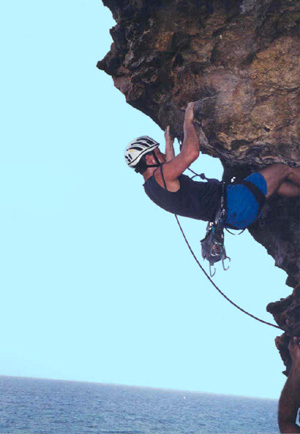
Steep enough for you?  Todd leading Going to Cayman With a Snorkel in My Jeans, 5.10c
Steep enough for you? Todd leading Going to Cayman With a Snorkel in My Jeans, 5.10c

John leads it and then Mark. I insist that Todd pull the rope and try again but when my turn comes I cowardly take the TR. Now I find out first hand what everyone’s been griping about. Someone has climbed up there and covered half the holds in soap.
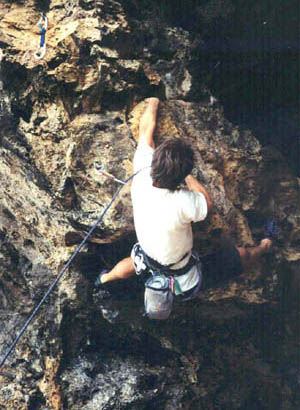
Mark leading Going to Cayman With a Snorkel in My Jeans, 5.10c

Well, not really, but it certainly feels like it. Not only are the soapy holds hideous in themselves, but they immediately remove all traces of chalk from your hands, leaving the draws, the next hold, anything you touch, feeling just as bad. With a dramatic array of heel hooks, knee bars, and just plain scumming of any part of my body against any available bit of rock, I pull through the moves cleanly.

Hooray! I’m going to be OK here. I can just feel it.

So I’m not at all scared of Ick, Theology! (5.10b), which doesn’t look that overhanging except for the bizarre starting move and a small roof at the top. This is where I get my comeuppance. After cruising through the starting move (made off a teetering stack of rocks piled as high as you can balance them), I’m feeling pretty good about myself. And then . . . soap! And steepness! And scary roofs! and I forgot to wear my helmet, so I’m psyched out too.

“Falling!” I yell. Again and again, only eventually arriving at the top after an epic battle, not to mention a race against the setting sun.

All overhanging, all the time. I’m so screwed.

Mark finishing the tricky start of Ick, Theology!, 5.10b

Tuesday at the Northeast Point

“It’s more like bulges,” John says, trying to reassure me. I’m nervous because we’re heading to The Point today, the place where the routes are long and steep and you start from the top so you have to be able to climb out. “You get rests.”

That makes me feel a lot better, so I even agree to lead the first route, No Problem, Mon, which is only 5.10a. Although it feels like it takes Todd and me about an hour to get everything set up before we can climb, the route itself goes smoothly.

Todd following No Problem, Mon, 5.10a

“You get faster at it,” John assures us, and it’s true that our setup for Walking the Plank (5.10 b/c) and Blackbeard’s Revenge (5.10b), which share a bottom anchor, goes much faster. All the routes are enjoyable and hanging above a sharp drop-off into the sea to belay is fantastic.

“Turtle!” people keep yelling, but I can never see it. Finally, while belaying Todd from the top of Blackbeard’s Revenge, I look down and see a turtle, huge and unmistakable, floating in the water below him.

“Turtle!” I yell, but no on can hear me. I watch the turtle until it dives and then go back to belaying.

Wednesday at Dixon’s Wall

The unusual thing about Dixon’s Wall is that it’s inland. The relaxing thing about Dixon’s Wall is that there’s nothing on it easier than 5.11. That means I don’t have to lead anything today.

I don’t mind the psychological rest and the routes here are amazing. They start on a surprisingly hard vertical wall and climb up to a fiercely overhanging headwall. With a lot of moaning and groaning, and a certain amount of hanging and falling, I make it to the top of both the 5.11s John sets up for us. The first, a 5.11b, has had a crucial hold break off and John says that it’s probably at least 11c now, but it’s not really so bad. What’s cool about overhanging stuff, I’m finding, is that the moves aren’t that hard when taken individually. So with the occasional rope-rest I’m able to do all the moves on, and actually enjoy, routes with ratings that would normally be way over my head.

The other route, a 5.11a, I very nearly get. My emotional compass has swung the other way again and I’m starting to believe that I’m going to be OK here in the land of the sharp and the steep.

Mark leading Dixon's Delight, 5.11a
Mark leading Dixon’s Delight, 5.11a

Thursday at Wave Wall

“You look a bit uncertain,” John says, offering me the lead on Old School, a 5.8 warm-up.

“It’s the approach,” I say. “I just need to sit for a bit.” Sometimes a sketchy approach takes up my entire stock of courage, leaving me without enough left over for the sharp end. The approach to Wave Wall is wild, traversing across low-angle but wet slabs in hiking boots with jagged rocks and a pounding sea below you. Still, it’s certainly worth the effort now that we’re here. You can hardly find a more gorgeous belay setting.

The route description for Old School reads, “If you’re not on a jug, you’re probably off-route,” something that could be said about most of the routes on the island. I’m getting used to the rock now and know to look around for the jugs sometimes camouflaged as pockets, aretes, or just clumps of convoluted sharp, black rock in which secret edges can be found.

Me leading Old School, 5.8

Old School lives up to its billing as a good warm up. John has a project on this wall, Unsuspecting Remora (11d/12a). We belay him on it in between other routes. Todd leads a 10d called Hang Ten on which the crux is getting the anchor clipped. Not liking the sound of that at all, I choose to follow it. Then I lead a 10b called New Wave that shares the same anchors but with a much better clipping stance.
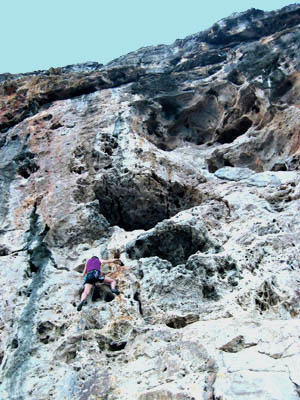
Me leading New Wave, 5.10b

By now John has successfully redpointed Unsuspecting Remora and Todd just has to try it. Unable, or perhaps just unwilling, to use John’s sequence, he tries everything under the sun, including a dyno to a mud-filled pocket.
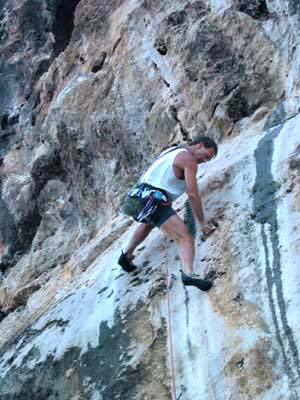
John finishing the first crux on Unsuspecting Remora, 5.11d/12a
John finishing the first crux on Unsuspecting Remora

“That’ll go,” he insists. I just shake my head and turn down the opportunity to try it myself when he finally gives up and lowers off.
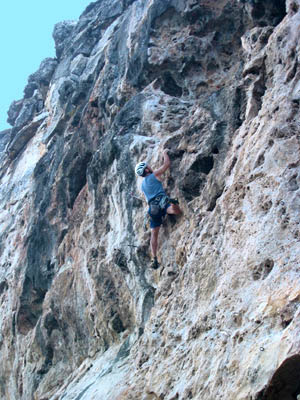
Todd between the first and second cruxes of Unsuspecting Remora, 5.11d/12a

Friday at the Northeast Point

The scene of my disgrace. Yes, I was supposed to bring a rope down, and yes, I was supposed to double check before leaving the top that I had everything, and, yes, here I am halfway rapped down the route without a rope.

“Got your prusiks?” John asks.

Yes, I have my prusiks. Berating myself the whole way, I prusik 15 feet or so of Shiver Me Timbers (5.10b) until I’m over the crux bulge and can yell up to Todd what the problem is. Todd sends me down a rope and I finish the rappel. Then Todd rappels part way down and I look up and realize he doesn’t have a rope either.

“Oh,” he says. “You forgot your rope. I thought you wanted mine for some reason.” Sigh. We rearrange our strategy for getting three people down and up a route at The Point, perhaps not the ideal location for a three-person party. By the time I get around to actually leading the route, it feels like a cake walk in comparison. After all, I’ve already done the crux, albeit on prusiks.

Me at the crux of Shiver Me Timbers, 5.10c, with my chalk bag closed
Me at the crux of Shiver Me Timbers, 5.10b, with my chalk bag closed

Once we’ve finally managed to get ourselves and our belongings back on top again, we shift over to The Devil Wears Flippers, 5.11a.

“Do you want to lead it?”

I shake my head ferociously.

“I’ve only ever climbed three 11s cleanly, you know, all on toprope and two of them were in the gym.” Plus with the low crux and all, though it turns out later I’m mistaken as to where the crux is.

Todd leads the route, pulling through what I think is the crux fairly easily and then lingering a bit to fix a backclip at the spot where John now tells me the crux actually is. He gets that too and is out of sight when John further adds that the top is pretty hard.

“He saw that,” I say, unconcerned. One advantage of climbing at The Point is the opportunity to preview the route as you’re rapping it. Todd had been checking out the top moves while waiting for his turn to go down, so I figure he’ll make it through OK.

But he doesn’t. There’s some sort of muffled yell from above us. John and I look at each other. “Did he say take?” Todd pulls up more rope. “Guess not.” More rope, more rope, then a tug. John locks off. Another indecipherable syllable floats down to us. This one sounds a little like “fuck!”. When Todd starts climbing again we notice that he goes a long, long way before he starts taking rope. One big disadvantage of climbing at The Point, and indeed many places on the Brac, is the almost total inability to communicate with your belayer. It turns out that Todd has downclimbed/fallen quite a ways in an attempt to get us to lock off after saying what was, after all, “take.”

The plan is that John will now lead the route again and then I’ll follow him. This is to avoid my having to trail a rope and clip as I go.

“I want you to get this clean,” John says. It’s a common theme with my partners, and I wonder why I’m so often blessed this way, that they’re almost more interested in my successes than their own.

I’ve now watched two people climb through both the opening moves and the stated crux but when my turn comes I’m surprised by how hard the moves through the first few bolts are. Perhaps a bit of a reach problem, I think, and certainly this section is pumpy. I struggle through it then relax until I hit the double draw that marks the middle crux.
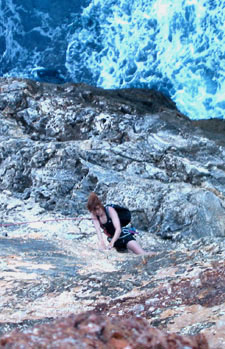
Me following The Devil Wears Flippers, 5.11a

It’s not like I haven’t been warned. With my hands on not-so-great holds I commit to moving upwards and realize, too late, that I don’t have my feet high enough to reach the next hold. My only hope is to bump one of my feet from this tenuous position. I’m on the verge of slumping onto the rope right then and there, tired and convinced that I can never hold this position with only one foot on, but I silently urge myself to at least fall trying, bump the foot, find myself still on the rock, though desperate, and grab for the next hold.

Mercifully, it’s good enough to hang off of and a few more thin, powerful, and, yes, painful moves find me through the crux and at a resting ledge.

One more hurdle to go.

I approach the top moves so cautiously you’d think I was on lead with my last piece twenty feet below me. I so don’t want to blow this. Someone has removed the draw from the bolt where Todd said “take” after pumping himself out trying to find a good clipping hold, another sign that my partners are doing everything they can to get me up this thing. I study each move, planning ahead, knowing each time before stepping up that I can step back down if I don’t like what I find.

Surprisingly, it’s not really that hard. But then I didn’t have to clip from there.

My second ever outdoor 5.11. I feel like a champion, the more so because of how close I came to giving up.

Saturday at Wave Wall

“I want to lead it,” I say, referring to Parrot Preserves on Rye, 5.11a.

“OK,” Todd says.

“So we have to do it first,” I insist. Our gear is in front of a 10c and 10d that share a common anchor, but if we start with those I know I’ll never have the strength left for an 11a.

We grab just what we need and teeter farther down the Wave Wall traverse to the route in question.

“But you have to go first,” I tell him.

“You want me to hang the draws, don’t you?” he laughs. I’m not ashamed to admit it. I’ll take any advantage on this, my first 5.11 lead.

I’d like to say I’m stronger now, and more confident, having arrived at the top by hook or by crook on an amazing three 5.11s here on the island, but mostly I just liked the sound of the route the way John described it.

“It’s 5.8 to a rest, then a 10d power crux, then a slabby technical crux.” Yes! A technical crux, for God’s sake.

“The bolts aren’t a long ways apart because it’s a slab, are they?” I ask doubtfully. No more long slab falls for me, thank you very much.

“There’s a bolt everywhere you need one,” he says cryptically. Then takes pity on me and verifies that they’re every bit as close together as I’ve gotten used to them being here. Indeed, aside from a few run out sections at the very easy tops of some routes at The Point, there is absolutely nothing to complain about with respect to the spacing of the bolts, except perhaps the possibility of actually being able to Z-clip in a few spots.

I’ve promised myself that I’m not going to beat myself up over my performance on this route, that my triumph is in being willing to try it, that you can’t lead a 5.11 cleanly until you’ve led a few 5.11s sloppily.

I run through the 5.8 start, past the midway anchor placed so that 5.8 leaders will have a few more routes to do, and into the start of the 10d power crux. I take it one bolt at a time, aiming for the little cave below the roof that will mark the end of the overhanging section. I’m expecting to rest in the cave, which was spacious looking with a ledge-like floor from below, but the cave turns out to be not much more than a notch in the rock. No room in here even for a little person like me.

I’m uncomfortable enough to decide that I won’t bother trying to rest here. All I have to do is pull this roof and I’ll have all the rest I need. John said, “It’s not as hard as it looks, is it?” and Todd agreed. Why then is this hard? Because I can’t reach the next good hold. I find and reject a couple of intermediates, my right hand in a bomber undercling and unwilling to relinquish it. I work my feet up but because my arm span, between the undercling under the roof and the next jug over the roof, is the limiting factor, it doesn’t help.

Getting desperate and wishing I’d tried to rest after all, I jiggle my right hand farther out, to the very edge of the incut hold, and make the reach. Now it’s as easy as was promised and I’m over the roof, breathing a sigh of relief.

Me leading my first 5.11, Parrot Preserves on Rye, 5.11a

Indeed the bolts up here are plenty close together, and nicely tagged by the draws hanging from them, but it’s a slab only by the sport climbing definition that a slab is anything that doesn’t overhang by very much. Approaching each move cautiously, as I did on The Devil Wears Flippers, I find similarly that this section isn’t so hard at all. Which I guess demonstrates once again that the vertical realm is a much more comfortable one for me. I clip the anchors and then monkey about with trying to get even higher. I want to prove that I could have hung the draws myself. Todd and John are getting restless, wondering why I haven’t said “take” already. Finally I find a stance I’m happy with and reach over and casually tap each bolt. Now I say “take” and lower off, one seriously happy camper.

“What did you guys think about the rating?” John asks.

“It might be a little soft,” I admit, then immediately berate myself for it. I did the damn thing and I’m not going to knock it down. “Maybe 11c/d, ” I say, taking the opposite tack. “I hesitate to actually call it 12 . . .” We all smile and agree that it might be just a little soft, but who the hell cares. I was told it was 11 and I stepped up and led it. And that, as I promised myself, is the only victory I need.

Things are winding down on our last day here. I’m happy and don’t need to climb another thing, maybe as long as I live, but Todd wants to take a stab at Unsuspecting Remora again. On lead this time.

He dreamt about it, he claims, and now he knows how to do it. I’ve had those nights myself, tossing and turning and working through what I’m sure will be the magic sequence for some route that’s haunting me. And just as Todd does, I always find out that I’m terribly wrong.

Things aren’t looking good as once again he’s unable to work through the low crux using either John’s sequence or his own. He tries the dyno thing again, on lead!, something I wouldn’t dream of doing in a hundred years, and John catches him when it doesn’t work any better on a third try than it did on the first two. Then, like magic, he does some small thing different with one of his feet and casually, statically, reaches through and pulls it.

So it’s smiles all around as we pick our way back across the beach and into the Carribean sunset. John got his redpoint, Todd found a way to do the lower crux of Unsuspecting Remora (“I could walk it now,” he tells me confidently later) and I led my first 11. Not all overhanging, not all the time, but all good.

Todd leading Shooting the Curl, 5.10a
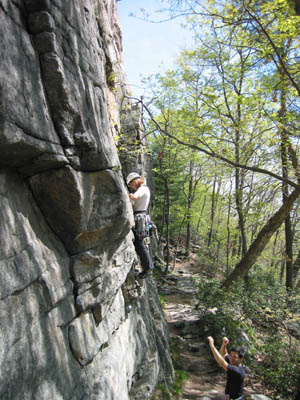
Ant’s Line, Take Two

For my second attempt at leading Ant’s Line (5.9), I did have a certain strategy as follows: Climb easily up to the crux, place two pieces, downclimb to the rest, pull the crux, and finish quickly on the easy ground above.

It’s always good to have a plan.

Step one. Climb easily up to the crux.

Is it just me or is this move hard? I don’t even have gear in yet. Has there always been a hard move here? Has anyone besides me noticed that I’ve hardly even left the ground?

Todd suggests that if I’d climb the crack directly instead of trying to step in off the ledge I could have gear. Despite the fact that climbing the crack directly is rather obviously harder, thank you very much, he has a point. I get some gear in and climb through to the corner that marks the start of the route proper.

Step two. Place two pieces.

Ack! This is a godawful stance and I’m going to fall off before I even get so much as one piece in. What was I thinking, climbing up here with nothing but that tiny nut below me? Sure, it was a great tiny nut, but still. I’m going to die and I’m not even going to do it on the crux.

I scurry back down to the tiny nut and augment it with a bigger nut, higher up. Then I lean my forehead against the rock and breathe deeply. Maybe I don’t want to lead this route after all.

Step two, take two.

This time I come prepared. I hang the piece I’m pretty sure goes in under the roof on the front gear loop. Fortified by a brief rest and my second placement, I charge back up to the crux. I fire in the piece I’d selected. Success! Probably the first instance of my ever remembering what the crux gear is. But then, the last time I tried to lead this route it took about five minutes hanging out in this miserable stance to get something in. I’m not likely to forget that.

And the second piece? Yeah right. I’m going to hang out here long enough to figure out where I can place a second piece. This one caught me last time. It’s going to have to do.

Step three. Downclimb to the rest.

Been there. Done that. Twice.

Step four. Pull the crux.

This part goes surprisingly well. I guess all that work on overhanging stuff in the gym has finally paid off. The holds feel bigger and more postive, the feet more plentiful and useful, than the last time I tried to lead this route. I love it when a plan comes together!

Step five. Finish quickly on the easy ground above.

Um. It used to be easy up here. I swear it did. Through the crux and wanting a real rest, I find only a poorish stance and poorish gear. I place the gear, a bomber nut behind a pitiful flake, and climb on in search of the Stance That Is To Come. I never find it. Eventually I look up and realize that the top is tantalizingly close and there are jugs all the way. I abandon my attempts to fiddle in another half-assed piece of gear and aim for the end. Victory is mine.

When Helmets Collide

I wouldn’t have chosen the Nears today, a day that’s only barely gorgeous for February. The Nears get more wind and less sun than the Trapps, but today is Todd’s day to choose, so here we are. There are an awful lot of scary-hard 7s and 8s in the Nears. Maybe we ought to walk over here more often.

We start with Disneyland, a classic and usually over-booked 5.6. I’m pretty sure I’ve led it before but don’t remember. I certainly don’t remember doing the “crux mantle move” and am fairly sure I won’t be doing it this time. I make my way up the pitch slowly, approaching the move, then do nothing like a mantle, or at least nothing like a mantle that any real climber would admit to doing, more of a squirmy wiggle up onto the finishing ledge. We walk off from Disneyland, triumphant and only a little cold.

Todd wants to do Yellow Belly next, a two-pitch 5.8. The first pitch, rated 5.7, will be mine. It seems ideal, nothing too terrifying for either of us this early in the season. But upon looking at the topo we see that the first pitch goes up the corner to the roof, then detours under the roof around to the left, pulls around that corner, goes up, pulls back around another corner, etc. I can feel the rope drag already. We check the topo in the other guidebook and find something completely different. The other book shows the first pitch pulling the roof directly. It also rates the first pitch at 5.8.

“Look,” I say. “I’m just going to pull the roof. It’s well protected, one move of 5.8 roof and then it looks like 5.4 climbing to the top.” When will I ever learn? We don’t rate routes 5.8 because they have one move of 5.8 roof and then 5.4 climbing to the top at the Gunks. Those we rate 5.6.

I dance easily up the opening corner, drifting right onto the face below the roof as the crack in the corner widens into an off-width. I reach the roof feeling smooth and confident with only a couple of pieces beneath me.

Ouch. Damn helmet. I can’t get close enough under the roof to place gear. Bang, smash. I’d like to take the friggin thing off. Bump.

“Damn it!”

When I finally manage to get a couple of pieces in, I’m excited about the idea of pulling this roof just so I can get out from under it. I reach over the roof as high as I can and find a bomber finger lock for my left hand. I bounce my feet, can’t find a good place for them, finally put my left knee up, not that that helps. The next holds, the horizontal above me, seem just out of reach, but I make a final push and snag the horizontal with my right hand. Uh oh. Not bomber, dude. Not bomber enough that I feel like taking my left hand out of that finger lock, not without any feet anyway.

Scurry back down. Hide under roof. Bang. Damn it! Breathe hard.

“I think a bit of height might help here,” I tell Todd, remembering the thing that looked like a jug over my head and off to my right.

I take a second stab, worse than the first. Knee hurts now. I know I’m not supposed to put it up there but my foot just won’t go.

Scurry back down. Hide under roof. Smash. Damn. Breathe hard.

“Can you get some gear in over the roof?” Todd asks. Of course, the old gear in over the roof trick. Why didn’t I think of that?

“Maybe,” I tell him.

For the third time I put my pinky finger into the finger jam that is becoming less and less apprecicated for its bomberness. Where could gear go? Not where that finger jam is but maybe in the horizontal where it curves around to the right. In fact, if I could just grab that jug . . . Somehow it’s not as far away as it looked. Jug, mama, jug. I wrench my fingers out of the finger lock, almost believing they aren’t going to come out this time, and put my other hand on the horizontal and now I can get my feet over the roof. I’m here!

Smash. Ouch. Bloody helmet. There’s another roof over this roof.

I’ve got just about my whole arm sunk into the horizontal. My head might go in if it weren’t for the helmet. My back against the side wall, both feet under me, up to my butt. There isn’t enough room in this alcove for me and my helmet and the rock and the rack. The rack. Yes, put a piece in. First piece goes in, hallelujah, just have to clip it. Seriously consider clipping it straight to my belay loop. No, hang a runner. Should clip it long here. Can’t do it. Might want to hang right now. Draw then. Consider clipping straight into it again. No, pull up the rope. Won’t go in. Slipping down, just friction keeping me up here, had to let go of the jug to place the gear, sliding, I can tell. Clipped. Safe.

Immediately I want to get out of here. A simple escape to my left and I’ll be standing, standing like a normal human being stands, just standing. I want it so bad.

I move to the left, just need to grab the edge of this big crack up here and pull myself into it. I don’t believe I can do it. I’m exhausted, my hands are numb from fishing around in cold, damp cracks, the pinky won’t regain feeling for two weeks, my gear is all the way down there at my feet. I crawl back into the alcove.

“Why did you go back in there?” Todd asks me later.

“I needed to rest,” I tell him.

“I didn’t find it very restful there,” he says.

“Neither did I,” I agree, “but it was close to my gear.”

Somehow I manage to warm my hands up and sally forth from the alcove once more. This time, all goes well and before too much longer I’m slumping down on the belay ledge, wishing I could just lay here but knowing that I have to set an anchor, pull up the rope, put Todd on belay.

I’m flattered when Todd pokes his head over the roof and retreats back down before pulling it, then know he’s in the alcove when I hear him laughing to himself. He makes quick work of the rest and now it’s his turn.

From the belay we can see that someone has bailed from the tree (twig!) above us. Hmmm. Must get hard up there or something. With a few false starts, Todd gets up into the crux of the second pitch, stuck in an alcove below a roof, where else?

“I think you want to go left,” I tell him.

“Yeah, I think so too,” he says with deep regret.

I don’t know what to tell him except that from down here it looks pretty easy. When he commits to the moves he makes it look easy too.

My hands have gone numb from the cold while belaying, I’m glad to be climbing again. At least I’m glad until I crawl into that alcove.

Smash. Damn. This route ought to come with a no-helmet warning. It’s cozy in Todd’s alcove, a lot more comfortable than mine was. I could stay here all day. I ponder the possibility that I will stay here all day since it’s totally unclear how I’m going to leave here. Have to turn around the other way (bang). Okay. Nasty little horizontal, no feet. This is one of those stinking fingertip traverses is what this is. I decide that I’m going to use the one foothold the wall offers, way up and off to the side. I undercling the horizontal, yanking myself up and over onto that foot.

There, sitting on my foot. Just like the pros do it. Only now I have to somehow leave this position. I grope blindly with my left hand, must be something around this corner to hold onto, and finally wiggle and jiggle my weight off that foot so I can actually move again.

The rest was easy, by the way.

Bouldering at the Gunks

It’s such a beautiful day for February that it would be a beautiful day for April. There’s no reason why we can’t climb anything we want today, even multi-pitch, but for some reason I have my heart set on bouldering.

Perhaps it’s just stress-avoidance, to not have to lead for the day, but I like to believe that bouldering is good for me, unlike a day of TR’ing, which is also stress-free but does nothing to ease my worries for the next time I step up to lead. Besides, I need to get strong again after my annual January layoff and the routes I’m capable of leading don’t exactly challenge my strength (physical strength, that is).

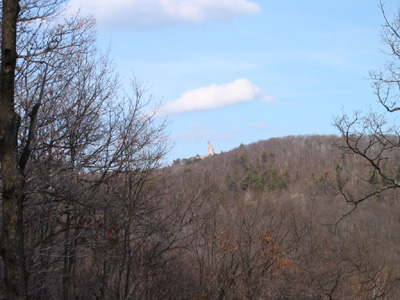
Skytop in the distance on a beautiful February Day

So I put my foot down, claim that it’s my day to decide what we’re going to do, and we load Todd’s mattress-sized bouldering pad into the car and set off for the Gunks.

We start with the 5.9 variation to the left of Keyhole, a route I have some history with in that it was the scene of one of my less forgivable temper tantrums. I should be able to climb 5.9 and the fact that I couldn’t that day, even on TR, caused me to pitch a fit of disproportionate proportions.

On our first-ever day of bouldering we also started with this route. On that day, it wasn’t clear if I couldn’t make the last couple of moves or wouldn’t make the last couple of moves. Ah well, it was only practice that day, learning to land on the pad and to spot each other.

Today I have to get used to dropping onto the pad all over again. I get a move higher with each attempt until I reach that point where it’s all or nothing. Todd has done it by now, ready to move on to the next problem, it only remains for me to finish. I jump.

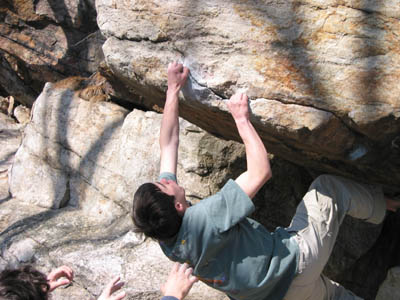
Someone in position for the dyno on the Gill Egg

“I don’t really have to go any higher than that,” I explain to Todd from the ground, “and I’ve already dropped from there. If I move my hands and don’t make it, it’ll be the same fall.”

He agrees, not that there’s anything to agree with. I’m stating the obvious in an attempt to talk myself into moving, instead of freezing, the next time I’m up there.

I climb back up to my high point, place my left foot on the edge Todd’s found for me, higher than the one he uses but probably better, carefully move my right foot so that it’s against the crack instead of in the crack so that I won’t flip if I fall. I pause. I look up. Funny, the top seems easily reachable from here and I feel so stable. I think I can just take my right hand out of the constriction and calmly put it right up there on top. I’m sure I can. It really feels like I can. Yes, certainly I can.

I do.

Now for the bad part – I still have to jump. It’s not like my feet are any higher, but my head is, so it feels higher. Ugh. I don’t like jumping.

This is why I imagine that bouldering’s good for me – the steady pushing forward, one move at a time, with no promise of sudden safety if I make it, and then the intentional fall. I can hang there as long as I like and unless someone comes along with a ladder, sooner or later I will have to fall. There’s no slamming in an emergency piece to hang on, no specter of the stance to come if I can only pull through this next move, no asking Todd to take over the lead for me. Do the move, take the fall, black and white.

Someone getting into position to start the Gill Egg

Triumphant on this route at last, we move on. The Gill Egg next to us is empty. A ridiculous dyno problem I have no hope of ever sending, we give it a try for the sheer bouldering-ness of it – you don’t have to be able to do it to try it.

“Why don’t your feet slam into the rock when you fall off?” I ask Todd petulantly after striking my soles against the slab beneath the roof yet again.

“Because I swing them out before I let go,” he tells me.

“If I could swing my feet without falling off, I wouldn’t be falling off,” I complain, but on subsequent attempts I do somehow become more capable of getting my feet under me before I hit the ground. I guess it just needed thinking on.

Before too long we’re joined by about a hundred other people, psyched by the meatiness of our pad. A lot of them can actually do the problem, including one guy who manages to do it statically, to great applause from the spectators, including me.

Although the atmosphere is social and entertaining, we eventually reclaim our pad and shuffle off. I’m too intimidated to step up for my turn at the plate when it takes me five moves just to get into the starting position, especially considering that getting into the starting position was actually kind of my goal for the day.

Note: it turns out this next problem is called the Middle traverse. No wonder it didn’t seem low!

So we move under Doug’s Roof and start the Low Traverse. I’ve seen people on this before, often without a pad or spotters, but I’ve never tried it. So far Todd and I have stuck to problems with simple, obvious landings, where the pad can be placed once and then forgotten till needed. The Low Traverse is, well, a traverse. Todd sets out first and I struggle to keep the pad beneath him, he moves so fast. I’m terrified that he’s going to fall while I’m looking down and either a) land on me, b) miss the pad because I don’t have it positioned right, or c) topple over backwards and hit his head because I’m not spotting him.

The starting holds on the Gill Egg

Todd arrives at the end of the traverse without incident. Now it’s my turn. I’m moving too slowly, that’s the obvious problem. The holds aren’t really bad, though they have that soapy feel that chalk-caked holds under roofs at the Gunks sometimes get. If I swung confidently between them, crossing through instead of shuffling, smearing my feet instead of looking for that perfect foot hold, I might have the endurance to get through this.

I’m too cautious, too hesitant. I get to about the middle of the traverse where the feet disappear altogether and can’t go on. My God! I’m so high up. Low Traverse, indeed.

The High Traverse, which Todd works next, having mastered the Low Traverse on his first try, is absolutely no higher at its highest point. It is scarier though, because in order to make those first few traversing moves you’d actually have to get horizontal. Todd is unwilling. He jumps.

I try the Low again, then try the High for jollies. The moves up to the start of the High are delicate and slabby, a nice change for my tired arms. I enjoy working out the intricate body position options, so close to the ground and so much more my style, but then I’ve succeeded at last and am up to the two-finger pocket where the real fun begins.

Got Milk?  Todd totters along with bouldering pad in tow

I grope around the horizontal crack that starts the hairy traverse, trying to decide if I can hold on long enough to at least bail safely. I have absolutely no desire to fall on my back from this height and no delusion that I can actually do the traverse. It’s only a question of whether or not to try the next move.

This is why bouldering is good for me, I remind myself, and make the next move, swinging out under the roof proper. I throw a hand up for the next hold and get it. Even Todd didn’t go past here. I lower my legs and look at the pad way down there beneath me, nothing but air between us. I’m glad it’s so big. I don’t know how those boulderers with pads about the size of Crazy Creek chairs do it.

That’s enough of the High Traverse for me. I make two more attempts at the Low, one starting from the other direction, but never manage to get through the blank area in the middle. On my last attempt I call down that I’m going to jump and Todd exhorts me to continue on, to try at least. I make once last hand shuffle and come off, not jumping this time but really falling. To my surprise, I make my best landing of the day, square on the pad and upright. Surprised, dizzy from the adrenaline rush, I lean back to lay down and fall off the edge of the pad. A perfect landing and I failed to stick it!

By now my arms are like rubber and my fingertips are raw. Even Todd can’t make it through the Low Traverse again. We assemble our light, though bulky, belongings, and totter off down the carriage road. Just a couple of anonymous boulders out for another high-fun, low-commitment day.

Practicing

I really didn’t want to be here, stuck like every other newbie 5.6 leader at the beginning of the wide stuff on Baby. Todd said I should go back to the car for the #4, but I was too cool. After all, I’ve led Baby before, which I don’t even remember it was so easy. According to Steven’s recounting of the tale, I slung the chock stone, didn’t bother to back it up, and face climbed around the offwidth section.

The chock stone is long since gone, but it’s the part about backing it up that led me to believe I could do this without the #4. I certainly wasn’t carrying a #4 that day. Steven must have thought I had another option available to me.

Now, standing here stuck like . . . well, I already said that part . . . I don’t see another option. With a #3 in at my feet, as high as it will go, I have all the gear I’m going to get. And I’d like to know how I ever face climbed around this section. I can see chalk on the flake to the right but I can’t see how climbing the flake would be anything like 5.6.

It’s only later that it occurs to me that a chock stone is more than just gear. It’s an extra hold as well.

That stupid #3 is so in my way and it’s not even a great piece. Every time I put my foot in the crack in the hopes of actually starting the next move, my foot slides down until it’s resting on the cam. This is unsatisfactory. Cheating issues aside, I don’t want to lose my one foot hold and my one piece of protection at the same time.

“I can tell you how I do it,” Todd offers, “but maybe you don’t want to know.”

“I know how you do it,” I tell him. He laybacks the whole section. I fondle the edge. “It’s a good edge for laybacking,” I admit, “but I really can’t see myself laybacking that far.” What is it? 6 feet? 10 feet from the gear before you’re done? I’m actually pretty good at laybacking. At least, it’s not one of the things I know I need to work on, like dynos and slopers, but I’m not keen on laybacking on lead. My confidence doesn’t run that high. No, it’s either offwidth the crack or face climb the flake.

I paw around the inside the offwidth a bit, looking for something better than a full-on arm bar, and find only the smallest of sidepull edges. Unsatisfactory. I finger the face holds to my right again. Unsatisfactory. I try once more to put my foot in the crack. This is ridiculous. I’m coming down.

Much whimpering and clinging later I’m finally below the #3 and ready to remove it. Funny how easy the stuff above me looks from here. Why you simply stand up there and . . .

I climb back up and resolutely stuff my foot in the crack – below the cam this time. It sticks. I throw my right arm in the offwidth and re-find that microedge and step up. Yes, I’m up. That was a mistake. I really don’t know if I can get back down now. I shuffle the other arm up, find a much better sidepull in the depths of the crack, and stick my whole other leg in. Squeak, squeeze, scrunch. Up I go, more committed with every inch.

I can almost get my foot on the slopey edge that marks the finishing point for this section. Briefly I high step to it, then change my mind. If I’m going to fall, I really don’t want to fall upside down. Instead, I squeegee up a little higher and then step on it.

For a moment, I think I’ve had it. I need to pull just slightly higher to reach a real hand hold, but I can’t get there. I’m teetering, groping blindly inside the crack, looking for anything. Finally I find the smallest opening in the cap above me and the last six inches are mine.

With great relief, I cling to the holds above the offwidth and strew gear about madly.

“That didn’t look so bad,” Todd says.

Next time I’m bringing the #4.

We’re at the Gunks today practicing. Maybe cheating’s a better word. Next week at GunksFest 2001 we’ll be climbing in this area, from Baby to Jean. I’ve just led Baby. Now Todd leads Jean (5.9). We learn that the old blue thing that used to mark the start of the crux has been replaced with a new red thing. I learn that just because I made it over the roof the last time we did this route doesn’t mean I’m just going to sail over it like nothing today. Despite the fact that I know where the good holds are now (yes, I swear there are some), I still have trouble getting my feet over the roof.

At one point, I find a knee bar. Oh blessed, blessed knee bar. On a subsequent attempt the knee bar is gone. Why hast thou forsaken me? Eventually I go over the roof three times, never the same way twice. You know, if I could find that knee bar again I really think I could lead this route.

We finish the day with Maria Direct (5.9) and Maria Redirect (5.11). I actually get through the lower crux on Maria Redirect without falling, reaching what Todd calls “the rest.” I fall off of the rest. Perhaps he meant “the rest of the route.” Eventually I get started on the second half of the route and manage to get to the top in one push. So, I can do the lower crux and the upper crux; I just can’t do “the rest.”

“If I can do Maria Redirect at the GunksFest,” I tell Steven by email, “pretend that I’ve always been able to do it.”

It’s going to be the best GunksFest ever!

Smooth Sailing Away

Sail Away

“Are you guys going to do Sail Away or Wild Wind?” we shout down from the top of Hidden Tower where Todd has just led Wild Wind (5.9). They say it doesn’t matter to them and I say that we’d love to get on Sail Away, which is only partly true. Sail Away is 5.8- with lots of stars. Back home in Gunksland, stars mean “hard for the grade.” I’d love to get on Sail Away if I’m brave enough to lead it, good enough to lead it clean, and if it’s not going to scare me too much.

Me on top of Hidden Tower

While belaying Todd earlier I was listening to these two guys climb Sail Away, an exchange that might have frightened even less timid leaders than I.

“Just do it, dude! It’s like three moves of friction and you’re there. Don’t look around for holds–there aren’t any. You just gotta step up. Stick your foot anywhere. It’ll hold! See that jug up there? That’s what you’re going for. It’s bomber, dude. Go for it!”

Despite these assurances, the fearless leader refuses to progress.

“Come on, dude! Are you going to climb or are you just going to stand there? I’m not letting you down until you fall on that piece.”

Fearless leader is cajoled into stepping up.

“That’s it. Keep going. Don’t stop there! Two more moves. That’s it. Don’t look for gear. It’s like 5.5 the rest of the way. You gotta layback it. The holds are huge! Go! Go!”

The fearless leader returns triumphant, crediting his belayer for his success. I’m not so fearless, nor am I interested in quite so vehement a belayer, but I keep the lessons I have learned in mind as I prepare for my ascent. 1. the crux is friction, no holds but the gear will be close, just step up, it’ll stick and 2. above the crux I have to layback without placing any more gear, but it’ll be easy.

If you’ve led Sail Away, you’re probably already snickering, but let’s not get ahead of ourselves. My first hurdle is the start, which I decide to do directly since I can get gear in. I place a piece, get through all the hardest stuff, and have my foot come off as I start to step up on top of the big round lump. I catch myself easily but my heart starts beating wildly.

“Can you put in a second piece?” Todd asks. You know, I think I will put in another piece. But these moves are easy and then I’m in the crack and just sailing along (heh, heh, heh), jam, jam, jam, waiting for the crux to show up.

Me leading Sail Away (5.8-)

As I get near the top I feel the crux must be coming soon. I can see the spot where I can choose between going left and going right and I know the crux has to be before that. I start seriously sewing it up, placing a piece just about every move, wanting to have something in high when that gosh-darn just-go-for-it friction crux rears its ugly head.

Eventually I arrive at a move that seems a little harder, like maybe by half a grade. There’s no friction involved here. The crack never ends. I see a larger-than-average hold caked in chalk above me, which I assume is the “finishing jug”, but I’m disappointed by its slopey greasiness and put my fingers back in the crack instead. As for the 5.5 layback, it just doesn’t happen. I take the left exit and don’t fall off it, unlike two of the last three people I watched climb the route. Did they substitute something easier for Sail Away while I wasn’t looking? The whole experience mystifies me.

“Maybe stars mean easy for the grade at Joshua Tree,” I suggest to Todd. But easy or hard and however you choose to do the crux, Sail Away is a beautiful line, well worth doing and nicely protected.

Coulda, shoulda, woulda

If I can sail (heh, heh, heh) up a classic 5.8-, I ought to be able to make my way up this short, relatively unknown, extremely straightforward 5.8 called Right Sawdust Crack at Trashcan Rock, right?

I could have done it too. It’s a short route right off a block, so every piece of gear is vital and my habit of sewing it up isn’t overkill, but only common sense. It’s steep right from the start, much steeper than Sail Away, and wider too, but I could have done it if there hadn’t been this section where the crack opens and flares. If you climb at Joshua Tree, you know what I mean. Suddenly the lovely crack you’ve been using for both jams and gear becomes unuseable for either, leaving you feeling a bit stranded.

But I could have done it anyway if it weren’t for the fact that the first piece I fired in was not quite bomber, being a little tipped out from the flare.

I still could have done it, but unfortunately the second piece I placed was way too over-cammed, not a good piece at all, so it had to come out, not so easy to do what with it being over-cammed and all.

But I still could have done it, except that when I get the second cam wiggled back out, and I’ll bet this has never happened to you, it turns out that I’ve somehow clipped the biner from the first cam through the trigger from the second.

That’s when I panic.

I can’t just leave it like that – I have visions of the rope being cut by the trigger wires – and I only have one hand to work with. Five minutes of cursing and fumbling later, I manage to disentangle the two cams from each other and say “take”.

Other than that, I could have done it.

Double Cross

Almost since the day we booked our tickets, Todd has been asking me if I’m going to lead Double Cross (5.7+), the infamous newbie slayer of J-Tree legend. Don’t you just hate leading a route everyone tells you you’re going to die on? I’m feeling pretty dubious until I read one guidebook’s description that “unprotected easy climbing leads to a ledge from which the leader must place adequate protection.” Aw, shucks. I can place adequate protection from a ledge. I’m a Gunk’s climber for heaven’s sake. Ledges are my home turf and adequate protection is my middle name.

My answer, all along, has been, “If we can get on it. I’m not going to stand in line for it.”

So where’s the bloody line? The leader from the previous party is nearing the top as we arrive, allowing me only enough time to brood but not enough time to back out. I watch his second start up. Interesting. This unprotected start doesn’t look all that easy. It doesn’t look 5.4 easy. And you call that thing a ledge? I call that a dip in the rock, a depression, a bowl, a dish, but not a ledge.

The previous leader has one piece – a cam – in at the start of the crack and, personally, I don’t like the looks of it. The crack flares at the bottom. The point at which the crack becomes a good gear-eater is obvious. It’s also obvious that the crux is below that.

But I’m doing it.

I sketch my way through the unprotected start. It’s not as easy as I’d like but at least it isn’t any harder than 5.7+. I stand on the “ledge” and survey my options. Although the crack is too flaring for solid cam placements, it has some nice constrictions. I place two beautiful nuts. I survey some more. Below the nuts, under an overlap to the left, I place a cam, more to protect the nuts than to protect me. I feel good. Double check, this is Double Cross. Yes, I feel good.

I make the first few tricky moves and then it’s smooth sailing (heh, heh, heh – oops! wrong route) from there. Another classic route that deserves the distinction, and another one I’m glad I led. I suspect that if people are hitting the ground from Double Cross it’s because they’re forcing in cams where nuts should go.

Spot the mistake

Todd has his eye on Left Ski Track (5.11) across the way. Well, who wouldn’t? It’s a gorgeous looking line. It’s also got the crux at the bottom and poor looking protection opportunities where you need them most. So we shift over to Lower Right Ski Track (5.10b) which not only has the crux higher up but has a bolt protecting it as well.

Todd leading Lower Right Ski Track (5.10b)

Todd gets the bolt clipped from a crazy-looking stance, then shifts and manages to fire in a #4 Camalot into a pod as a backup. What can I say? We’re trad climbers. He ends up hanging (but not on the bolt! as he insists) before firing through the longish crux, even managing to get another piece in along the way. I ask him to lower off because I want him to be able to give me an attentive belay and beta as I go. This turns out to be a mistake later, but for now I get the beta I need when I need it . . .

“Left! Left!”

“I can’t.”

But I try anyway and get it and pull through over the bulge onto the stance above the crux. The climbing above the crux is relatively easy stemming but I’m tired and it feels like I could come off with every move. Having gotten the crux clean, the last thing I want to do is fall off the easy stuff above it.

Todd decides he wants to take another burn on it as I’m climbing – I guess this was the real mistake – so I leave some gear in as I go. I pull through the last roof traverse problem, another pumper, onto the easy ground where people rapping down from above land. I start to remove the two pieces he has in at the roof.

“Leave those in,” Todd says. “They’re keeping the rope from getting wedged into the crack.”

I put back the nut I’d just pulled out. It’s too small, really, kind of wobbly, so I just lay it in there (this then is the mistake) and lower off. Just before I get back to the crux, the rope stops. The nut above me has shifted such that the rope and nut are now jammed in the crack together. No amount of yanking from either side will free them, not even after I climb back up a few moves.

Now what? I can’t get down and I’ve already got slack in the system from moving up. Out come the prusiks. Feeling sketched, I use a prusik cord to tie a prusik knot instead of using one of the runners to tie something sensible like a kleimheist. Now this is the mistake. It’s serious overkill. There’s no way the knot is moving on its own. After every couple of moves I have to stop, grab the rope with my teeth, and drag the prusik up the rope until it’s taut again. Even when I get back up to the final roof I can’t free the rope and have to make those last wild moves self-belayed.

Overhangs

Another classic is Overhang Bypass (5.7). After having just been as scared as I’ve ever been while on top-rope, I’m ready for something a little more casual.

“Just enjoy this,” I tell myself. “No fear, no panic. At 5.7, it’s the easiest thing you’ve tried to lead so far. Have a good time on it.”

And I do. Up to a point. Holy cannoli! This one move, coming out of the notch, is stinking hard. Can this be the way to go? The book suggests I should pull the roof straight up but common sense is telling me no. There’s no chalk up there for one thing. The chalk, and the gear, both head left. I put a piece out left and cautiously try the crazy move. I step back down and put another piece in even farther left and try again. I step back down and shorten the runner on one of the pieces. This is stupid, I know. It’s only going to save me a few feet of fall and it’s going to kill me with rope drag later, but it does the trick at least. I pull through the off-balance, layback, arete humping, corner turning move and, with my feet on the gear, discover that there’s no more gear straight up. Stinking “easy” friction. No way, buddy. I scootch left some more to a crack, which turns out to be so easy that I don’t end up putting any gear into it, and dance up to the belay under the overhang that gives the route its name.

As I’m belaying Todd, heaving up the rope made heavy by that short runner, I eye the second pitch of the route. I can do that. I have each move figured out – big jugs, big feet, plenty of gear. Then Todd says he wants to lead it. I’m disappointed, but relieved to discover that I’m not relieved. Because I’m not grateful that I don’t have to lead it, I don’t have to lead it. When my turn to follow comes, I realize I’m pretty much leading it anyway. In fact, he had gear closer to him for the one tricky move than I did.

We rap down to the rap landing and suddenly Todd wants to lead North Overhang (5.9). Oooh. Now I’m grumpy. If he was going to do his own Overhang pitch, then he shouldn’t have gotten to lead one of mine. He offers me the lead. Yeah, right. There may be bolts at the roof but there’s plenty more climbing on this route and no one there to guarantee that only the bolted part is 5.9. Would have served him right though.

As it turns out, only the bolted part is 5.9. As it turns out also, the route is seriously hard 5.9. You might have thought grades for J-Tree roofs would seem a little soft to us, given that we come from the land of the roof, but there hasn’t been any sign of that so far. Let’s just say that we both made it through by the skin of our teeth.

Clean and Jerk

Every once in a while, through the ups and downs of climbing, there comes a moment when theoretical progress manifests itself in a flash of reality. Clean and Jerk (5.10c) was one of those times. I’m not good enough, strong enough, tall enough, to climb Clean and Jerk, with its long, powerful moves and sustained climbing, cleanly. But I did.

Justin leading Clean and Jerk (5.10c)

Lost Horse

For our last day of climbing we head into Lost Horse looking for the Shorter Wall, both because we’re trying to get away from the crowds and because we expect to meet friends there. I rack up to lead Swiss Cheese (5.6) which Julie has just led. There are two routes here, but the guidebook only shows one.

“I think Swiss Cheese is actually the left one,” Dave says, “but, whatever, it was pretty 5.6.” The right route has more bolts and looks easier so I take a smaller version of our normal rack and start up it. Somewhere near the top, protected by bolts that are close together even by sport climbing standards, I get major willies. The moves are longer than they looked from the ground and the edges on those swiss cheese-like holes are less positive than they appeared. Maybe I’ve just got my trad lead head on too firmly, but I move slowly and uncomfortably through the final moves and top out with a sigh of relief.

“When someone has just led a route, and they say it felt hard for the grade, you should always agree with them just out of principle,” I tell Todd later, after a bit of a sulk. He offers that the moves were “tricky” but won’t go so far as “hard.” Mumble mumble 5.10 climbers. Think everything under 5.9 is 5.6 Bet they can tell the difference between 10b and 10c alright.

Todd leading Split Personality (5.9) in the foreground and Julie leading Beck's Bet (5.8) in the background
Todd leading Split Personality (5.9) in the foreground and Julie leading Beck’s Bet (5.8) in the background

I’m set up to lead Beck’s Bet, a two-tiered 5.8 hand crack, just contemplating the fact that I don’t like the first move already, when someone behind me asks, “Is that Dawn about to lead that crack?” Saved from the fearsome crack for the moment, I reach over and shake Jay’s hand.

“Back to your roots, huh?” Jay is right. Joshua Tree is where I learned to lead and where, after three days, I led my first 5.8. That was two years ago, back when I was a prodigy. Who knew then that two years later I’d still be struggling with 8s.

“I was a little worried about that,” I tell him. It’s been on my mind that I still haven’t led a second 5.8 at Josh, at least not cleanly. One day we stopped at Intersection Rock and looked up at the Flake, my first, and so far only, Josh 5.8. It was intimidating and I had no desire to try to repeat it.

I can’t dally with Jay long, not tied into the rope. The time has come to face my 5.8 du jour. I hoard my collection of #1, 2, and 3 cams as I go, placing anything else I can to save the precious hand sizes for later, going so far as to back clean such that I only leave one piece in the first half of the crack. When I get to the top I realize that I’ve still got most of them left on the rack and also that I’ve finally led that elusive second 5.8.

Smooth sailing indeed.

Me on Butterfly Crack (5.11c) at Trashcan Rock
Justin and Melissa in their matching do-rags at Locomotion Rock
Melissa leading Leaping Leana (5.6)
Todd, Justin, Melissa, and me behind Sports Challenge Rock