The world is so full of a number of things . . .

That’s how I feel today, enjoying a second non-climbing day off in a row. There are so many other things to do and mostly to just not have to do any particular thing but to move from thing to thing as the mood takes me.

I don’t know what’ll happen tomorrow. Perhaps Todd will suddenly regain the desire to climb and we’ll go. But the best two weather days are behind us, so I think I’m safe. LOL. Why be safe from one of my hobbies over any other?

Only part of me wants to climb, coming I think from thoughts of making a climbing blog. I thought by stopping writing about climbing I could come to love climbing again but now it seems that’s not the case at all. If anything, writing about climbing was one of the things I loved.

It’s true though that the pressure is off without the writing. I felt only twinges of guilt that we weren’t climbing today on such a gorgeous day. Yesterday was kind of cold and windy so it wasn’t so bad but today was perfect climbing weather. Why should I feel guilty for doing one thing over another? Climbing does that to me somehow.

Canyoneering at Zion and Climbing at Red Rocks

Brian took a lot of photos of our canyoneering adventure and did a write up. Canyoneering wasn’t supposed to be so cold or involve so much snow. Although it was 90 degrees and sweltering at ground level in Zion, down in the canyon it was only barely above freezing. The water we had to swim in felt like it was freezing, but since it wasn’t ice, I guess it wasn’t. The snow we had to hike over, on the other hand, was certainly frozen.

What I remember most clearly about that day was that we were only one turned ankle away from tragedy. I really believed that: that all of us needed to pull together to ensure that we all got out alive. I was racing through the canyon about as fast as I could because I was so cold I couldn’t stop, so I was one of the first few out. Most of the group wasn’t far behind me, but Todd and two others (our hosts Brian and Tom) still hadn’t shown up after what seemed like a really long time.

I was starting to think something must have gone wrong and that we were going to have to go back in after them to affect a rescue when they finally came around the last bend into view. They were laughing and chatting, taking pictures and strolling casually along. Whereas I was in a epic battle for survival, Todd was just having a nice day out.

Before that, Todd and I spent five days climbing at Red Rocks and had a blast (much warmer than down in that canyon). The only sad spot was getting up at 5:00 am and making the slog up to Crimson Chrysalis only to find out we were 6th in line! Not kidding.

We did the first three pitches of Cloud Tower instead. Two beautiful pitches of 5.8 and then a sweet 5.10 hand crack. Then a sketchy but not difficult traverse away from the 5.11 and towards a bush with a rap anchor. Not only did we manage to get off without leaving any gear but we actually scored a sling. We did the first pitch of CC at the end of the day – could probably have eeked out a few more but people were starting to rap down and I was pretty wiped from our Cloud Tower adventure. We did the three pitches in about 6 due to various confusions and the part about there being no fixed anchors.

Some other highlights were: Dark Shadows (4 great pitches) and Sour Mash which we shared with only one other party several pitches ahead of us. We did a little cragging at the Brass Wall one day. Full on hot – the weather was almost too nice – but some really, really good climbing.

It was my best trip to RR by far – the first time I haven’t been rained on, if you can believe that in the desert, and we were never seriously lost, only occasionally meandering more than seemed necessary. The new SuperTopo book was great. My only regret was that it was a real book so we couldn’t pull out individual pages to take up the route like we could with our downloaded Lover’s Leap SuperTopo guide.

I’d still move the damn climbs closer to the road if I could but I sure wouldn’t move Vegas any closer to the climbs. The build-up out there is not to be believed.

This was my best vacation ever and it was all thanks to not smoking.

I was so filled with energy and joy. I wasn’t always rushing to get from one thing to the next so that I could get to the end so I could smoke. I wasn’t desperate for time away from Todd so I could smoke. Delays didn’t bother me. The unexpected didn’t throw me. And it was all because I wasn’t focused on when my next cigarette was going to come. Not to mention how much more pleasant the hiking was without
smoker lungs. 🙂

I never knew I was in prison till suddenly I was free. I wish I could grab every one of you having a hard time quitting and drag you out here with me in the clean, clear, wide open air where life doesn’t revolve around an addiction. We’re free!

Roger’s Rock beta spew

Mike Rawdon and I have been taking an annual trip to the Daks for so long now (2 years) that it’s become something of a tradition. Part of the tradition is that we do something that stretches my boundaries of suffering and adventure, i.e. a 7 mile hike to climb 3 pitches of runout slab and the First Free Ascent of the Direct Variation of Bees Three (for which I expect appropriate guidebook credit).

This year Mike suggested Little Finger on Roger’s Rock and I snickered quietly to myself. I was getting off light. A well-protected 5.5, up and back in a day, and best of all, no hiking: kayak in and rap down.

Mike had a two-seat kayak, one dry bag for the rope, a couple of garbage bags, and one extra life jacket. My pack got the life jacket because it had the rack and both packs got stuffed into garbage bags with “lots of air” which was theoretically going to keep them floating in case of an upset. Ha.

With the two of us and all our gear in the kayak it rode pretty low. I’d never kayaked before but I’d been in a few canoes, all of which had tipped over. Mike assured me that kayaks are harder to tip than canoes and I assured him that my upsets had all involved teenage boys and we pushed off.

Now, my idea of a Lake is Placid. OK, we were on Lake George, not Lake Placid, but still. This lake was kind of choppy. I’m not saying you could surf on it but it wasn’t what you’d call glassy smooth either. The trip out went pretty well, although it took me a while to get the hang of rotating the oar appropriately (works best if you just don’t think about it).

From the boat launch we headed left towards a little island just off shore. We went between the island and shore – a tight squeeze thanks to all the stepping stones that have been placed, you wouldn’t want to try it in a larger vessel. Then we stayed pretty close to the shoreline. The rock got close and steep. After a bit there was a small projection of low land and we stopped there and secured the boat.

Next we had to scramble along the shore a ways to get to the slab. The line is really not that “obvious” when approaching this way because the trees hide the slab and you’re not far enough away to see the crack. But Mike had been there before and once you see the crack you know it.

The route was great, well-protected as advertised. It was hot that day and sunny and the rock got pretty hot, especially when actual friction moves were required. We could feel our shoes melting out from under our feet but a slight breeze kept it from being miserable. I led the direct variation (5.7) and it was a great capper to the route. From the end of the direct variation Mike led the last scramble sideways to the first rap station.

That’s when the real fun started. The first rap is more sideways than down, straight through a very large bush. Almost every tree has a sling around it and there’s no clue whether you can make the next one or not. We probably should have done some lowering rather than rapping, but Mike only had to climb back up once. I wouldn’t want to try to pull two ropes there, FYI. I felt lucky we kept getting just the one rope back.

It seemed to take as long to get down as it had to get up – and to be a whole lot more work and scarier besides – but we finally made it back to the kayak.

Well, the trip back was an adventure. The chop had gotten worse, not better, and we had waves breaking over the top of the kayak. It was soon flooded and the roll when a wave hit was frightening. I kept wondering how I’d ever get out of the kayak upside down with my legs wedged up, around, and over my pack. Mike told me later he didn’t think we could have taken on another wave and made it, which I’m glad he didn’t mention at the time.

When we got to the boat ramp some folks came down to help us pull up the kayak. They were pretty impressed by us and I have to admit I felt pretty good about it myself. Rather than getting off easy, I’d had a high adventure day.

Twelve feet above the bomber blue Alien

I’ve never given much thought to leading the crux pitch of Grand Central, despite the fact that Todd keeps telling me I should. Its rating of 5.9- PG pushes it out of reach for me: PG is a bit much for something right at my leading limit. But then we were on it again recently and the crux seemed kind of straightforward, a little pumpy but a lot of good feet, so when we find ourselves heading towards the Nears on Sunday I make the suggestion myself. “Why don’t I lead Grand Central?” By which I mean, “Why don’t I lead the crux pitch this time?”

Todd tries to give me a lot of beta but I stop him. This isn’t because I’m proud. It’s because I can never remember the beta once the actual route is in front of me. All it does is confuse me.

He leads the first pitch and I follow him, trying to judge the feel of the rock. It’s not hot today, but it’s damp, with the sort of mist in the air that often washes against the cliff line and clings to the rock. But the rock feels dry and the climbing doesn’t seem any harder than usual . There’s a sort of luxury to starting a hairy lead from off the ground. I’m only following for now.

Then I arrive at the belay and instantly I’m panicked. I’d forgotten this section right off the belay. Faced with it now, I distinctly remember that I was scared even following this part of the pitch last time around. Sure, the crux isn’t bad, but the thin hand traverse over smooth, white feet leading up to it is terrifying.

I don’t want to do this. What did I get myself into? I’m stuck now. We’re committed to the route; Todd has led this pitch oodles of times before; we never would have gotten on Grand Central in the first place if I wasn’t planning to lead it. God help me, but I’m going to have to go up there.

“It’s like 5.4,” Todd says, dismissing the entire section.

This doesn’t reassure me. As flaky as I may sometimes get, I’m pretty certain that I wasn’t shaking in my rock shoes a few months ago because I was following a 5.4.

He shifts his focus to the crux. “The blue Alien goes in vertically. You can tell it’s really good.”

Bomber blue Alien at the crux. Excellent.

“It’s like twelve feet, but you can see the finishing horizontal so you know how far you have to go.”

Twelve feet above the bomber blue Alien. Sure.

Then he says something about going right. This turns out to be important later.

So I gather up my gear and struggle to climb over the belay without stepping on his head. I put a piece in as soon as I can and then climb practically back into factor-2 fall range before reaching the horizontal that marks the start of the hand traverse. I load the crack up with small cams as I work my way across it (saving the blue Alien, of course), get to the point where I’m supposed to turn the corner around the arete and freak out a little.

Pumped from hanging out to place yet another piece, I’m not so sure I can pull the move. I scurry down and backwards, find some good feet to hang out on, and try to gather my courage.

OK. What I really did was put another piece in, but gear counts as courage, doesn’t it?

Now I’m around the corner and the real fun begins. Todd can’t see me, but we can hear each other clearly enough. I put the blue Alien in vertically. It’s a fine blue Alien, but it hasn’t stopped being blue. Above that, I place a small nut. That’s my crux gear. I look up for the finishing horizontal and spot a line of chalk a few moves over my head. I scan the surrounding holds–left, right, straight-up, chalk everywhere. What did Todd say about going too far right? Not to do it, I think. Too bad. There sure are some nice holds over there.

I glance back at the rope, see that it’s become caught in the horizontal crack back at the arete, and flick it free. Enough. Time to go.

As I climb I find myself naturally drifting right towards the better holds. I’m not really supposed to be over here, am I? But there’s a spot here where I could probably put a small cam in. And a good nut placement over there to my left. Bad stances though. So steep. Todd said it’s easier to just climb through, and it’s not so far away, that line of chalk over my head. One more move ought to get me there. Can I make it?

No.

I start downclimbing frenetically. I’m going down but the rope isn’t moving. It’s caught in that lousy horizontal on the arete again. Instead of sliding down to Todd, telling him to take in slack, it’s pooling on the ledge beneath me. I’m in a Lord Slime situation. (“What should you do if the leader says ‘rope’?” he posed on rec.climbing. Steven and I both guessed “duck.” Todd’s answer, “nothing, because my belay is always perfect” made me smile at the time. The correct answer was “take rope in.” It’s just like the follower saying “up rope,” Lord Slime explained. )

I’m climbing towards safety without getting any closer. Somehow, despite the growing fear, and through my intense concentration on what I’m actually doing, I remember that exchange on rec.climbing and I know what I should do.

“Up rope!” I command in a loud, clear voice.

Nothing happens.

“Rope!” I insist.

Still nothing.

“Take!”

I’m still above my last piece and a little worried he might pull me off, but it’s obvious that nothing else is going to work and he’s got six feet or so to yard in before he gets to me. The rope starts to move. As he’s taking out the last of the slack I stop him, “That’s enough. You don’t need to pull on me.”

“What’s going on up there?” he asks. I explain. He’s been close enough for me to explain all along. I just wasn’t rational enough.

I try to flick the rope back out of the crack but it won’t go. I’m higher than I was before, with the crack just out of reach, and I can’t downclimb this last move back to the previous stance. It was a sort of layback/high-step thing that I’m not willing to try in reverse.

I feel every bit as stuck as the rope. I can’t get down to free it and I won’t climb up until it’s free. I eye the new nut I’ve managed to add in above me. I know it’s my ticket out of here. If I would only use the draw as a hold I could lower myself back onto the ledge and fix the rope. Or bail.

I don’t want to bail and I don’t want to pull on the draw. I want to do the route. I want to do it right. I’ve become focused on the stuck rope. Only it is preventing me from getting this clean. If only it would behave, I’d sail up this thing.

With a last, angry pull I wrench it clear from the crack.

“Um, what exactly did you say about going right?” I ask Todd before I start climbing again.

“That you should,” he says. “The farther right you go, the better.”

Ah.

I move farther right this time. The route seems a little more familiar somehow. Good feet. Yes, I remember that part. In fact, the feet are good enough that I’m willing to stop and put another piece in. I don’t care if it is steep and pumpy. It just makes me feel better. I get to the line of chalk over my head. From here I can see the actual finishing horizontal, still several moves away. Good thing I didn’t know how far away it was when I started or I never would have left the ledge.

“Are you at the horizontal?” Todd calls up.

“No,” I answer. I expect him to ask what’s taking so damned long–I was supposed to climb quickly through the crux–but he just warns me that the rope is caught in the crack again. Stupid rope. I look at the gear I just placed, then at the holds above me. It’s cool. I can get there from here.

A stranger starting the crux of Grand Central (5.9-).  Photo courtesy Mike Rawdon
A stranger starting the crux of Grand Central (5.9-).
Photo courtesy Mike Rawdon


Later that same day

I’ve had my scare for the day so we walk down to Elder Cleavage to give Todd his turn. He’s led the route before, but not cleanly, and I’ve never been on it. There are people on the first pitch and after sitting for a bit Todd points out that the route isn’t usually busy–no point in waiting for it–so we shift focus to Main Line, a two pitch 5.8G we’ve been meaning to do for a while.

Todd asks me which pitch is harder. I tell him they’re both 5.8 but secretly I’ve been reading the guidebook. I know that the second pitch is the crux and I’m feeling good enough after Grand Central to keep it for myself.

He leads the first pitch more slowly than I’d expect on a 5.8 and with a lot more whining about bad gear than I’d expect from a G. Following him, I tend to agree. By the time I join him at the belay I’m a little nervous. If that was the easier pitch, then what’s in store for me?

There’s an easy face above the belay with a couple of horizontals leading up to a roof. So far, so good. But then . . .

“Does it look like there’s gear under that roof to you?”

“Go up and see,” Todd says. “If you don’t like it, you can downclimb.”

So I climb up to the first horizontal and place two cams, then climb to the next and place one more. I’m about halfway between Todd and the roof. I still don’t see any gear up there.

I grab the sturdy lip just over the roof and poke my head into the pod above it. There’s a crack in the back of it, flared in all directions. I can tell I won’t like any piece I manage to place there so I don’t even try. I step back down from the roof and shuffle over to the stance in the corner.

“I don’t think I should do this without gear,” I say, testing the waters.

“Neither do I.”

A relief. It’s not just my imagination this time.

“That’s like a factor one fall.”

“It’s not that bad,” he says, but I know something he doesn’t. I know that the cam closest to me isn’t very good. It’s slightly overcammed and in questionable rock.

I’m eyeing the fall back to the doubled cams in the crack below it. Down a bouncy slab. Maybe even over the roof Todd’s belay is perched above.

This is a G rated route. It’s constantly being recommended as a line that doesn’t get the traffic it deserves. I must be missing something. I step back up to the roof.

I push our biggest cam into the pod and wiggle it around. I find a placement: two cams tipped out, a hollow echo protesting every movement. I look at Todd.

“It might hold.”

He shakes his head. I take the piece out and retreat back to my corner.

“What about there?” Todd asks.

“Just a shadow.”

“How about that?”

“I could maybe get an alien in there,” I say doubtfully We’re looking at a small crack under the roof, several feet to the left of the pod. “But what’s the point? I wouldn’t trust it.”

Why must it always be this way? Why is it always one step forward and one step back. I’ve had my challenge today. This route was supposed to be fun. Casual. A diversion between harder things. We were going to run up it, rap back down, and be back at Elder Cleavage before the other folks were finished. Is there anywhere, ever a route that’s as straightforward as you expect it to be?

I’m frustrated. The thread I just started on rec.climbing is ringing in my ears. But this isn’t the same thing, not the same thing at all. This is no short fall on good gear. This is ankle breaking territory. You hope.

“What should we do?” I ask.

“I could try it.”

“Will you do it like this? If this is the gear?”

“Probably not. I’ll have to see.”

This is different from other times I’ve let Todd take over for me. This is different because I don’t want him to do it either. The anchor is fixed, nice bolts with chains. We can always just bail.

On a two pitch 5.8G.

Stupid rec.climbing thread. Stupid 5.8s that are all out to get me. Maybe I should just stick to 5.9s from now on. My record is better. I swear it is.

I slump against my stance in the corner, listless, defeated. There’s no good answer.

“You could try the move.”

Huh. I could try the move. He’s got a point. I’ve had my head over the roof but I was looking for gear, not jugs. Always the gear comes before the move. But there is no gear. I could try the move.

“Maybe you can get a jam in the pod.”

Yes, maybe I can get a jam in the pod. With a good jam I’d risk a lot. I could try the move. Maybe I could get a jam.

I traverse back to the notch in the roof and poke my head over it again. I try to wiggle my fist in where the cam went but my fist doesn’t have the reach that a cam has and I can’t get it high enough. Instead I match hands on the good lip and jack my feet up high. I can see it up there–the next real hold–and I reach for it with all my mind. I’m stable. I will not fall.

I touch the hold. My hand sinks into it, my fingers curl over the top. It’s a god damned suitcase handle. And before I have time to think of the gear and the fall and the pain, my feet are moving and I’m up over the roof, making one last long move, scared now suddenly because I’m higher than I ever meant to be.

Adrenalin carries the day. There’s no indecision in the middle–there can’t be. Only in the beginning does the mind overrule the muscle. I’m balanced over the roof, pumped and breathing heavy, but at a stance with gear. I did it.

I finish the pitch, detouring too high around a block marked with an X and ending up in even worse rock. It’s all choss around me. The gear I place is sparse and questionable, the rock is steep, but the moves are there and the end is near. I feel great.

Only later does it occur to me that I should have placed all that gear I eschewed: the nut in the flared crack, the tipped out cam in the hollow hole, the tiny alien so far away. Maybe they would have slowed me down.

As the days pass I stop feeling great and start feeling sick. It plays in my head at night and always there’s a different ending: me hanging over a huge roof with a broken leg. Todd tells me that soloing is like that. It feels good while you’re doing it, but it’s best to not look back.

But the jug was so solid. I couldn’t have fallen, couldn’t have. It was right to go on.

I think.

Strictly Speaking

One of the nice things about climbing with Steven is that he’s always up for one of the moderate classics. The other nice thing is that we get a reasonably early start to the day, so we actually stand a chance of getting one of the moderate classics.

Amazingly, in three years of climbing at the Gunks, I’ve never been on Strictly from Nowhere (5.7 PG) in any form. Today I see Steven’s face peering down at me through the trees as I start up the talus. His smile tells me we’ve got it.

All the signs of yet another miserably hot and humid day are present, but at 8:30 the temperature is still low enough to climb with some confidence.

“The great thing about Strictly,” Steven says, “is that it’s the first route where you have to stop in the middle of the crux to place gear.”

Way to wig me out, Steven.

So I climb up to the corner determined to place beaucoup gear before the crux, just in case I don’t feel like stopping to place any in the middle. Slightly below the roof I run into a tricky move and back off. I have a green Alien, somewhat oddly placed, in right before the move. I’d like to place a second piece. The roof looms above me–who knows when I’ll be able to protect again. Now is the time, I tell myself.

I have it in my head (though it turns out I’m wrong) that Strictly is a G-rated route, so I’m confounded by the seeming lack of gear. I remember watching from a nearby route as a leader on Strictly kicked out a nut while climbing past it. In fact, I’m pretty sure I can see where that nut went and I’m not surprised it came out without much coaxing. I refuse to place the nut.

After a thorough scouring of my options I finally decide that my only choice is to step back up to the hard move and place something from there. So I do. Ouch. Once I get the piece in and pull my way through the move into the roof proper, I realize that that was actually the worst stance on the route. In fact, this is exactly what Steven meant when he said you had to place gear from the middle of the crux.

Steven asks me if I want to lead the second pitch as well and I shrug–whatever. “It’s like 5.4, isn’t it?”

“Nooooo,” Steven says. “I wouldn’t say that.” So it’s my lead again.

Classically, Strictly is done in three pitches. The more modern approach, now formalized by the installation of bolts directly above the roof, is to climb it in two pitches. Under the old pitch breakdown, all the difficulties were on the second pitch. The last pitch, now largely ignored, was indeed something like 5.4. But the new breakdown actually splits the hard parts between the two pitches.

As I find out.

In fact, the second pitch is loads of fun with perhaps more wild moves than the first pitch, though none quite approach the same level of difficulty. As I pull through each tier expecting the rock to smooth out above me, I find yet another layer of overhangs. The short pitch ends on a shady ledge. I belay Steven up, glad I finally got on Strictly from Nowhere and grateful to be out of the sun.

90/90 PG

The fact that I led Walter Mitty (5.8+ PG) despite its having a reputation, if only because Todd had given it one, was made even more remarkable by the accident. No sooner had we thrown our packs down that day than a ranger loading the stretcher into the back of his truck took Todd away with him for carry-out duty.

I’m happy to say that the injuries were minor, though the circumstances were distressing: hit the ground from 30 feet up, pulling two pieces, and on a route I’ve led. There have been times when just reading about an accident has put me off leading for weeks.

So there I was, left contemplating leading a 5.8 that Todd had found thin, heady, and runout, and this back in the days when he was climbing hard and fearlessly, before I tamed him, while farther along the carriage road a person who could easily have been me, at least in my tortured imagination, was being handed person to person down the talus slope.

Add to that the fact that it was a 90/90 kind of day (90 degrees with 90% humidity) and I had every reason not to do a thin PG at close to my leading limit.

The story of my leading it is pretty anti-climactic compared to the story of my thinking about leading it in that nothing happened. As Steven has pointed out to me before, sometimes you place more gear on a PG than you would on a G. Because you’re never sure where your last piece will be, you take advantage of every opportunity. Such was the case on Walter Mitty as I put not just one, but two, pieces in at each horizontal, so much so that when I went to place gear again after the crux I found I had used almost every small to mid-size piece I was carrying.

Todd admitted that he had very likely skipped placements to find himself as run out as he was feeling that day but I didn’t skip a thing and although the gear was at my feet when I pulled on that tiny flaky edge on my way through the crux, it was a lot of gear at my feet and I felt OK about it.

Saving some gear for the part after the crux wouldn’t have been a bad idea, though.

Adopt-a-Crag Day

As climbers, we may disagree on some things (To bolt or not to bolt? Chalk: necessity or graffiti?), but one thing we can all agree on is the need to preserve access to our local climbing areas. Without access to the cliffs, style issues become moot.

Imagine you’re a land manager. People are spraying obscene messages on the rocks, leaving cigarette butts and beer bottles on the ground, destroying public property, and trampling new trails through a fragile eco-system. Who are these “people”? Can you distinguish one user group from another?

Help put a face on the local climbing community for the land managers in your area by attending Adopt-a-Crag day. Learn what kind of problems they face and be a part of fixing them. Show them that climbers are a strong, responsible user group, willing to work with others and carry (at least) our share of the load.

Many of us help support The Access Fund financially so that they can fight for us when access to an area is lost, but how much more meaningful to prevent that loss? You can be an important part of establishing and maintaining climber-friendly attitudes in your area.

For extra credit, plan an Adopt-a-Crag day of your own. See Adopt-a-Crag Day planning information from the Access Fund.

See also: Why Should I Belong to the Access Fund and the RMF? by Leslie Brown

Arc of a Diver

I don’t know whether to laugh or cry over this one.

Ostensibly we pick the route because it’s open. Secretly I pick the route because it’s 5.9- G and therefore On The List. I haven’t told Todd yet that I’m going to lead the crux pitch, but I fully intend to.

Let me spoil the suspense by saying that the 5.9- part went very smoothly. It was just hard enough to give me a huge charge when I did it but not so hard that I had to stand there for half an hour first. Ten minutes tops. No, it wasn’t the 5.9- that got me, proving once again that 5.9- is kind of a gimme rating at the Gunks, rather it was the 5.8 first pitch.

I pull through the pumpy first few moves and lead up quickly to the tiny roof near the end of the first pitch. It’s a small roof, so small in fact that you can easily stand beneath it and still have fully half your body over it. No, the challenge of this rooflet lies not in its sharp, well-protected outthrust but in the smooth slabby rock above it.

There’s only one hold above the roof, that’s the problem. I wish I could say that it’s a height thing, that I can’t reach that solitary hold, but that wouldn’t be the truth. I can reach it all right. I just don’t like it.

If I could only crank my left foot up over the roof I think I’d be OK, but my feet aren’t quite high enough, or my hip joints aren’t quite flexible enough, to maneuver myself over the lip. I need to bounce the right foot higher, to smear it, in other words, and I so don’t want to. I keep eyeing the fall behind me.

Which is perfectly fine, in case you’re worried.

I add a third piece to the crack beneath the roof and start equalizing. I have the sinking feeling that Todd is going to come up here and pull right through this and that, worse yet, so am I once I’m not on lead. But no matter how many times I try I can’t find a sequence that guarantees results without consequences, and I’m so damned anti-consequence these days.

I lower off and let my ropegun take over. I watch him approach the roof, waiting to be shown up. What’s this? Todd has taken one peek over the roof and is now traversing right.

“There aren’t any holds up there,” he says.

“But that’s not our route,” I protest as he gets farther and farther away. Now ten feet out with no gear in, he’d better find an easier place to pull the roof. Or come back where he belongs.

Todd makes what looks like a balancy step up over the dwindling roof and traverses back left again. As he leads the remainder of the first pitch and runs it into the second pitch, I’m left scratching my head. Is the roof 5.8? Should I have gone to the right? Should I have more faith in my ability to recognize a non-5.8 roof when I see one? I assumed the route was 5.8 and I wasn’t, but perhaps it was the other way around.

Todd hasn’t placed any gear on his detour. That leaves the way clear for me to find the answers out for myself.

I climb up to the roof. Fifteen seconds later I’m over it. I think Todd is losing it.

“I don’t even see how you reached that hold,” Todd says.

“But you didn’t even try,” I argue. And neither did I really. When Todd chose to run away from the roof instead of pull it I had a brief respite from the demons in my head, but now they’re back.

Try the move. Take the chance. Try the move. Take the chance. Stop being such a weenie.

Price of Admission

The Slash a.k.a. The Scar a.k.a. The Scab a.k.a. The Rant

“This is fucking ridiculous,” I rant as I steam my way through the bushes towards Todd. “That’s it. I’m never climbing anything ever again.” I’ve just turned a corner around some pile of scrunge to find that we’re still not at the top of this thrash-fest. My right foot plunges through the bushes I’m using as a foothold and I have to wrest my leg free of the grasping branches before I can take another step.

At least he appears to have some sort of anchor. I can’t believe we were simul-climbing back there. Without my knowledge, I might add. If I’d known, I might have placed some gear but the rope drag as it wound its away through trees, around boulders, and across slopes of dirt and dead branches was bad enough already. Still, imagine if one of us had slipped! If you’re not going to place gear there’s precious little reason to remain tied together. I grab the rack as I pass him.

The relatively low angle above leaves me plenty of breath to continue my tirade as I slog towards the tree line.

“There’s absolutely nothing about that route that wouldn’t be improved by a couple of bolts at the top of it. Rap down from the second pitch and you have yourself a very fine route. But this! This isn’t climbing. This is just suffering. There’s no way anyone actually enjoys this. You know why there’s no anchor there? You know why we have to climb three pitches of crap to get down from that route? It’s the price of admission. How to keep the riff-raff away.”

I make a last detour around a patch of sand, heading for something that vaguely resembles rock, and touch the realm of the horizontal.

“Off belay!” I growl.

I throw a cordelette around a tree and put him on belay. Even though I didn’t place any gear on the way up, we’re still going to do this right, god dammit. We’ve taken enough stinking chances on this trip. What is it? Is safety on a holiday too? Todd waits with unexpected patience until I say “on belay.” I think he knows better than to push me now.

“I thought you were going to throw my rack over the edge,” he says later.

“I wouldn’t throw your rack over the edge,” I tell him. Not that there was any edge to speak of, just a sort of filthy slope, an off-vertical bowling alley, a poorly terraced, poorly maintained cliff garden. Nothing where you could really let something fly.

But all that happened later. It started with . . .

Deception, 5.6

I suppose some people would call it scrambling, or one of those other words–third-classing or fourth-classing, between which I’ve never been able to discern the difference–but I call it soloing and it’s something I promised myself I’d never do. I should have asked for a rope the minute Todd told me to put my rock shoes on, but I wavered long enough that he was already mostly there and Nathan was halfway up which made getting a rope to me on such blocky terrain problematic.

It’s a when-in-Rome kind of thing. Nathan says he always starts the route up there, although I’m pretty sure it really starts on the broken ground somewhere below where I stop to change my shoes. Todd solos all the time anyway. I scramble, of course, and once I even downclimbed something with a name but that was a descent at Joshua Tree and what other choice did I have? Wait until someone came along with a bolt gun?

Admittedly the corner I crawl up so carefully isn’t hard, but it’s fifth class territory, so when I tie into the rope at Todd’s single piece belay and cast off on lead it seems almost anti-climatic. What I’ve had to do just to get to the starting point of this route exceeds what I’m willing to do altogether. It’s not that I’m too much of a social coward to ask for a rope when I need one. Grrrr. It’s just that I hate always being the weak link.

There’s one sketchy move on Deception. It would have been a little less sketchy if I’d put the green Alien I’d been saving where Nathan meant for me to–over my head, instead of at my feet. You have to traverse across an irregular dike: one good foot, one iffy foot, one good foot, no hands. At least I’m not soloing now.
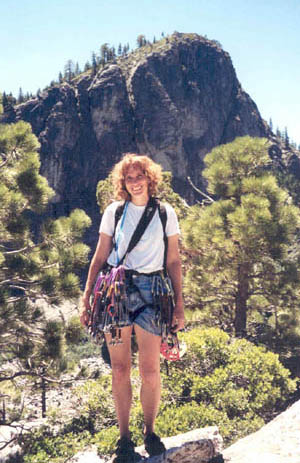
At the top of Hogsback, looking back on the East Wall of Lover's Leap
At the top of Hogsback, looking back on the East Wall of Lover’s Leap
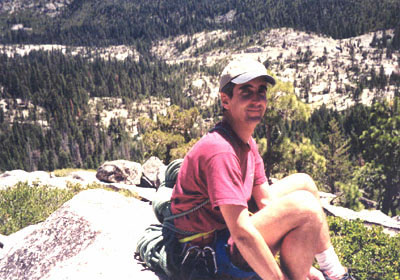
Nathan at the top of Hogsback

Bookmark, 5.7

After a lot of negotiation, the crux pitch is going to fall to me after all. Perhaps crux isn’t the right word. The first pitch is also 5.7, after all. Perhaps the right word is: off-width. I don’t do much leading on off-widths, finding them quite hard enough on toprope. Unlike some people who claim that you can’t fall out of an off-width, I usually feel like I’m going to fall out every single minute.

The #4.5 we’ve been dragging around all day (and placing–a lot of big placements at the Leap) will only go so high in the crack, namely at a spot where I can stand quite casually and before any of the difficulties have begun. The off-width feature is perhaps 15 feet long. There’s a big old hold about 8 feet up. I measure about 6 1/2 feet from my toes to my fingers. Optimistic math suggests that I only need to make one move. Off-width math says otherwise.

Snuggled deep within the crack, my feet resting on the last bit of the blocky stuff below, I’m already hating life. I place two silly pieces: a black Alien and a brass nut. Honestly, what’s the point? It’s not like I’m going to make any moves above gear like that.

“I can’t,” I whine.

“You can,” they cheer.

One of them recommends turning around which helps. Wiggle, squiggle, wiggle, squiggle, hating life, having gained about 6 inches in height and feeling, as usual, as though I’m about to slip free at any moment. Wiggle, squiggle, “can’t”, “can”, and I find it. A hold! Not a great one but enough. I wedge my way up far enough to place a pink tri-cam that I think is pretty good and then do something that actually resembles climbing until I’m free at last.
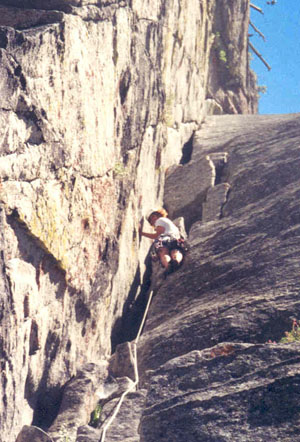
Leading the third pitch of Bookmark, 5.7

“Best lead ever!” I tell Todd. He looks at me like I’m crazy but I know what I mean. What I mean is that it wasn’t my kind of climbing and it wasn’t my kind of gear and even though it wouldn’t set any new standards in the realm of bold leads, it felt pretty good to me.

“You can’t call yourself a 5.7 leader until you can lead 5.7 crack, face, chimney, off-width, in the cold, rain, snow, etc., etc., etc.” People are always spouting this kind of crap online. Ah well, today I got one step closer to calling myself a 5.7 leader.
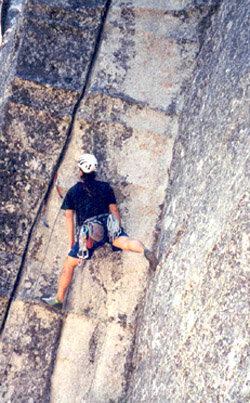
Todd leading Short Step, 5.10b

Phantom Spires

Todd and I spend Sunday at Phantom Spires, planning to leave the classic lines at the Leap for one of the weekdays to follow. Middle Spire seems hugely popular–there are two cars in the parking lot and two parties at its base–so we trudge up the hill to Upper Spire.

On the way up we’re cursing Nathan who said it would be cooler here. In fact, he suggested we bring something with long sleeves. Is he crazy? We’re both on the verge of keeling over before we stagger into a tunnel of rock at the base of the spire and burst through to the dark side. Ah, relief. Sure enough, I have a fleece on before long and I’m enviously eyeing the sunny side of the rock.

Upper Spire is hard, the main difficulty being getting off the ground, or at least getting very far off the ground. Todd has to take over the lead on a supposed 5.8 for me after I completely fail to figure out its tricky opening moves (a dyno to a hand jam, as it turns out). Later I get my revenge when he pulls on gear while leading Crispy Critters, 5.10a, which is a great route as long as you’re not the one leading it.

We lead little, toprope much, and run out of water before we get around to Gingerbread, a 5.7 that has been recommended by a passer-by as “the best 5.7 in the world.”

The Groove, 5.8

My first attempt at leading 5.8 here, as referenced above, ended in abject failure. Now my second attempt back at the Leap isn’t going so well either.

“I think I could lead anything here if I could just get off the ground,” I fume to Todd. Nathan edges discreetly away. According to SuperTopos, the start isn’t even the crux of the route but it’s what we at the Gunks call a “bouldery start.” I’m guessing that these moves haven’t been factored into the rating at all.

If I climb straight up, I get stuck. If I layback to the left, I get scared. The issue is, once again, having to climb past an Alien. And not even a well placed one at that. I’m just not willing to chance falling on it. I don’t like the idea of hitting the ground, not even from two feet up.

Eventually a compromise is reached. I climb straight up, insert a second Alien, return to the ground, and make the layback to the left. Sure enough, the rest of the pitch is pretty stinking cake. I never even find the so-called crux. The things you have to do just to get on a route around here. Sheesh.
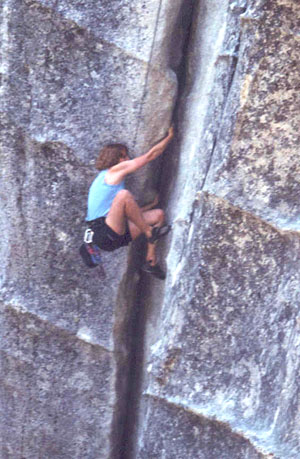
Me on Surrealistic Direct, 5.10a
Me looking very honed on Surrealistic Direct, 5.10a

The Line, 5.9

“There is one thing I’d like to know,” I ask one of the local experts. “The topo says there’s no gear for the first 20 feet. It also says that the crux is 20 feet off the ground. What I’d like to know is: which comes first?”

The expert laughs. The gear comes first. So it’s mine, all mine.

I’ve got a monster-sized rack, bigger even than our usual over-large offering. I’m standing 15 feet or so off the ground with two pieces in. They’re in about one inch from each other, but it still counts as two pieces.

I want to come down.

Although the climb up here was mostly on an easy ramp there was just this one move to get where I am now, just this one move I don’t think I can undo. Above me is a move I’m sure I can’t do. Todd has just pointed out that it’s probably a layback off a smear and there’s no way I can do that.

“Rest there,” he says, which is just what I’m trying to do.

“It’s not as restful as it looks,” I answer.

“That’s often the case,” he admits.

He wants me to downclimb. I just want to beam back down to the ground. He wants me to put in another piece if I’m going to lower off. I just want to . . . well, I said that already. I start to ask him why two pieces is good enough to fall on but not good enough to lower off of but I can’t get the words to come out straight. I decide it’s easier to put in the third piece than to argue about it.

“This is an anchor,” I say, half to him, half to myself. “Why can’t I fall on an anchor?”

Of all my options I’m now the least scared by the idea of going up. If I could do this move I’d be at a stance; I’d have gear everywhere I could look; I’d be safe. I do the move in stages, using my strategy of hovering as a preparation to moving. I put my left foot against a bump, press hard, and lightly lift my right foot until it leaves the rock. I survive.

It takes two more tries but finally I have both hands on the dike above me and I’m climbing. This ride is worth the ticket price, I decide. It’s fun and not scary, although I have to run it out just a little because I’ve got a long ways to go and a limited number of runners. Basically the route goes like this: put hand on lip of crack, put foot on dike where hand just was, layback/high step up until other hand can reach next dike, stand up, repeat. The ability to hand/foot match would come in pretty handy around here. My friend Lisa would be queen.

About two miles later Todd warns me that I’m less than halfway through the rope and already halfway through my runners. It’s the part about being less than halfway through the rope that really amazes me. I start backcleaning, clipping the rope directly to biners, running it out a little further, anything to conserve on runners. It’s a good thing this route goes straight up.

For all that the pitch has seemed very long, I still manage to miss the belay stance. It’s described in the guide as a “ledge.” People who climb at the Leap have a thing or two to learn about ledges, I think, when the stance is pointed out to me later. Todd shouts up that I have 15 feet left and I realize that it’s now or never and manage to build a decent belay out of scraps. I look down at the remains of the rack: two blue Aliens, two black, the two smallest nuts, the two largest, the brown tri-cam, a #2 and a #3. I’ve never seen the rack so depleted. Then I laugh to think that this is still 11 pieces, more than some people leave the ground with if you believe them.

Nathan on the unnamed face to the right of Short Step

April Fools, 5.8/5.9 PG/R

We have three guidebooks and we have none. The contradictory ratings and route descriptions between the three books and miscellaneous local gurus leaves us more lost and confused than not having a book at all would. We also have none literally; we’ve left them all on the ground.

Dave shows us where to start. He tells us the first pitch is 5.7. He also recommends that Todd lead it (“heady”). One book says the first pitch is 5.8 and ascends a line of bolts. These we never see. The other book says the first pitch is 5.8R. This we don’t see till it’s too late. The third book is mercifully silent.

Todd takes his time leading the pitch. When I join him at the belay I tell him I never found the 5.7 move on it. “I found a couple of 5.10 moves, but I didn’t find the 5.7 move.” The next pitch is mine. This one is alternately described as: 5.8, 5.9, 5.8 and “the best hand crack at the Leap.”

With a couple of small roofs to turn and a runout wider section, the pitch is no gimme for me and I’m inclined to take the 5.9 rating and feel pretty good about it. I have to hang at the first roof to get a piece in high enough to commit to it, then find myself sweating and swearing when the crack suddenly opens up in back and I’m forced into layback after layback farther and farther from my gear. A creaky #3 is my salvation and when I finally sink a hand jam above it and push my whole body against it in a last desperate high step, I understand what people mean about a good hand jam being a belay.

But it’s nothing compared to what comes next. The third pitch is either a 5.7 route-finding challenge, a 5.8 face climb past a bolt, or non-existent, depending on who you listen to. We take the 5.8 path–straight up. Todd leads it and finds the bolt: removed. Above the bashed bolt is a long line of bad gear. When he insists on slinging a chicken head that is round like half a basketball I feel compelled to protest. The going is slow and I’m itching to get down. Eventually he’s out of sight and moving a little faster. Turns out that it was the moves that got easier, not the gear that got better.

Something like two hours later we struggle back into camp, grumpy and scratched from our scramble to the top up “The Slash” which I’ve taken to calling “The Scab.” We give Nathan and Dave a piece of our minds for recommending the route and then leaving us to it. They give us suggestions on various more pleasant ways we could have gotten back down from the end of the second pitch. A little late now.
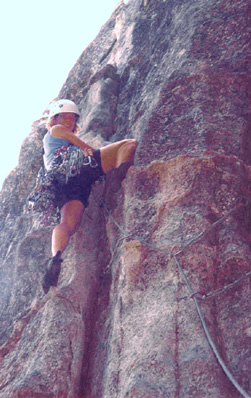
Me leading the first pitch of Surrealistic Pillar, 5.7
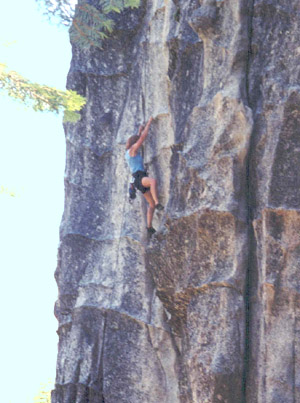
Through the crux on Surrealistic Direct, 5.10a

Donner Summit

With only one day and very little motivation left we head to Donner Summit. Checking out some of the crags close to the road doesn’t improve our attitude. We half decide to just take a walk but finally resolve to give Dave’s recommendations another chance and do the first pitch of One Hand Clapping (5.9, first pitch is 5.8).

I tell Todd it’s his lead, “because I’ve been getting all the good ones.” This is the problem with my edging into 5.9 territory. Where once the harder 5.8 and classic 5.9 pitches would have been enjoyable romps for Todd, these days they’re terrifying tests of will for me instead. Sometimes I wonder if we wouldn’t enjoy ourselves more climbing quickly and without fear or uncertainty with Todd on lead, but I don’t see how else I’m going to learn to lead 5.9s well without leading a whole bunch of them badly first. Then I wonder if my dream of fear-free leading when only I get good enough is an elusive target, pushed ever farther by harder grades. Todd still gets scared, I notice. Sometimes he even still gets scared on 5.8.

Not this 5.8 though. The first pitch of One Hand Clapping is as enjoyable as Dave said it would be, truly unmissable. In fact Black Rock is everything that the rest of Donner Summit wasn’t–inspiring. The other crags get points for being close to the road, but this crag was worth the walk up. Now that we’ve done the first pitch of One Hand Clapping and loved it and have looked around at the beautiful rock and splitter cracks surrounding us, we actually want to do a wee bit more climbing today. Unfortunately we’ve hiked up here with two guidebooks to Lover’s Leap and none for Donner.

So Todd curses his way up a crack that has been loosely described to us by the party now climbing One Hand Clapping as 5.10a with the hard part at the bottom. He has to hang once through the thin section, although he should have pulled through because he was within reaching distance of a stance as it turned out, then moans and groans through the stuff at the top of the crack that we thought was going to be easy. Following it later, I’m amazed at how much harder–and longer!–each and every segment of the route is than it looked.

“It’s the route that just keeps on giving,” I say to Todd.

“First ascent, first ascent,” he keeps chanting.

And it may be for all we know. Even with the guidebook in our hands later we can’t figure out what route it was he climbed, if it has a name at all, and if it does, what it’s rated.

It was hard. It was good. We climbed it. We’re done.
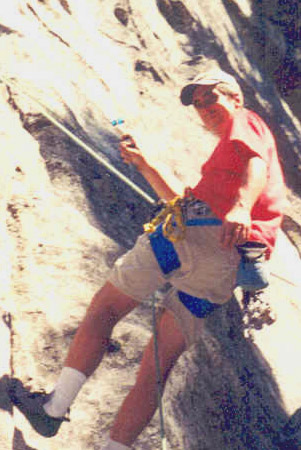
Nathan showing off his booty cam
Exit Stage Left

Have you ever seen a climber caught in a web of his own devising? No, I’m not being figurative. This isn’t some kind of morality play. It’s safe to keep reading.

I see Todd’s foot slip, the right foot I think later, though it’s more of a reaction than a realization at the time. Surprised because Todd never slips. Surprised because this is only 5.9. Surprised because, even though he said the move was hard, he seemed so in control until the moment he started to slide.

I brace myself for the impact. I never know whether I’ll fly or not–depends on how much drag is in the system and how hard the fall is. I duck my head, turn my non-belaying shoulder into the wall, wait for it to come.

It doesn’t.

After a moment I lift my head. Why don’t I feel him? I’m half afraid to see Todd fall past me, his rope cut, his knot undone, something drastically wrong, and half expecting him to be hanging on somehow, annoyed because I have him locked off.

What I see is him trapped in a criss-crossed hatch of slings and rope. He untwists himself and drops the last foot or so onto my belay. He has what turns out to be no worse than a stubbed toe, though inside a tight pair of Anasazi’s he wonders if it’s broken, a wicked rope burn across the back of one knee–I can see it from where I’m standing–and assorted scrapes and bruises. In terms of damage, it’s the worst fall I’ve ever seen Todd take.

And this is only the start of the epic.

Things started off well, although we should have guessed there was a good reason we’d never heard anyone mention Exit Stage Left, a 5.9 that pulls the Modern Times roof “directly”, before. Certainly the start was disgusting-looking enough–a mossy, chossy corner followed by vague wandering up to the GT ledge–but we fixed that problem by starting on Jim’s Gem, a 5.8 that starts just to the right of Exit Stage Left and crosses lines with it somewhere before the GT ledge.

I led this improvised first pitch, finding it tricky in some places and a little runout in others but never enough of either or both together to worry. Reaching the ledge I felt both good about my lead and nervous about Todd’s. The roof to the left of Modern Times, the one we were supposed to pull “directly”, is very deep. Deeper than anything I’ve ever pulled. On top of that, the nice day was going bad as isolated clouds turned into solid sky cover and thunder rumbled in the distance.

“We could just do Modern Times,” I suggested as Todd reached the belay.

“No,” he said.

Twenty minutes later Todd is hanging from the rope pulling off his shoes to see if any of his toes are broken. A raindrop hits the dust beside me.

“Do you want to come down?” I ask.

“No,” he says.

He decides to aid through. There follows a whole lot of shifting and squealing, orders of ‘take’ and orders of ‘slack’ and for all that he doesn’t seem to be any higher. I keep waiting for him to say ‘climbing’, to have reached a hold from which he can continue free, but it doesn’t happen. Just ‘take’ and ‘slack’ and him hanging in the same place.

“You want me to do it?” I ask.

“No,” he says.

It’s not that I have any illusions that I can lead something Todd can’t. It’s just that I’ve at least done a tiny bit of aid climbing, which compares favorably to his none. The people whose ineptitude we’d been monitoring on High E are all gone. There’s just us and the steadily increasing pitter patter of random raindrops.

“We could leave gear,” I suggest.

“No,” he says.

Stubborn, that’s what he is. Anxious, that’s what I am. But eventually he does get it.

When I stick my head up over the roof and see all the gear I have to laugh.

“You’re supposed to put each piece higher than the last piece,” I explain to him later, “not put a whole lot of pieces next to each other.” Of course there weren’t any other places to put gear. “What were you doing up there?” Switching to shorter and shorter runners apparently.

It has started to rain and I know I should be pulling on gear, slapping on prusiks, doing whatever I need to do to get over the roof and to his belay so we can get down. Still, I can’t help but try it once. It’s not raining on me.

I get all the gear I can reach out of the way and commit to the move. It’s about a mile’s worth of move. I’m reaching endlessly for the next horizontal, fruitlessly trying to bounce my feet beneath the roof, get a heel hook, mantle off my low hand, freeze myself with body tension. Anything.

“Grab the orange sling!” Todd yells.

Obsessed as I am with getting the move, the term “orange sling” fails to translate for me. I fall off. Oh. The orange sling. The draw. Right.

Luckily I’m high enough over the roof that I can get back on. From a hanging position I make it to the next hold, but I doubt I ever could if I had to start from beneath the roof. I make a frightening traverse over to Todd’s belay and then scramble the last twenty feet up to the top. Just as Todd hits the grass the drizzle becomes a downpour.

We have three raps to get down. By the end of the second rap, we’re as wet as we can get. We put on dry shoes, which some stranger has been kind enough to hide under our packs for us, and shuffle back to the car, beaten by a 5.9.