So the question is: would rapping Epinephrine really be a betrayal of the name Tradgirl and everything it stands for? There are people who think so, but I’m not one of them. I only wish I hadn’t asked if it was possible in the first place. Now I feel like the whole world is waiting to see if I can live up to the Trad in Tradgirl.
Trad. It’s a loaded word. I only ever wanted to get farther from the ground, and I thought that trad would take me there. I didn’t know the label would come to weigh on me in a million little miserable ways. I mean, I knew I wasn’t an alpine climber. And it didn’t take me long to discover that I wasn’t an aid climber. But I thought, well, I thought, that I could climb trad.
“Let’s just do it,” I say to Todd. We’ve gotten a typically late start somehow, despite getting up at an ungodly early hour. Now it’s well after 10:00 a.m. and we’re at the base of Epinephrine (5.9) trying to decide whether or not today is THE day. “I just want to get it over with,” I add. “Then maybe we can enjoy the rest of the trip.”
Another party is just starting the chimney. As Todd leads the pitch that will take us to the base of the chimney we can hear them moaning and groaning above us. Someone up there isn’t having much fun. I had planned on taking the first chimney pitch, but when I join Todd at the belay he tells me that he wants this lead. We can still hear lamentations from the party above us. They’ve gotten the pack they’re hauling stuck. We firmly expect to catch them by the top of the tower.
So Todd sets off and soon I’m hearing even more moaning coming out of the chimney. Sometimes I’m pretty sure it’s Todd and sometimes I’m pretty sure it’s not and sometimes I think they must be moaning in concert. He says later that it took him an hour to lead the two pitches as one but I’m at a comfy belay spot and I don’t notice the time flying by. With about 30 feet of rope left he starts complaining about being runout and not seeing an anchor.
“You’re almost there,” the party above him calls down and sure enough it’s only a few gasps later before he tells me that he can see the anchor. Then it’s my turn to start huffing. The chimney begins innocently enough, a nice width. I move quickly: butt, feet, hands, butt. So okay, this is a little tiring. It takes an awful lot of . . . what? Thigh muscle, maybe. And then it gets bad. The chimney narrows and now it’s knees, butt, hands, squirm. Thank God for the kneepads at least.

Todd at a belay in the Epineprhine chimneys
The party above us has escaped. I’m the only one groaning now. What made me think I could lead this? I’d be terrified, stuck here, wedged in, no gear in sight below me and the tantalizing prospect of gear above me that I can’t reach because I’m stuck here, wedged in. I’m glad I’m on toprope but would be even gladder still to be out of the chimney altogether. A brief respite in the form of ramps up the back of the chimney and then one more burst of that hideous narrow stuff and I’m at the belay, gasping and heaving, slumping down on the 6 inch belay ledge like a rag doll. Only 200 feet to go.

Me at a belay in the Epineprhine chimneys
Confession: I don’t consider suffering to be a necessary, or enjoyable, part of climbing. Chimneys count as suffering.
Todd offers me the sharp end and I hem and haw over it. Not if it’s anything like that, and yet I want to do this. I’m so torn between the need for safety and the desire to be a full member of the team that I can’t make a decision. Finally, we agree that I’ll try, aiming for the next belay rather than the top of the tower.
My pitch is certainly the easiest of the chimney pitches. I have only a brief section of comfortable chimneying before I get to escape through a series of cracks to the anchor. Some tricky moves in there but my feet are firmly beneath me where they belong, not jammed into my butt like I’m some kind of contortionist. When I reach the anchor I consider continuing. There are bolts up there. But when Todd suggests that I bring him up, I happily agree.

Me leading the third chimney pitch on Epinephrine (5.9)
It has already sprinkled once today and now, as Todd leads through to the top of the tower, it starts again. Only a few drops of rain fall but the wind picks up and the temperature drops. Todd is stuck at the move to get out of the chimney. He goes back and forth, unhappy with the gear, unhappy with the move.
“OK,” he says, more to himself than me, “I’m just going to do it.”
“You really need to,” I think, but don’t say. The winds are nearly gale force; I’m shivering in my t-shirt and I’m prepared for the deluge to start at any moment.
Finally he commits to the move. “Easy”, he says and he’s gone, moving quickly to the top of the tower and off belay. My hands are shaking as I dismantle the anchor. I’m eager to climb, just to be moving and to be warm again. This stretch of chimney is much easier than the double pitch at the start and as I climb I think “yes, I could have led this. I should have kept going.” But then I’d be the one at the top of the tower now, exposed to the elements.
When I reach the top I ask Todd what time it is. 3:45. On the one hand, we’ve done the first half of the route in a little over 5 hours, an acceptable time. On the other hand, we haven’t made up the time we lost by getting a late start. We don’t stand a chance of finishing the route.
“We could see how high we get,” Todd suggests.
“I just want to go down,” I say. The hell with what anyone thinks or expects of me. The wind is whipping around us and although no more rain has fallen than those first few drops, the air is heavy and moist. We begin a tense descent. The ropes stick on the very first pull and Todd has to climb back up 30 feet to free them. We’re very concerned. Neither one of us wants to re-climb any portion of the chimney under any circumstances. The wind is strong enough to pick up the cams hanging from my harness and fling them into my back. The rope ends below us have a life of their own. We rap cautiously, not skipping any stations, always careful to pull the lead rope. When I hit the anchor from which I first belayed I know we’re safe. From here we can rap on one rope if we have to by slinging the trees on the ledge, but it isn’t necessary. Miraculously, both ropes end up on the ground with us.
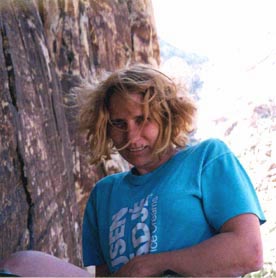
Just about being blown off Epinephrine on our wild rap down
We walk out feeling somewhat demoralized. Every part of my body hurts; I have bruises all along my spine. The wind keeps blowing us into pointy bushes and leg bruising boulders. We’re still waiting for the rain. We did not climb Epinephrine to the top, but we climbed Epinephrine. It’s done.
The next day I’m belaying at the bottom of Frogland (5.8), which we’ve found surprisingly empty, when I hear another party approaching. An older guy and a younger guy clamber on up to the ledge. One of them asks about our MEC pack and somehow we end up on the subject of ordering gear from foreign websites.
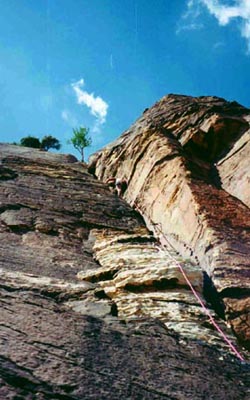
Todd leading the first pitch of Frogland (5.8)
Confession: I like the easy sociability of places like the gym and the Gunks. I don’t climb to get away from my fellow man.
Todd is quickly off belay so we don’t talk long before I’m heading up to join him. I’m sorry to say goodbye to the first climbers we’ve met on this trip but I don’t expect to see them again. They’re only just starting to unpack and we’ll certainly be faster than some old guy and his partner. As I pull onto the ledge where Todd’s belaying I give a quick glance back down to the bottom of the route.
“They’re still racking up,” I tell Todd as I grab the rack and lead through. A pleasant low-angle corner leads to a short hand crack. There’s a cam fixed up there so I step up to clip it but have so much trouble fishing the sling out of the crack and find myself so unstably jammed that I have to step back down. After another false start, I finally remember enough jamming technique to hold steady and clip the cam. Another few moves and I’m through this short section of crack but during the pause I’ve become aware of the fact that not just one but both of the other climbers are at the belay with Todd.

Todd following me on the second pitch (5.6) of Frogland (5.8)
“How the hell did that happen?” I ask myself. Aside from this one bumbly section I’ve been leading smoothly and quickly. Luckily the anchor is fixed so I don’t have to muck around with gear for long. The slowest part of my leading is usually getting the belay arranged.
Confession: I think convenience anchors are the greatest thing to happen to climbing since we gave up the hip belay. Finding a nice set of bolts never detracts from my enjoyment of the climb; it enhances it.
As I belay Todd up I’m dismayed to see that George, the old guy, is following along about 10 feet behind him. When Todd pauses for a moment I shout down “Forget about trying to clean that cam.” Like most men, he’s incapable of leaving behind a piece of potential booty.
“Don’t worry, I’m already past it,” Todd answers.
“Should we let them pass us?” I ask him as he joins me. “They’re really fast.”
“If you want to,” Todd says, but we’re saved from having to decide when George detours to another belay below me. He and his partner plan to take the original route, which the Swain book describes as a variation. As an added bonus, George’s partner spends some time fishing for the fixed gear. Despite all that, their leader starts up from their belay before Todd is finished leading the next pitch.
Now I’m worried. The other leader’s path is going to intersect with ours and I need to beat him there. Otherwise, well, otherwise it’ll just be a mess. He diddles around a bit with what looks like an intimidating roof above him while I quickly pull the intimidating roof above me and scurry madly for the intersection point. Got it! By about 15 feet.
So now three of us are at the next belay and it’s my lead and this looks like the crux. One of two 5.8 pitches, it starts with a spooky-looking runout to a bolt and then heads up to a spookier-looking roof. I’m supposed to “fingertip traverse” under this roof according to the guidebook, which sounds like a godawful thing to have to do at 5.8, and I can’t tell from here how high I’ll be able to get gear in.
“Maybe I shouldn’t”, I say. I’m afraid of slowing this circus train down if I get scared under the roof. I don’t want a whole belay ledge full of witnesses to my soggy lead head. Todd leaves it up to me and I figure the fastest way to go is to just go, so I grab the rack and cast off, only barely ahead of George coming up the pitch behind us.
Fortunately, once I leave the belay I forget about the audience. The climbing up to the bolt is easier than it looked and the runout doesn’t bother me a bit. I get gear in nearly under the roof and pause. The guidebook makes it sound like I’m supposed to be right under the roof, but the wall meets the roof so tightly I can’t imagine being able to crimp across it. Instead I scope out the chalked line a few feet below.
“Here are the hands,” I think, “but where are the feet?” There’s a bulge down there. Not edges–beautiful secure edges–but friction is what’s going to get me across this thing. Mindful once again of how many people are waiting for me to move, I take a deep breath and go. The traverse isn’t that long. One piece in the middle might be nice but it’s not to be had so keep going, sketchiest move at the end, fingers in the crack, an edge for my left foot, phew!
I’m shaky and want gear. The little crack above me looks hard and I’m thinking of my duty to Todd besides. I try to fish in a nut but the crack is too small.
“Aren’t we carrying the brass nuts?” I ask Todd, unable to find them in the typically messy state I leave the rack in. OK, we’re not carrying the brass nuts. But there’s a pocket and I have tri-cams and that’s what they’re meant for, right? I put in a very unsatisfactory red tri-cam.
“Is that a good piece?” Todd asks, which is what he says when he wants me to know that now would be a good time for a good piece.
“No,” I tell him. “But it’s all I’m getting.” By now I’ve realized that I’m going to climb the arete just to the left of the tiny crack and not the tiny crack itself, which makes me feel a lot better. That’s 5.6 climbing over there and then a dash up a much nicer crack to the unfixed belay. I scope it out as quickly as I can and even get in a piece for upward pull. Nicely done.
“George says most people undercling the roof,” Todd tells me when he gets up there.
“Then why is all the chalk three feet below the roof?” I ask him.
“Maybe the undercling is so great you don’t need chalk,” he says, sticking his tongue out at me, and then he dashes off for the next pitch since we can hear George below us practically at the crux already.
“Dawn?” George calls up to me. I can just see his head below me. He’s at the tiny crack after the traverse. “What did you get in here?”
“A tri-cam,” I tell him, which is too bad because he isn’t carrying any. I find it funny and flattering that he would ask me since it’s become clear by now that he could solo the route blindfolded in his tennis shoes. But it’s also becoming clear that he’s a careful leader who doesn’t skimp on the gear out of foolish pride. I don’t know what he gets in but soon he’s just beneath me and with no way to a stance except to go through me.
At my invitation, and with an incredible amount of apologizing, he climbs over my belay to a stance where he can sit but not, unfortunately, get in enough good gear to set up a belay of his own. He has to wait for me to clear out so he can use my stance but he spends the time re-apologizing for climbing over me (“terribly rude” he says again) instead of fuming over the fact that we’re holding him up.
Confession: I don’t think there’s any one “right” way to share a route and I’d much rather deal with a pleasant, polite person like George than with someone who has a rule book printed on his forehead.
“We’ll see you on the descent if we get lost,” I tell him as I’m leaving, which, as it happens, we do. Todd and I cruise through to the top but make a false start down the wrong side of the formation and have to climb back up to check with George before starting down again. The right way this time.
They catch up to us on the descent and we let them pass. They’re making it look as “surprisingly quick and simple” as Swain says it is, though Todd and I are slow and miserable–slipping, downclimbing, butt-scooching, trying to follow George and his partner, but eventually getting so out-distanced that we have to find our own wandering way back to the base of the route.
“A descent like that takes all the fun out of a route,” I say.
“I may be done climbing,” Todd says, looking at the blister that’s popped on his little toe.
“Trust me,” I tell him seriously. “We’re both done climbing.” I’m thinking that we still have to get down the hill and make the long walk out of the canyon before we’re back at the car.
Confession: I love rapping. I’d rather rap than walk off any day. And don’t tell me how much safer walking off is. You haven’t seen me do it.
I’d say that the best part about climbing Triassic Sands (5.10a) was rapping back down from it in two easy raps but that would be selling the route short. This beautiful route starts with a sparsely protected but secure 5.7 pitch up to a ledge, which is where the real fun begins. I’d heard a lot about this route, including Todd’s opinion that I could lead the 5.10 pitch.
“It’s one move of 5.10,” he said.
“So what’s the rest of it?” I asked sarcastically. “5.9+?” 5.9 is my absolute leading limit and by the time we struggle up to the base of the route I feel like I’ve had my fill of excitement for the day. These long, hot, uphill, uncertain approaches are going to be the death of me and we sit for 15 minutes before we even think of gearing up. I take the first pitch and leave the 5.10 for Todd.
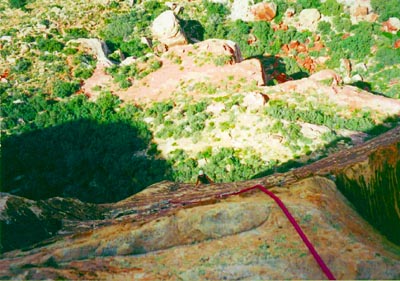
Todd following me on the first pitch (5.7) of Triassic Sands (5.10a)
Although the short crux section is protected by two pieces of fixed gear, it’s certainly more than one move long and it’s not soft like some people would have you believe. Todd takes it seriously enough to place gear in between the two fixed pieces and when it’s my turn I struggle with the moves and only barely get them clean on toprope.
Above the steep section is a nice crack, surrounded by those classic Red Rocks varnished edges. Take your pick: jam or crimp; it’s all up to you. I do a bit of each on my way up to join him. The climbing feels sustained and I’m a little pumped from the hard stuff below. I’m glad I didn’t lead this pitch.
The next pitch, which is the last we do (if you continue on, the fixed anchors end and you have to walk off), is the most beautiful pitch I’ve ever led. Much like the end of the crux pitch, a highly featured crack runs straight up for miles. The only downside is that the crack is fairly parallel and same-sized for much of the way.
I start off from the belay conscious of the fact that I need to ration out the gear in that size. On the other hand, I know I should place a piece shortly after leaving the belay. I climb until the two concerns balance out and stuff in a cam.
“Hey, I get bolts,” I say, looking up. “Three bolts in about three feet.” I climb a little farther. “Actually, it’s like four in four feet.”
“Must be the old aid line,” Todd says.
“Or there’s something really hard up there,” I answer.
I clip the first bolt, an ancient, rusted looking thing and then bravely skip the next one. I don’t want to run out of draws. I clip the next two and continue merrily on my way.
Confession: Sometimes I trust the oldest, mankiest looking bolt you ever saw more than my own freshly placed gear.
Some lower angled climbing leads to a change in crack size and a corresponding change in gear size. Then my crack ends and I traverse left, placing a pink tri-cam along the way, into a similar crack and from there up to the belay ledge.
“I could lead that pitch all day,” I tell Todd when he joins me. We rap off easily and debate what to do to finish out the day. We finally decide to run up the first two pitches of Prince of Darkness (5.10c). It was on the to do list but we never got over to it. Now we begin the trudge down and around to that area of the canyon. Even though we’re making it up as we go along, this turns out to be one of our more successful trudges.

Me following on the first pitch (5.6) of Prince of Darkness (5.10c)
There are three parties up there, which is odd because we’ve only seen a few other climbers on the whole trip. They’re spread across multiple routes but are all converging on the top and the rap back down. Todd flies up the 5.6 approach pitch and then hands me the sharp end for my taste of Prince of Darkness.
The guidebook says there are 14 bolts in 110 feet. So I ought to be fine, right? Todd hands me the small rack he carried for the 5.6 pitch.
“I think some of the pitches take gear,” he says.
“14 bolts in 110 feet,” I say. He hands me the gear anyway.
I climb confidently to the first bolt. Even the second bolt isn’t so bad. Then it gets steep. From below you can see that the wall bulges out and, although it doesn’t actually feel overhanging, it feels very, very vertical. Stances are hard to come by. Only a few moves, then a clip, but I’m starting to strain.
“How many bolts have I done?” I ask Todd, tired and ready to be at the anchor that I still can’t see.
“Four.”
“Four??!!!” I have a long ways to go.
I climb it in short chunks, from bolt to bolt. At each bolt I consider saying “take” to rest and re-gather my courage. Then I remember that I’d really like to get this clean and that I’m safe for now and I agree with myself to climb to the next bolt and see how I feel there. Every once in a while there’s a stance and at one point I step up and am sorely disappointed by the hold I was going for and panic briefly.
“I’m not happy here,” I say gloomily.
“You’re doing great,” someone rapping off to my right shouts. “Good, strong leader.”
“The bolt’s about a foot below your waist,” Todd adds, less inspiringly but more practically.
The combination reassures me and I shuffle around and move on again. Eventually Todd yells up that I’m at the half way mark. By then I can see the anchors, out of sight for most of the pitch, and better yet I can see that the angle eases off again for the last two bolts. I clip into the anchors and belay Todd up, dreaming of the water that he’ll be bringing before I remember that we left the water on the ground.
“Otherwise, it’ll be too easy to keep going,” Todd said. And sure enough I’m looking up, not down, and thinking that we could squeeze in at least one more pitch. It’s a shame not to climb the whole route but at least I get the gist of it.
As we walk out on our last day, I’m once again cursing at the branches that keep leaping out to snag and wound me and at the unsteady footing in the wash.
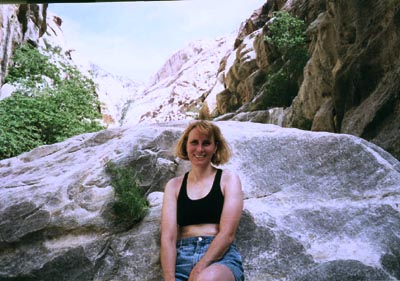
A peaceful moment in Black Velvet Canyon – no bushes are attacking me!
“The climbing here is great,” I say, “but I’m not sure it’s worth the walking.” On some days I think we spent almost as much time walking as climbing. In my opinion, Red Rocks would be greatly improved it if were moved closer to the road. Of course, I realize that most of my trad buddies wouldn’t agree with me, but dammit Jim, I’m a climber not a hiker.
And I’m not a trad climber, not anymore. Just a climber. Sometimes I climb on gear, sometimes bolts, and I’ll gladly take a toprope, especially on something that’s too hard for me. If you see me, say hi. But if you want to tell me what’s wrong with climbers today, give it a miss. I’m what’s wrong with climbers today. And I freely admit it.

Looking out from a belay in the Epinephrine chimneys. Can you spot the rock that looks like a school bus about to drive over the edge?
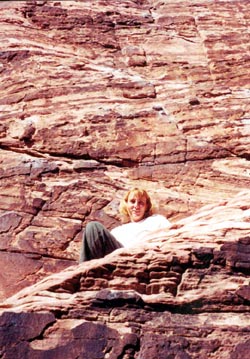
Dawn at the Cat and Dog crag
An unknown climber at Cat and Dog crag
Leave a Reply